The Dreaming Brain: Creativity, Sleep, and the Unconscious Mind
The Dreaming Brain: Creativity, Sleep, and the Unconscious Mind
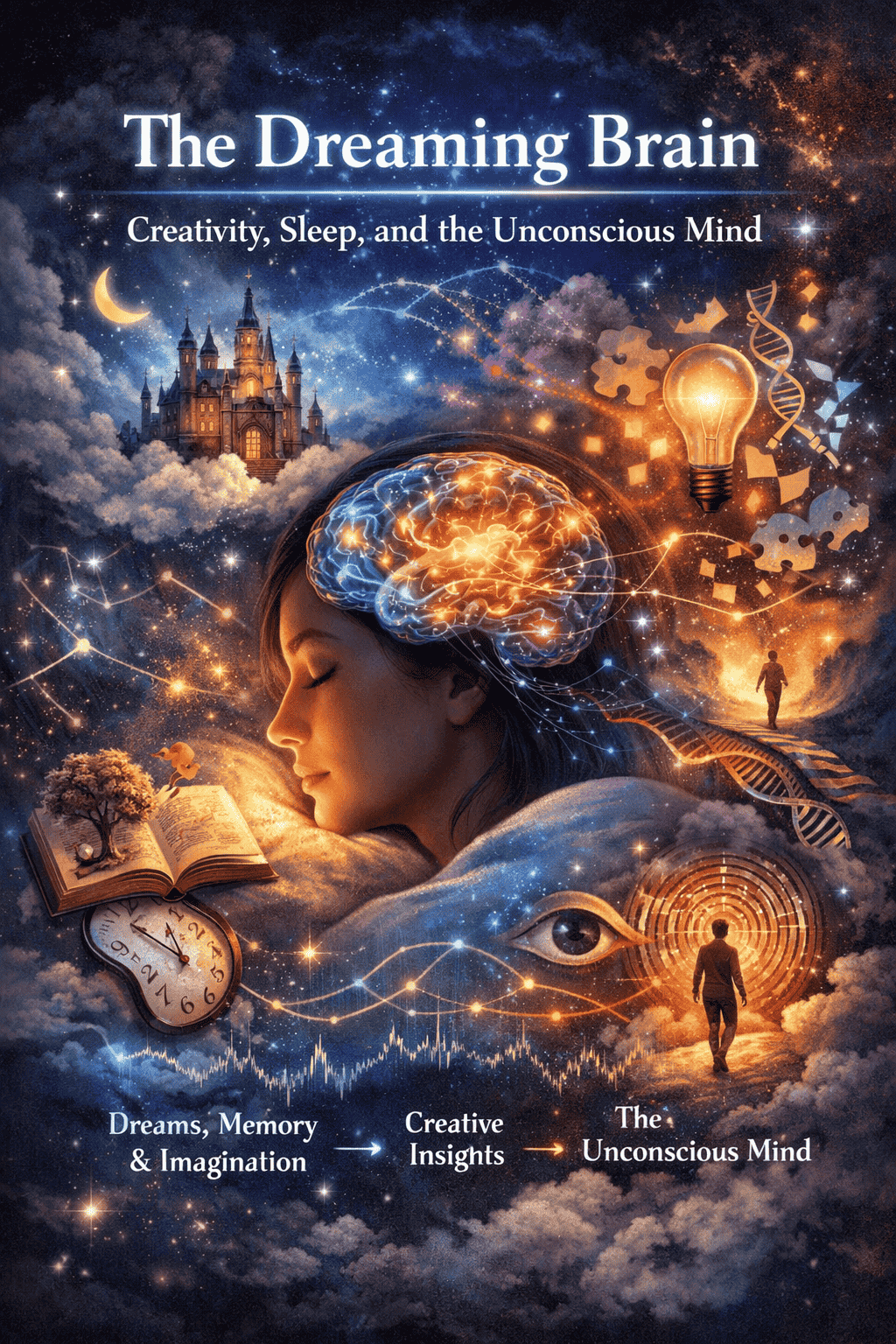
Even when the body is at rest, the brain is not shut down. Rather it enters one of its most active, mysterious, and creative states. What really happens during sleep? One start dreaming, memories replay, ideas recombine, and entire inner worlds unfold without conscious control. For many years, dreams were merely treated as symbols, omens, or random noise. Yet modern neuroscience offers a different perspective: dreaming is a fundamental cognitive process, deeply connected to creativity, memory, emotion, and the unconscious mind. This article will further explore how the dreaming brain works, why dreams exist, how they influence creativity, and what emerging science reveals about the unconscious processes that shape thought, even when we are asleep.
What Is the Unconscious Mind?
It simply means, mental processes that operate outside conscious awareness are handled by our unconscious mind and these include:
Automatic associations
Memory consolidation
Intuition and insight
Emotional regulation
Pattern recognition
Dreaming is considered as one of the clearest windows into unconscious cognition. The brain processes information without the constraints of logic, attention, or social rules, during sleep, allowing unusual connections to form.
The Neuroscience of Dreaming Brain
Although dream-like activity can occur in other stages as well, dreaming occurs most vividly during REM (Rapid Eye Movement) sleep.
What happens during REM sleep?
The prefrontal cortex is less active which is responsible for logic and inhibition.
Memory networks interact freely
The brain’s activity resembles wakefulness
Emotional and visual regions are highly active
This environment created in the neural regions allows the brain to simulate experiences, explore possibilities, and reorganize information.
Explore more - Neuroscience of Dreaming: Why Your Mind Never Sleeps
Why does our brain dream?
As seen centuries ago, dreams are not meaningless byproducts. Several neuroscience theories suggest that dreams serve important functions, like:
Creativity and insight, recombining ideas in novel ways
Memory consolidation, strengthening pruning and learning irrelevant information
Prediction and simulation, rehearsing future scenarios
Emotional processing, integrating emotional experiences safely.
Neuroscience rather than asking what dreams mean, asks what dreams actually do.
Dreams and Creativity:
There are several creative breakthroughs that are a result of dreams:
Problem-solving insights
Scientific discoveries
Musical composition
Artistic inspiration
Dreams help to weaken the cognitive constraints. The brain explores combinations that waking thought would normally suppress, without strict logic or self-criticism.
Scientific research has shown that dreaming improves:
Insight-based problem solving
Remote associations
Divergent thinking
Explore Further - How Dreams Can Improve Creativity
Sleeping Brain as a Creative Engine
Sometimes creativity needs more relaxed mind than we think and during sleep:
New connections form across neural networks
Memories are replayed
Emotional relevance is prioritized
Concepts are reorganized
This is the reason why some solutions are sought after rest rather than during intense focus. The dreaming brain is exploratory and not chaotic.
Can Scientists Really See Dreams?
Advances in recent times, in neuroimaging and machine learning have brought science closer to decoding dream content. Using:
AI-based pattern recognition
fMRI
EEG
By mapping brain activity patterns, researchers can now approximate visual elements of dreams. This demonstrates that dream content leaves measurable neural signatures and does not mean dreams are being “recorded”.
Read in depth - Scientists Can Now See Your Dreams
Billion Neuron Theory:
The Billion Neuron Theory, rather than focusing on single brain regions, suggests that consciousness and dreaming emerge from the collective behavior of vast neural networks. What are the facts of this theory?
Creativity results from network-level interactions
Meaning is emergent, not encoded
Dreams arise from large-scale neural synchronization
Dreams conscious experience emerge when a collective network of neurons synchronizes and exchange information, producing patterns that feel meaningful even without centralized control, according to the Billion Neuron Theory.
Explore Further - Billion Neuron Theory
Boltzmann Brain Theory:
A very disturbing and unusual theory, the Boltzmann Brain Theory is a thought experiment proposing that a self-aware brain could randomly arise in a chaotic universe. It is abstract but raises profound questions:
What makes experience feel continuous?
Can awareness exist without history?
Is consciousness dependent on the environment?
The Boltzmann Theory is a threat to everything that we believe and what if we were a result of just a random fluctuation instead of an evolutionary history.
Read more about - Boltzmann Brain Theory
Dreams as a Temporary Reality
While dreaming the brain constructs a world, time feels distorted and logic feels unnecessary. They also reveal how easily the brain can simulate reality, reinforcing the idea that waking consciousness is also a construction just more constrained.
Why Dreams Feel Emotional and Real
Our dreams often carry intense emotions because:
Memory and emotion interact directly
Logical filters are reduced
Emotional brain regions remain active
These connections explain why dreams feel meaningful even when they are illogical.
Sleep, Memory, and the Unconscious - Dreaming Brain
Sleep helps in strengthening learning by:
Weakening irrelevant details
Stabilizing important memories
Replaying neural patterns
Allowing past experiences to influence future thinking, dreaming may act as a bridge between memory and imagination.
When Dreams Become Meaningful - Dreaming Brain
Dreams are informative and they reveal:
Unconscious concerns
Creative potential
Unresolved cognitive themes
Emotional priorities
Having an understanding of dreams does not require interpretation manuals, only awareness of how the brain processes experience.
Why the Dreaming Brain Matters
Studying our dreams helps us understand:
The nature of reality perception
Consciousness itself
Memory formation
Emotional processing
Creativity and innovation
Frequently Asked Questions (FAQs) - Dreaming Brain
Why do we dream every night?
Dreaming is a natural outcome of REM sleep and the brain enters REM sleep multiple times each night, and neural activity during these stages.
Do dreams have meaning?
Rather than symbolic messages, dreams reflect unconscious processing. Their “meaning” lies in how the brain integrates information.
Can dreams really improve creativity?
Yes, research shows that dreaming supports novel associations and insight-based thinking.
Is dreaming the same as imagination?
Dreaming and imagination both share the same neural pathways, but dreams occur without conscious control or self-monitoring.
Can science fully decode dreams?
Not yet, current technology can approximate patterns, not reconstruct full dream narratives.
Also read more about brain and its creativity - Click Here
Cognitive Psychology: How Brain Thinks, Decides, Distorts Reality
Cognitive Development from Childhood to Adulthood
Clinical, Cognitive Disorders & Mental Health
Cognitive Behavioral Science & Therapy
Brain, Consciousness & Perception
Dreams, Creativity & the Unconscious