Scientists Can Now See Your Dreams: How Dream Decoding Works
We all can see dreams, different types of dreams. One moment you are sitting in a forest with your best friend, and the next you are being chased by someone. You then suddenly wake up, and poof, your brain acts like none of it ever happened. Our dreams are so powerful that they create these vivid, cinematic worlds that feel so real. And then dreams evaporate the second we open our eyes. But now comes the exciting part: What if you could record your dreams? Sounds amazing, right?
The next morning you simply hit the play button and watch exactly what your mind created overnight. Sounds like a sci-fi movie, but all of this is possible due to dream reconstruction neuroscience, where scientists have come up with tech devices to give this experience. All thanks to neuroscience, your brain might soon have its own “dream replay” button. Let's read further about dream reconstruction neuroscience and its advancements.
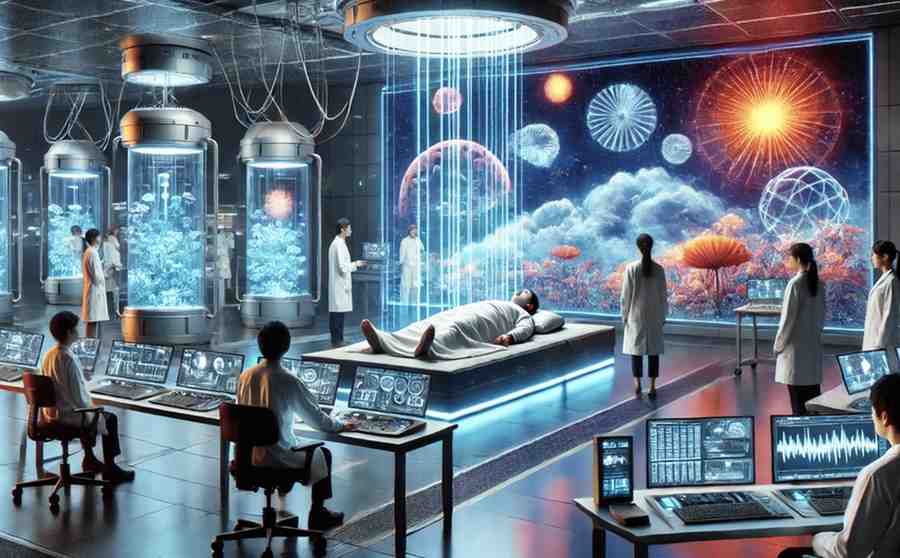
First Steps Toward Recording Dreams:
For the very first time, at the ATR Computational Neuroscience Laboratories in Kyoto, Japan, researchers introduced a system capable of translating brain activity during sleep into rough visual reconstructions.
The ATR Computational Neuroscience Laboratories approach combines:
- fMRI (functional magnetic resonance imaging)
- EEG (electroencephalogram)
- Deep learning algorithms
All of these together allow scientists to observe, decode, and estimate the visuals appearing in a person’s dreams.
How Scientists Captured Dreams:
While wearing an EEG cap, a group of volunteers spent multiple nights sleeping inside an fMRI scanner. This setup helped researchers to collect:
- Electrical activity via EEG.
- Blood flow changes which are linked to neural activity via fMRI.
Participants were gently awakened and asked to describe what they had just seen, during the REM sleep stage, when dreams are most vivid.
The same process was repeated hundreds of times, which allowed them to create a detailed database mapping:
Brain-scan patterns → Dream imagery
For instance:
- One pattern created for a dream about a person.
- Dreaming of an animal, a building or an animal created another pattern.
There were many such repeated recordings, which allowed the scientists to “train” the AI to recognize dream-related activity.
**Disclaimer For Readers: Current dream reconstruction research reconstructs rough visual categories based on previously trained brain–image associations under controlled laboratory conditions. It does not record dreams like a video camera or read personal thoughts.
How does tech read these dreams?
Dream recording does sound like a magic trick; let's see the science behind it:
- fMRI: It does not take pictures of dreams; instead, it tracks blood flow changes, which tell us which parts of the brain are active. There will be a unique activation signature for each type of image, for example, for faces, landscapes, animals, etc.
- EEG: EEG captures the electrical activity of the brain and shows us the speed of occurrence. EEG captures bursts, spikes, sleep waves and REM patterns.
Both of these technologies together act like a location map with the time of occurrence. These technologies give researchers a 3D, time-based view of your dreaming brain.
Turning Brain Waves into Visual Content:
Researchers fed the brain-activity data into deep learning models once the database was complete. These models simply reconstructed visual approximations of what the participants dreamt.
Interestingly, the system achieved:
- An overall ~60% accuracy
- For specific categories like people, objects, or animals, 70%+ accuracy.
A lead neuroscientist on the project, Professor Yukiyasu Kamitani, explained:
“We were able to reveal dream content from brain activity during sleep, which was consistent with the subjects’ verbal reports.”
Although the reconstructions were abstract and blurry, they still matched the themes described by the dreamers upon waking up.
Why Does Dream Reconstruction Matter?
Beyond having the fun of watching your dreams like a vintage movie, this technology has powerful implications. The potential future applications of dream reconstruction include:
- For Understanding Mental Health: There is a potential that dreams could reveal emotional patterns linked to PTSD, anxiety, depression, and trauma.
- For example, if a person constantly dreams of being late or missing a flight. These kinds of dreams show how the brain rehearses scenarios linked to loss of control or fear of failure. To understand the patient’s stress triggers, therapists then try to use these recurring dream themes.
- Communication with patients who can't speak: Dream-decoding could create new pathways for communication for patients with locked-in syndrome.
- For instance, a patient who is fully conscious but unable to move or speak. The patient is then shown a series of images during sleep, like a mountain or a city. The patient dream contents could allow the patient to “communicate” feelings such as comfortable, scared, in pain, or even yes/no. Doctors will then decode which mental imagery the patient is experiencing through EEG or fMRI signals during REM sleep.
- To explore the subconscious: It is an unbiased, nonverbal window into the hidden layers of the mind.
An example of hidden fears: A person may dream of being lost in a giant building, who consciously feels confident about their new job. This dream particularly can reveal inner doubts or anxieties that person may not have acknowledged consciously.
Role of AI in dream reconstruction:
Here comes the most advanced part of dream reconstruction: To match brain activity patterns to real images, scientists have trained AI. How does that training work?
- Step 1: Participants look at thousands of images while they are awake. For example, faces, animals, objects, streets, etc.
- Step 2: The participant’s brain activity is recorded during each image.
- Step 3: The AI then learns, “Ah, this brain pattern means ‘person.’ This pattern means ‘human.’
- Step 4: During later stages of sleep, the brain produces similar patterns while dreaming. The AI decodes, “Oh! I have seen this pattern already; it looks like a human. Let me generate an image.”
It reconstructs a blurry but recognizable dream scene using deep learning models (like Stable Diffusion). It is not perfect, but it's WAY more accurate than anyone expected.
- They look like faded watercolor versions. blurry silhouettes, ghostlike outlines and slightly distorted shapes. But they have often matched what the dreamer describes afterward.
- The AI recreates an animal shape: if someone dreamed of a dog, tall geometric structures for a city and a rough face-like shape appear as a face.
Why Are We Far from Dream Recording?
Dream-recording technology is still in its initial stages. The current limitations to this include:
- The images are blurry and are of low resolution.
- There is no motion capture or accurate color.
- Cannot record dreams. in real time.
- Each person needs their own training data, no universal dream decoder.
As stated by neuroscientist Dr. Mark Stokes: “All of this has to be done with individual subjects. A universal classifier capable of interpreting anyone’s dreams isn’t accessible.”
What does that mean? Every person currently needs a personalized model trained for their brain patterns. There is no universal model.
Glimpse—Future of Dream Recording:
- This research marks a major step forward in oneirography, the study and recording of dreams, despite all its current limitations.
- The gap between our inner mental world and external technology continues to shrink as AI becomes more powerful and neuroimaging gets more precise.
- Watching your dreams might be as normal as checking your sleep tracker in the future. For now, dream recording technology offers an extraordinary insight:
- For the first time, science is learning how to watch dreams as your brain is telling stories every night.
Future of dream reconstruction:
The neuroscience behind dream reconstruction is advancing fast. Within a span of a decade, we may see more accurate color reconstruction, real-time decoding, emotional mapping of dreams, full-scene reconstruction and personalized dream models for each person.
What Dream Reconstruction Cannot Do Yet:
Cannot record dreams in real time
Read thoughts or emotions directly
Reconstruct memories accurately
Requires individual brain training
It works only under lab conditions
Beneath the Stars and Beyond - A reflective exploration of creativity, inner experience, and the unseen layers of the human mind.