Cognitive Behavioral Science: How Thoughts Shape Behavior
Cognitive Behavioral Science: How Thoughts Shape Behavior
At most of the times human behavior often feels automatic unless thought about consciously. Often, we tend to reach before reflecting, repeat patterns we don’t consciously choose, and struggle to change habits even when we know their consequences. Cognitive Behavioral Science offers a comprehensive explanation as to why this happens. It is a study of how beliefs, thoughts, emotions, and neural processes interact to shape behavior often outside conscious awareness.
Instead of considering behavior as driven purely by willpower or emotion, cognitive behavioral science shows us that internal cognitive processes act as intermediaries. They influence how individuals perceive situations and respond to them. This article further explores the scientific foundations of cognitive-behavioral processes. How these processes influence behavior, and how structured cognitive frameworks help individuals understand and modify patterns, without offering medical or therapeutic advice.
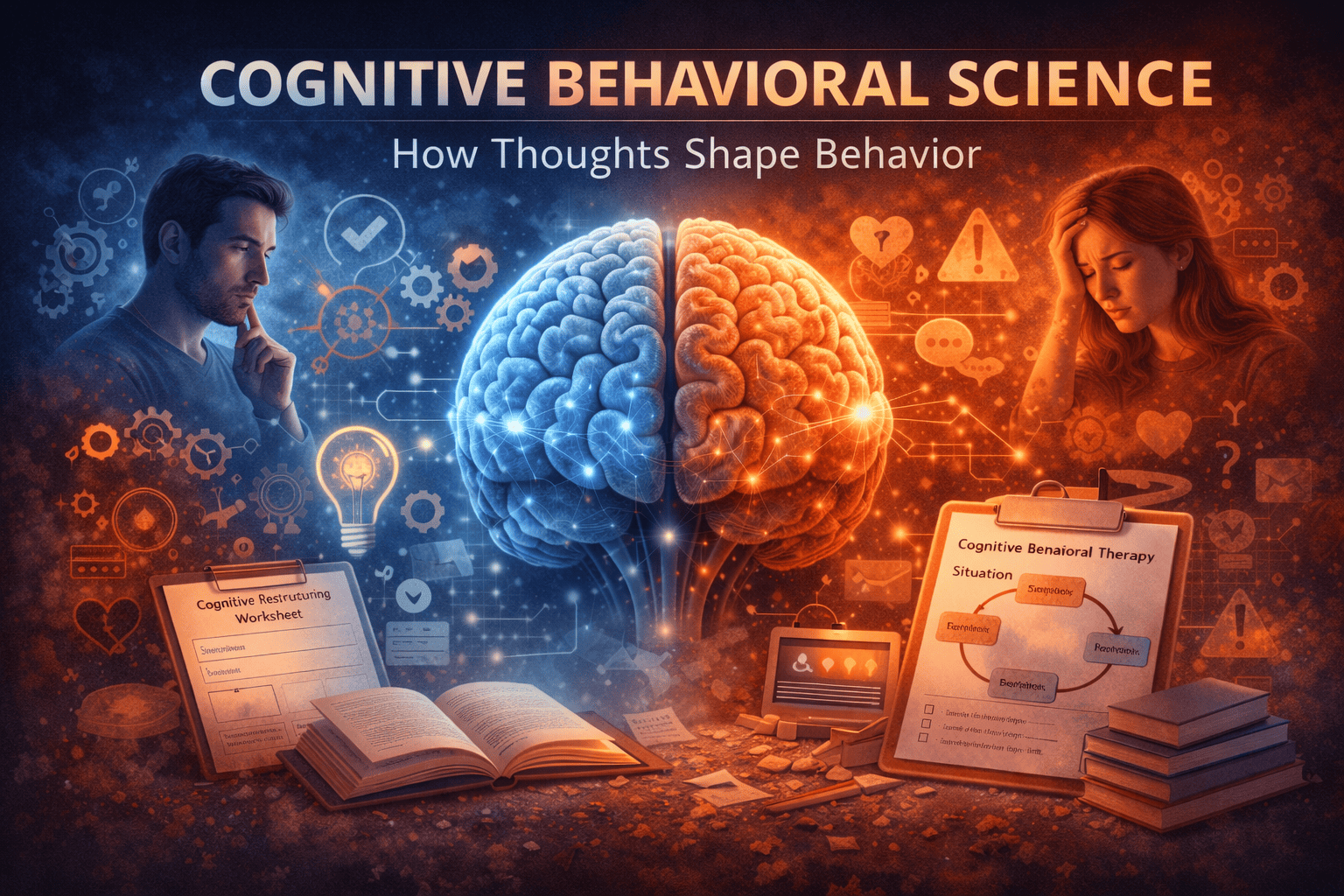
What Is Cognitive Behavioral Science?
Cognitive Behavioral Science examines the relationship between:
-
Behavior (Actions)
-
Cognition (Thoughts)
-
Affect (Emotions)
Behavioural science is based on the idea that behavior is shaped not directly by events, but by how the events are interpreted.
Behavioural interpretation involves:
-
Executive control mechanisms
-
Predictive processing
-
Emotion–cognition integration
-
Belief updating
Cognitive behavioral approaches do not focus on isolated behaviors, but they rather focus on patterns.
How Thoughts Become Behaviors
The brain constantly generates predictions by interpreting incoming information. These predictions further play a role on:
-
Habit formation
-
Behavioral tendencies
-
Emotional responses
In simple words what a cognitive-behavioral loop looks like is:
Situation → Interpretation → Emotion → Behavior → Reinforcement
Over time, behaviors feel involuntary even when they are learned, as repeated loops become automatic cognitive pathways.
Cognitive Behavioral Therapy (CBT):
Cognitive Behavioral Therapy (CBT) has long ago come from cognitive behavioral science as a proper structured way to examine and modify maladaptive thought–behavior patterns. CBT does not preach positive thinking; it instead focuses on:
-
Observing behavioral outcomes
-
Identifying automatic thoughts
-
Understanding emotional responses
-
Examining underlying beliefs
The principles of CBT are used widely because they align closely with how the brain learns, predicts, and adapts.
Read more: Cognitive Behavioral Therapy for Addiction
Reorganizing Thought Patterns or Cognitive Restructuring
Cognitive restructuring simply means reorganizing our thought patterns and is a process of identifying, evaluating, and modifying unhelpful thought patterns. Cognitive Restructuring involves:
-
Updating the predictive models of reality
-
Trying to interrupt the automatic interpretations
-
Engaging in executive control networks
The technique of reorganizing thoughts uses worksheets and structured frameworks. They are often used because it increases metacognitive awareness, externalizing thought patterns reduces cognitive load.
Read Further: Cognitive Restructuring Worksheet
Cognitive Defusion: Creating Distance from Thoughts
Most cognitive techniques focus on changing thoughts but cognitive defusion focuses on changing the relationship towards thoughts. Rather than treating thoughts as facts, defusion encourages to view them as:
-
Predictive signals, not truths
-
Mental events
-
Linguistic constructions
Defusion involves reducing emotional reactivity by increasing prefrontal regulation and disengaging limbic responses.
Read more about techniques: Cognitive Defusion: Techniques, Benefits, and Exercises
Cognitive Empathy: Understanding Other Minds
Cognitive empathy does not necessarily mean sharing someone's emotional experience, it rather refers to the ability to understand another person’s perspective, intentions, or mental state. The process of cognitive empathizing relies on:
-
Predictive modeling of others’ behavior
-
Theory of mind networks
-
Perspective-taking mechanisms
It also plays an important role in:
-
Cooperative learning
-
Social behavior
-
Conflict resolution
-
Moral reasoning
Explore Further: Cognitive Empathy: Neural Mechanisms, Functional Roles, and Development
Logic vs Emotion: The Neural Tug-of-War
Decision-making is not a one-way pathway, and it is rarely purely rational. In fact, it reflects a dynamic interaction between:
-
The prefrontal cortex responsible for planning, reasoning and inhibition.
-
The limbic system handles emotion, salience and threat detection.
This neural tug-of-war between logic and emotion explains why individuals sometimes:
-
Struggle with emotional override
-
Act impulsively despite knowing better
-
Experience regret after decisions
Understanding this interaction between logic and emotion is important for cognitive behavioral science.
Read More: Neural Tug-of-War Between Logic and Emotion
Addiction Through a Cognitive Behavioral Lens
Addiction as always thought of as a simple failure of self-control, from a cognitive behavioral perspective, it instead involves:
-
Emotion-driven decision biases
-
Habitual reward-seeking
-
Altered belief systems
From a cognitive perspective, they examine how thoughts justify behavior, how cues trigger automatic responses, and how beliefs sustain cycles.
To read further: Cognitive Behavioral Therapy for Addiction
Why Cognitive Behavioral Science Works
In most cases, cognitive behavioral approaches are effective because they try to align with how the brain naturally functions:
-
Repetition reshapes neural circuits
-
The brain predicts outcomes
-
Awareness enables regulation
-
Reinforcement strengthens pathways
Behavior changes can only become possible by understanding and restructuring cognitive processes and not by force.
Cognitive Behavioral Science Beyond Therapy
Cognitive behavioral principles are used in many fields like:
-
Organizational psychology
-
Education
-
Habit formation
-
User experience design
-
Behavioral economics
Cognition plays a role, anywhere behavior is considered.
Frequently Asked Questions
Is cognitive behavioral science same as CBT?
No, cognitive behavioral science is the broader theoretical framework, and CBT is one of the structured applications of those principles.
Does cognitive behavioral science completely ignore emotions?
No, it examines how emotions arise from interpretations and how they influence behavior.
Is this approach only for mental health?
No, cognitive behavioral principles apply to decision-making, learning, habits, and social behavior.
Behavior Changes When Understanding Increases
Cognitive behavioral science shows that behavior is internally consistent with underlying beliefs and predictions and is rarely irrational. When individuals know how to observe how thoughts shape behavior, they also gain the ability to respond rather than react.
Also read more about brain and its creativity - Click Here
Cognitive Psychology: How Brain Thinks, Decides, Distorts Reality
Cognitive Development from Childhood to Adulthood
Clinical, Cognitive Disorders & Mental Health
Cognitive Behavioral Science & Therapy
Brain, Consciousness & Perception
Dreams, Creativity & the Unconscious