Neurotechnology, AI, and Human Potential
Neurotechnology, AI, and Human Potential
The brain was treated as a biological constant, for most of human history, shaped by evolution, refined by learning, but ultimately limited by nature. In today's world that assumption is changing. With more advances in cognitive science, neurotechnology and artificial intelligence are redefining what the brain can do. How it interacts with machines, and how human potential may be extended beyond biological constraints.
The future of our brains has extended beyond neuroscience labs. It includes external cognitive systems, algorithmic decision-making models, brain–computer interfaces, and experimental approaches to enhancing learning, memory, and creativity. This article explores how technology is reshaping our understanding of the brain, not as a fixed organ, but as a dynamic system capable of expansion, integration, and augmentation.
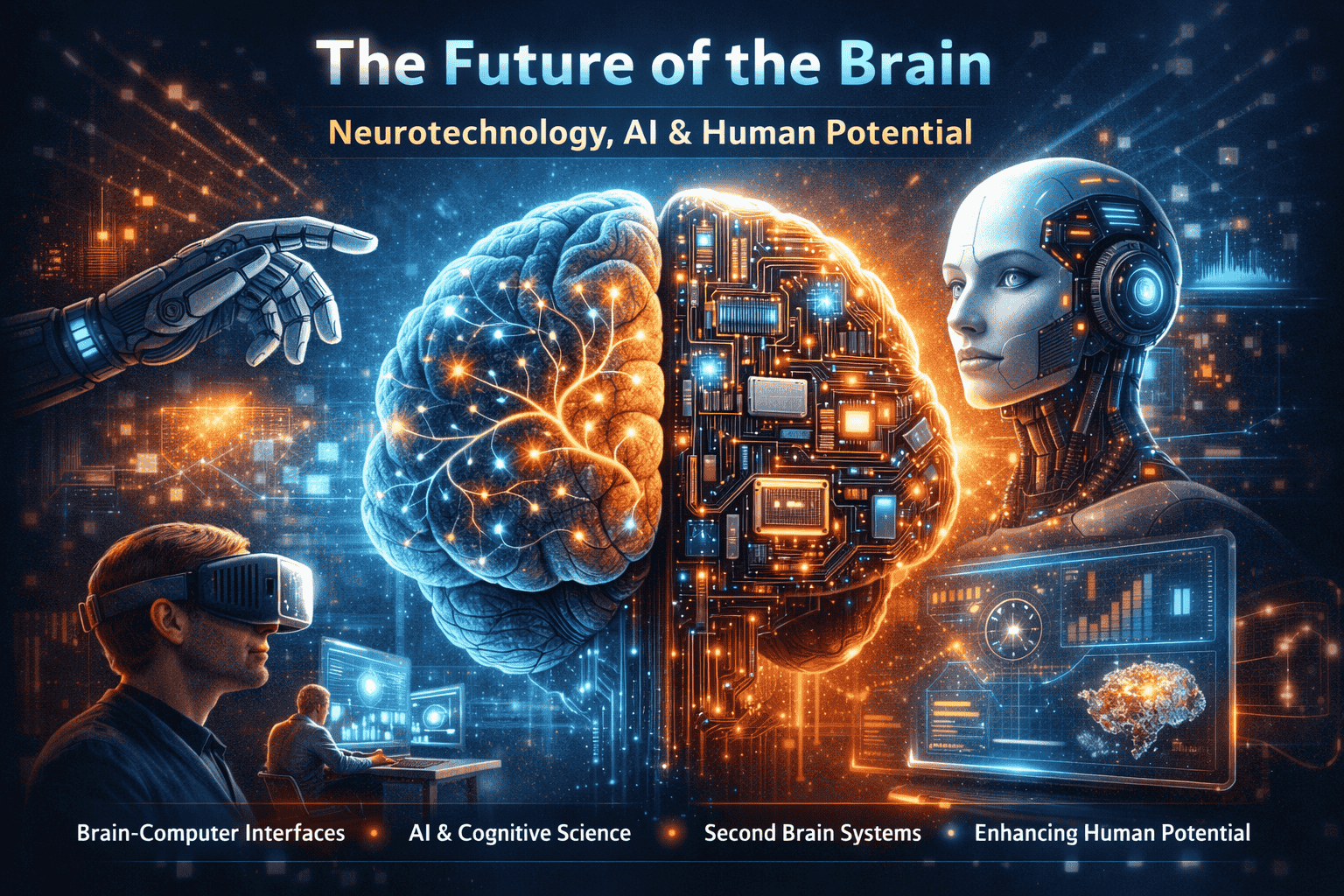
What Is Neurotechnology?
Neurotechnology means tools and systems that interact directly or indirectly with the nervous system to:
Extend or support mental processes
Record neural activity
Interface cognition with machines
Modulate brain signals
These technologies range from cognitive software to AI-driven brain models, from non-invasive wearables to implanted devices. The goal here is not to replace the brain, but to understand, support, and extend its capabilities.
Brain–Computer Interfaces: Neurotechnology
One among these neurotechnology tools is the development of the brain–computer interfaces (BCIs). BCIs allow neural signals to:
Used to control external systems
Be recorded and decoded
Translated into commands
BCI creates a direct communication channel between the brain and technology bypassing muscles, speech, or traditional input devices.
Neuralink: Rewriting Human Potential and Neurotechnology?
Neuralink is a brain–computer interface initiative. It aims to create implantable devices capable of recording and stimulating neural activity with high precision. Neuralink represents:
Real-time brain–machine communication
Advances in neural signal resolution
Improved biocompatibility
While most often the focus sounds more about enhancement or science fiction, core research aims to explore more about how neural information can be read, interpreted, and integrated with computational systems.
Read More - Neuralink Brain Chip: Rewriting Human Potential
The Concept of the “Second Brain”
Most of the advancements today have made our cognition reliable on language, writing, maps, and technology. And now this idea is further evolving into the concept of a “second brain”. What is a second brain?
Digital environments that support thinking beyond biological limits
Tools that extend memory and cognition
External systems that store, organize, and retrieve information
These systems offload cognitive load, allowing the brain to focus on higher-order thinking, rather than replacing cognition.
Explore in depth - Second Brain Labs: The Second Brain Outside Your Brain
AI as a Cognitive Partner
Artificial intelligence is becoming a cognitive collaborator, and it is no longer just a tool. AI systems can:
Support reasoning and prediction
Detect patterns humans miss
Simulate decision outcomes
Process massive datasets
When AI is combined with human cognition, it can act as:
A creative amplifier
An external analytic layer
A decision-support system
The future of cognition where insight emerges from collaboration rather than competition and may involve human–AI hybrid thinking.
Neural Portfolio Theory: How the Brain Manages Risk
Decision-making is a very complex process in which the brain distributes cognitive resources across options in ways that resemble portfolio diversification. The Neural Portfolio Theory says that:
Decisions emerge from weighted neural competition
Brain evaluates multiple possible outcomes simultaneously
Risk distributed across competing neural representations
This framework suggests that cognition itself is a risk-management system that bridges neuroscience with economics and machine learning.
Learn Further - Neural Portfolio Theory: How Your Brain Diversifies Risk
Algorithmic Thinking and Alpha Generation
In the fields of finance and quantitative analysis, the concept of “alpha” refers to excess returns generated through superior strategy. However, the idea of a WorldQuant Brain extends this concept to human cognition:
How do humans learn to outperform randomness?
How does the brain generate predictive insight?
How are patterns identified and exploited?
Researchers gain insight into both human intelligence and artificial systems, by studying how the brain models uncertainty and prediction, r.
Read More - WorldQuant Brain: Guide to Build Alphas
Cognitive Enhancement:
For centuries, the idea of enhancing cognition has fascinated humanity. Modern world enhancement discussions include:
Brain–machine integration
Neurostimulation
AI-assisted learning
Cognitive training
However, neuroscience at the same time tries to remain cautious. Enhancement does not only mean increasing raw intelligence, but it also means:
Adapting environments to brain function
Improving efficiency
Reducing cognitive friction
Supporting attention and memory
Rather than attempting to override it, true cognitive enhancement respects the brain’s complexity.
Limitless Brain: Myth or Emerging Science?
Most of modern science talks about the idea of unlocking “100% of the brain.” Neuroscience does explore how unused potential may be accessed through better alignment but rejects this myth. A limitless brain does not mean infinite capacity. It simply means:
Optimized brain–technology interaction
Better cognitive strategies
Enhanced learning environments
Reduced interference
Read in detail - Limitless Brain Lab: Unlock Your Cognitive Potential
Ethical and Philosophical Questions
Neurotechnology today is advancing more and more but it raises critical questions:
What defines human identity when cognition is extended?
Who controls neural data?
How do we prevent inequality in access?
Where does cognitive privacy end?
The future of brain science is deeply ethical and is not just technical.
The Brain as a Networked System
A more common theme across AI and neurotechnology is that intelligence is not centralized and is distributed. Just like consciousness emerges from neural networks, future cognition may come from:
Brain–environment integration
Brain–brain interaction
Brain–AI collaboration
Cognition will increasingly be networked despite the brain may remain biological.
Why This Matters Now
Advancing technologies today are shaping the future of the brain are not distant possibilities as they are already influencing:
Decision-making
Education
Creativity
Medicine
Work
Rather than passively with emerging technologies, understanding these developments helps individuals engage critically.
Topic Cluster That You Would Love To Explore:
Cognitive Psychology: How Brain Thinks, Decides, Distorts Reality
Cognitive Development from Childhood to Adulthood
Clinical, Cognitive Disorders & Mental Health
Cognitive Behavioral Science & Therapy
Brain, Consciousness & Perception
Dreams, Creativity & the Unconscious
Neurotechnology, AI & Future Brain Science
Culture, Media & Brain Narratives
Frequently Asked Questions (FAQs)
1. Will neurotechnology replace human intelligence?
No, neurotechnology aims to support and extend cognition, not replace it.
2. Is AI becoming conscious?
Current AI systems do not possess consciousness, and they are simulated intelligence through computation, not experience.
3. Are brain chips safe?
Research is ongoing, current efforts focus on safety, ethics, and limited applications rather than widespread use.
4. Can technology really enhance cognition?
Technology can support cognition by reducing load and improving access to information, but it does not bypass biological limits.