Cognitive Disorders & Mental Health
Cognitive Disorders & Mental Health
Thinking at most times feels automatic and seamless. Attention shifts on its own naturally, the memories often surface only when needed and emotions align themselves according to the context. But for some people, cognition does not always work this smoothly.
When the brain struggles, these are the moments when attention drifts uncontrollably, thoughts feel distant or unreal, motivation disappears without warning, or reality itself seems altered. These are instances that meet at the intersection of cognitive disorders and mental health, where neuroscience helps explain why the mind sometimes fails to function as expected. This article explains how and why cognitive processes can break down, focusing on neurological, psychological, and environmental influences without offering medical advice or diagnosis.
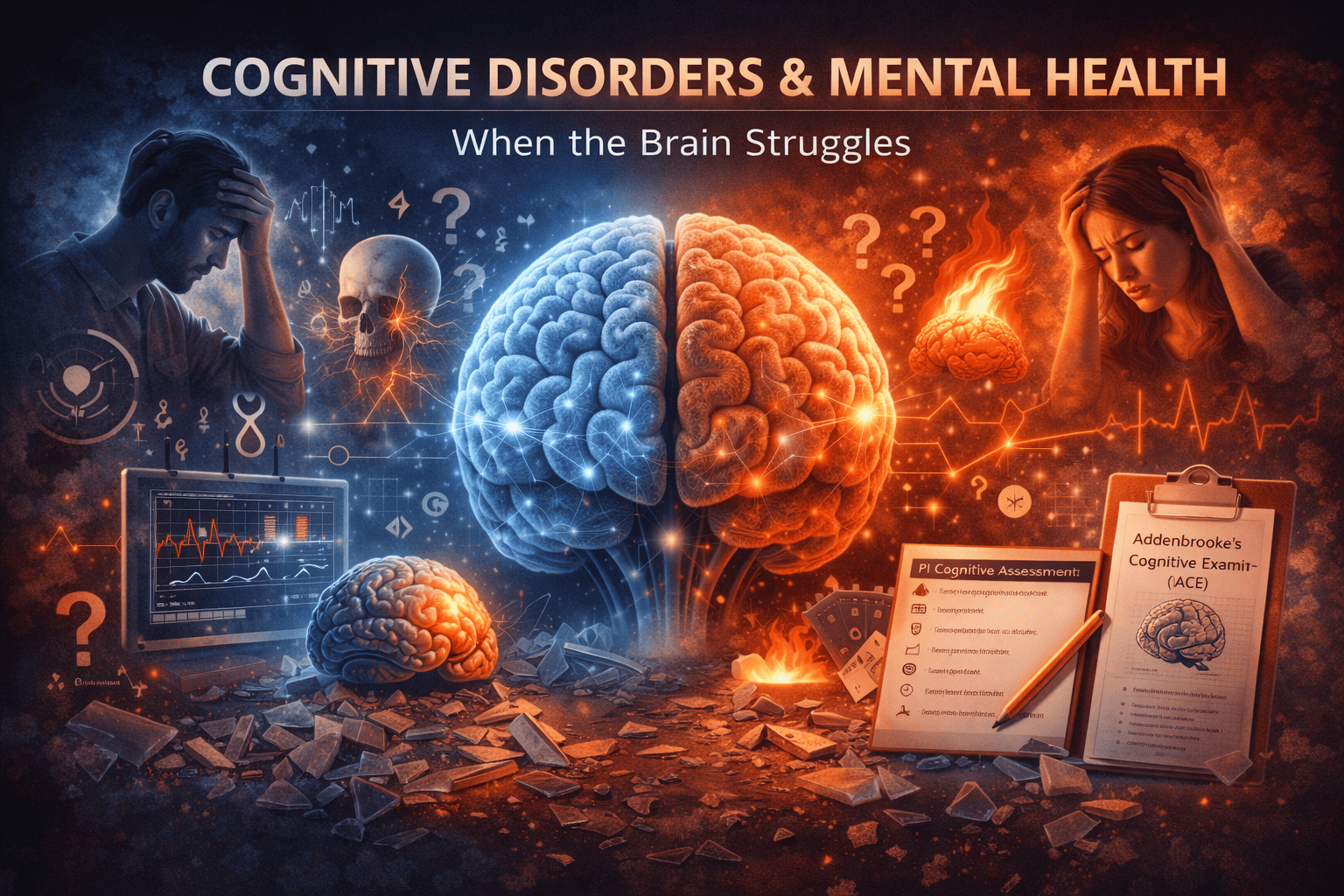
Mental Health and Cognitive Disorders:
Cognitive disorders interrupt in normal cognition and cause disruptions in mental processes such as:
Memory
Sense of self and reality
Attention
Perception
Executive function
Changes in cognition often tend to overlap with mental health conditions, but not all cognitive struggles are mental illnesses. Some are caused due to:
Social and environmental pressures
Neurodevelopmental differences
Chronic stress and overload
Brain inflammation or dysfunction
Understanding the differences between these is very important as it reduces stigma around it and improves awareness.
Sluggish Cognitive Tempo (SCT): When Attention Feels Distant
Sluggish Cognitive Tempo (SCT), also known as Cognitive Disengagement Syndrome (CDS) is a pattern of cognitive functioning which causes:
Difficulty in sustaining attention
Mental fog
Slow information processing
Daydreaming
SCT is characterized by under-arousal whereas in hyperactive attention patterns impulsivity is seen. Individuals with SCT often feel mentally present but cognitively detached.
According to neuroscience, SCT may involve altered attentional networks rather than motivational deficits.
Read more - Sluggish Cognitive Tempo (SCT): Understanding Cognitive Disengagement Syndrome
Brain on Fire: When the Immune System Disrupts Cognition
More commonly known as “Brain on Fire”, an Anti-NMDA receptor encephalitis, is a neurological condition in which the immune system interferes with normal brain signaling. The cognitive and behavioral symptoms may show:
Altered sense of reality
Memory disruption
Disorganized thinking
Changes in perception
Brain on Fire is a classic example of how cognitive and psychological symptoms can have biological origins, even when they appear psychiatric in nature.
Explore further about - Brain on Fire Condition: Anti-NMDA Receptor Encephalitis
Walking Dead Syndrome: Disconnection from Reality
Cotard’s Delusion or more commonly known as Walking Dead Syndrome, is a condition where individuals believe that they are dead, do not exist, or have lost internal organs. This condition is linked to:
Altered neural processing of bodily awareness
Severe self-representation disruptions
Disconnection between perception and emotion
It is not a failure of logic formation in the brain; instead, it reflects a breakdown in how the brain constructs the sense of self.
Read Further - What Is Walking Dead Syndrome?
Micro-Dissociation: Subtle Cognitive Disconnections
Micro-dissociation is brief and subtle short disruptions in conscious awareness during which attention momentarily disengages from the present moment. These episodes may involve:
Attention is detached
Time feels altered
Sensory input becomes less vivid
Self feels slightly “elsewhere”
When an EEG study was connected, these states showed transient changes in neural synchrony, particularly in attention and default mode networks.
Click Here For - Micro-Dissociation and EEG
ADHD and the “Ferrari Brain”
ADHD is very commonly and most often misunderstood as a deficit of attention. Instead, it is better described as incapability to regulate attention levels. Most commonly used metaphor for ADHD is “Ferrari Brain” and includes:
Difficulty controlling focus and braking thoughts
Rapid idea generation
High cognitive speed
According to neuroscience, ADHD is not a lack of intelligence or effort, instead it is differences in dopamine signaling and executive control networks.
Know More About: Ferrari Brain: Understanding the Fast Mind Behind ADHD
The Illusion of Normalcy in a Hyperconnected World
In today's world we are constantly presented with a continuous stream of curated lives, productivity, and emotional stability. This exposure to the curated world through social media creates an illusion of normalcy, where internal struggles feel invisible and invalid. This constant comparison can cause:
Amplify the feelings of inadequacy
Distortion of self-perception
Heighten the emotional dysregulation
Increase the attentional fragmentation
There is a rise of mental health challenges and they are more intensified not by internal dysfunction alone, but by external cognitive pressures.
Read Further - The Illusion of Normalcy: What Social Media Doesn’t Show You
“I Am Supposed to Be Somewhere Else”: Existential Cognitive Drift
Some of the cognitive experiences are not disorders but they are just existential experiences. A sense of misalignment between one’s inner state and external reality creates what is called existential cognitive drift. This in turn brings in a feeling of “I am supposed to be somewhere else” and it reflects:
Emotional detachment from the present context
Cognitive Dissonance
Temporal Dislocation
Uncertainty of identity
According to neuroscience, such experiences may involve interactions between memory, future simulation, and self-referential thinking.
Explore more: “I Am Supposed to Be Somewhere Else”
Common Factors Across Cognitive Struggles
There are differences in all the cognitive conditions and mental health issues but despite that many cognitive disorders and mental health experiences share underlying mechanisms:
Neural network imbalance
Attention dysregulation
Emotion–cognition mismatch
Prediction errors
Altered self-representation
Understanding these common patterns helps to better differentiate and move towards a solution.
How Cognitive Assessments Help Understanding Mental Health?
Cognitive Assessments are not like a pass or failure or IQ kind of tests instead they help us get a better idea of an individual’s cognitive functioning at a given moment. Tools like ACE or PI help us:
To identify patterns of cognitive difficulty and strength
Create a bridge between subjective experience with objective observation
Facilitate research on brain–behavior relationships.
These tools provide standardized ways to observe cognitive patterns, often used in research, screening, and clinical contexts and are not treatments.
Addenbrooke’s Cognitive Examination (ACE)
The ACE or Addenbrooke’s Cognitive Examination is the most commonly used cognitive screening tool. It is designed to evaluate multiple domains of cognition in a structured manner. ACE instead of focusing on a single ability, examines how different cognitive systems interact.
The cognitive domains assessed include:
Visuospatial processing
Attention and orientation
Language abilities
Verbal fluency
Immediate and delayed memory
ACE, from a neuroscience perspective, emphasises on the idea that cognitive health is multidimensional, not localized to a single brain function.
Cognitive domains are often discussed in context of:
Differentiating types of cognitive impairment
Neurodegenerative conditions
Cognitive decline
Explore in depth: Addenbrooke’s Cognitive Examination (ACE)
PI Cognitive Assessment: Understanding Cognitive Profiles
PI is a Cognitive Assessment is a psychometric tool designed to measure general cognitive ability. Particularly to assess how efficiently individuals process information and solve problems. Unlike other screening, PI focuses on:
Adaptive problem-solving
Processing speed
Logical reasoning
Pattern recognition
Instead of labeling cognitive ability as simply high or low, this type of assessment helps illustrate individual differences in thinking styles. Assessments are discussed in terms of:
Workplace and applied psychology
Learning and problem-solving styles
Cognitive performance evaluation
Learn more about - PI Cognitive Assessment: Meaning, Scoring, and Examples
Frequently Asked Questions
1. Are cognitive disorders the same as mental illnesses?
No. Mental illnesses involve emotional, behavioral, and psychological patterns, while cognitive disorders involve disruptions in mental processes. Often they tend to overlap but they are not identical.
2. Can cognitive struggles exist without a diagnosis?
Yes, many people experience cognitive difficulties due to environment, stress, or neurodiversity without meeting clinical criteria or having a diagnosis.
3. Is neuroscience replacing psychology in mental health?
No, neuroscience complements psychology by explaining underlying mechanisms, not replacing subjective experience.
Some Interesting Clusters for You to Explore:
Cognitive Psychology: How Brain Thinks, Decides, Distorts Reality
Cognitive Development from Childhood to Adulthood
Clinical, Cognitive Disorders & Mental Health
Cognitive Behavioral Science & Therapy
Brain, Consciousness & Perception
Dreams, Creativity & the Unconscious