How Humans Learn: Cognitive Development from Childhood to Adulthood
How Humans Learn: Cognitive Development from Childhood to Adulthood
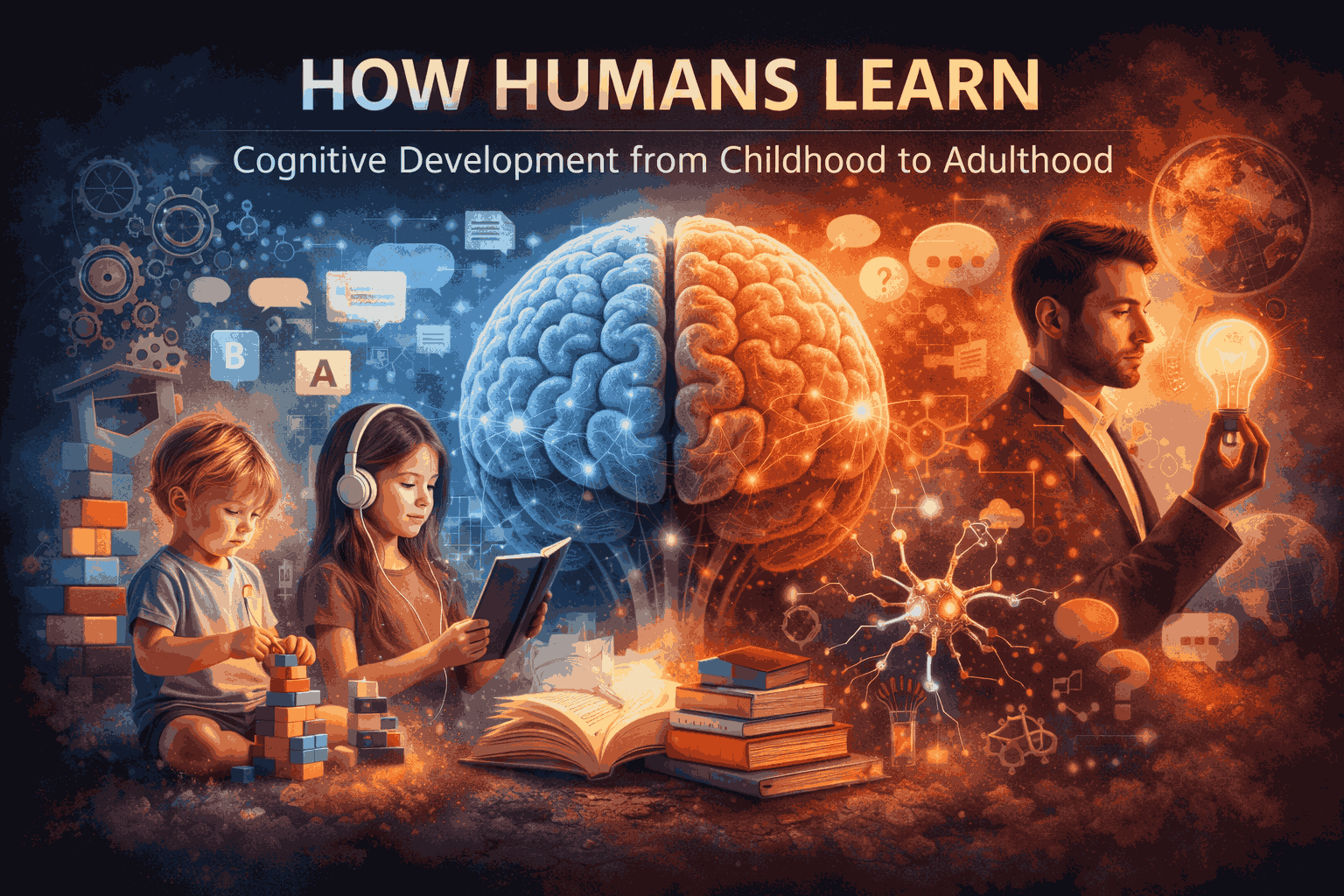
Humans do not learn everything at birth, not all at once. Learning does not follow a traditional single path. From neonatal stage to adulthood, the brain continuously reorganizes how it perceives, interprets, stores, and applies information. The gradual learning process and transformation of humans is explained by cognitive development. It is the study of how thinking, reasoning, language, and understanding evolve throughout one's lifespan. In this article let's explore how humans learn, how cognition develops from childhood to adulthood, and why culture, language, and social interaction play a crucial role in shaping the human brain.
What Is Cognitive Development?
Cognitive development are the gradual changes in mental capabilities from infancy to adulthood such as:
Perspective-taking
Thinking and reasoning
Learning and memory
Communication and language
It explains a detailed explanation about how children build knowledge, how adolescents refine their abstract thinking, and how adults continue learning through experiences in life. Cognitive development is about how the mind adapts to the world over time and not just about intelligence.
Jean Piaget’s Theory of Cognitive Development
Jean Piaget plays one of the major roles in the field of cognitive development, he proposed the idea that children are active learners, not passive recipients of information.
According to him, cognitive development happens through various distinct stages, each stage characterized by unique ways of thinking.
Main Idea: Children develop the ability to reason and do not think like adults.
Piaget stages of development include:
Formal operational stage
Sensorimotor stage
Concrete operational stage
Preoperational stage
Based on the interaction with their environment each stage reflects how children construct mental models.
Read More: Jean Piaget’s Theory of Cognitive Development
Bruner’s Theory of Cognitive Development
Jerome Bruner emphasized on the fact that learning is most effective when individuals discover knowledge actively, rather than being told.
Core Principles of Bruner’s Theory:
Learning is a lifelong process and not a product or a final outcome.
Learning is represented in different forms:
Enactive which is action-based learning.
Iconic is image-based learning.
Symbolic meaning language-based learning.
Bruner placed forward a powerful idea in modern education that any subject can be taught at any age, if structured properly.
Explore: Bruner Theory of Cognitive Development
Bandura’s Social Cognitive Theory: Learning Through Others
Albert Bandura, also more commonly known as Bandura, played a role in expanding cognitive development and he introduced Bandura’s Social Cognitive Theory. He explored beyond the individual mind by showing that humans learn socially along with the other ways of learning.
Principles of Bandura’s Social Cognitive Theory:
Beliefs about self-efficacy influence motivation
Learning happens through observation
Behavior is shaped by social context
His social cognitive theory explains why media, role models, and social environments strongly affect learning and behavior.
To know more about: What Is Bandura’s Social Cognitive Theory?
Neurotypical Development: What Is Considered “Typical”?
Neurotypical simply means patterns of cognitive development that align with statistical norms in neuroscience and psychology. Ways of thinking that align with most of the individual's thinking patterns. However, “neurotypical” does not necessarily refer to “better” or “perfect” or “ideal.”
A commonly used term “neurotypical” describes how most brains develop in terms of :
Sensory processing
Attention
Social cognition
Language
Understanding “neurotypical” is important because it helps distinguish differences from disorders.
Read more: Neurotypical Meaning: What It Really Means in Neuroscience
Language, Cognition, and Learning
Language is merely not just a communication tool; it shapes how we think. How language activates different regions of the brain while switching between languages.
A Brain That Thinks in Many Tongues
People who speak in multiple languages (multilingual brains) often show:
A very different pattern of memory encoding
An enhanced level of cognitive flexibility
Better control on attention levels
Language plays an important role in cognition and learning multiple languages can subtly restructure cognitive processes.
Read More: A Brain That Thinks in Many Tongues
Why Some Languages Don’t Forgive Mispronunciations
People who speak certain languages do not allow for even the slightest mispronunciation and some others are more flexible. This is because some languages are more sensitive to phonetic variation, meaning small pronunciation errors can alter the meaning completely.
Phonetic variation plays a role on:
Cognitive load exerted during communication
Early language learning
Perception of Accent
Structure and rules of the language directly affect how easily the brain processes speech.
Explore: Why Some Languages Don’t Forgive Mispronunciations?
Cognitive Development Does Not Stop at Childhood
Early life development is foundational but does not stop at childhood, learning continues throughout adulthood.
Adult cognitive development involves the following:
Lifelong adaptation and learning
Reasoning refinement
Metacognition which means thinking about thinking
Experience integration
Cognition evolves because experience reshapes mental models and not because the brain stops growing.
Why Development Matters in Real Life
Understanding cognitive development matters because it allows us improve:
Cross-cultural communication
Education systems
Workplace learning
Teaching strategies
Parenting approaches
Understanding it helps us to design environments that support how humans actually learn, rather than how we assume they should.
Frequently Asked Questions
1. What is cognitive development?
It is the gradual expansion of mental processes such as reasoning, thinking, learning, and language across the lifespan.
2. Do adults still experience cognitive development?
Yes, while early stages are foundational, development continues through learning, experience, and reflection.
3. Is cognitive development the same for everyone?
No, development is not a single defined path it varies based on biology, environment, culture, language, and social interaction.
Clusters For You:
Cognitive Psychology: How Brain Thinks, Decides, Distorts Reality
Cognitive Development from Childhood to Adulthood
Clinical, Cognitive Disorders & Mental Health
Cognitive Behavioral Science & Therapy
Brain, Consciousness & Perception
Dreams, Creativity & the Unconscious