What is the N200? When Your Brain Says "Wait - Something’s Not Right"
Throughout the day there is so much information that our brain processes. Some information is just regular while some others need more attention. And who decides which information needs more attention? Our brain - it works like a prediction device, constantly generating expectations about what comes next, what fits, what belongs.
What happens when something doesn't go as well as predicted? Even subtly or even before you consciously notice, a specific neural signal fires. It is seen around 200 milliseconds after the violation. Hence its name N200. Our everyday decisions built on prediction and mismatch are based entirely on N200 and its functions.
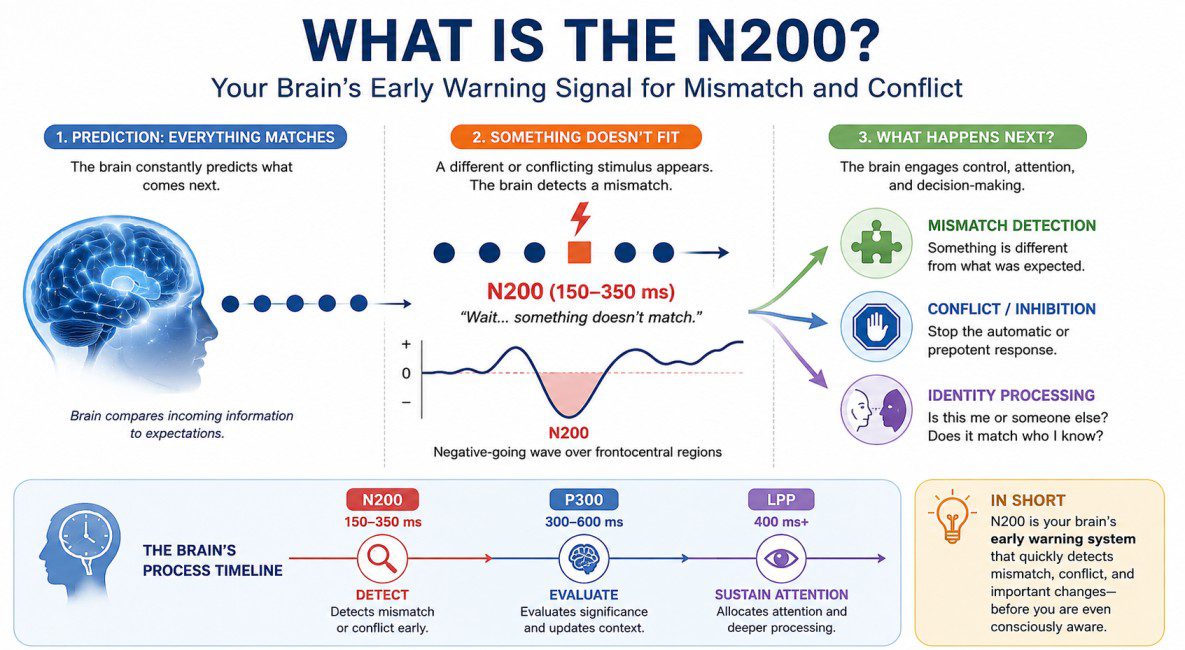
What exactly is N200?
- N = is a negative-going ERP component
- 2 or 200 = because it typically peaks between 150 and 350 milliseconds after a stimulus
- Prominently seen over - Frontocentral scalp regions
- Demonstrates - Activity in areas involved in cognitive control, conflict monitoring, and early categorization
The most commonly discussed characteristics of N200 are conflict monitoring, mismatch detection, and inhibitory control and they often overlap in research. In short, it is our brain signaling that something doesn't match what it expected.
The Mismatch Story
One of the classic ways to elicit ERP components like N200 is through an oddball paradigm.
To explain in an easier way: You present a series of the same stimuli (80%) and then occasionally something different appears(20%).
The brain responds to the different stimulus with a larger and a more negative N200. This does not reflect surprise instead it reflects that the brain is comparing. It is trying to match the incoming information against a stored template and flagging the discrepancy before awareness catches up.
In the case of auditory paradigms, this mismatch is known as the Mismatch Negativity, or MMN. Across all the other sensory modalities like touch, vision it is known as N200.
For analogy:
You go to the kitchen and see that something is slightly out of place. Maybe some vessels are not in place. You do not consciously scan for the differences yet your brain automatically flags these differences and later your attention gets directed towards it. The N200 is the wave seen at that point in time.
Research Insight:
A review published by Folstein and Van Petten (2008) in Psychophysiology examined N200 and concluded that the component reflects two partially dissociable processes: stimulus-driven mismatch detection and task-driven cognitive control.
It is reliably seen across experiments because it is not a single process but a convergence of related mechanisms that share a common neural generator in the anterior cingulate cortex and prefrontal regions.
Conflict and Control:
N200 can also be seen in conflicting situations competing with each other. Where the brain has to override a dominant response or suppress the dominant response.
One of the classic examples is the go/no-go task. In this experiment the participants are asked to respond to a certain type of stimulus only and on rare trials, a different stimulus appears where they must withhold that response entirely. This creates a strong habit of pressing a button.
This experiment in turn elicits a N200 over frontocentral regions, reflecting the conflict between the habitual response and the need to inhibit it. Stronger need for suppression, larger the N200 generated.
N200 = The brain trying to stop itself from acting on the autopilot mode.
Did You Know?
Some context about the go/no-go task:
- It is among the most studied inhibitory control tasks in clinical neuroscience. It is used to examine impulse control differences in ADHD, substance use disorders, and obsessive-compulsive disorder.
- In short for conditions where the brain's ability to suppress automatic responses is disrupted.
- Reduced or delayed N200 indicates - compromised inhibitory control even when behavioural performance looks intact.
The Three Faces of N200: Summary
Feature | N2b (Mismatch) | N2 (Conflict/Inhibition) | N2pc (Visual Selection) |
Peak timing | 200–300 ms | 200–350 ms | 180–280 ms |
Scalp location | Frontocentral | Frontocentral | Posterior contralateral |
What it reflects | Stimulus deviance detection | Response conflict, inhibition | Attentional selection in visual field |
Typical paradigm | Oddball, MMN | Go/no-go, Flanker | Visual search, spatial attention |
Amplitude direction | More negative = more mismatch | More negative = more conflict | More negative = stronger selection |
Each of the subcomponents mentioned has its own research uses but all of them share the same mechanism. Reflecting that the brain has encountered something that requires more than routine processing.
Research Perspective: Self/Other Discrimination
In a study that I worked on, participants were shown images of faces, sometimes their own face, sometimes someone else's while we recorded EEG.
Results: N200 demonstrated a significant main effect of face type. Other face images produced a negative N200 than self-faces, seen over central scalp regions in the 170–290 millisecond window.
Inference: The brain was working way before conscious perception to process faces that didn't match its internal self-representation. This happens because your own is deeply familiar like a fixed template that your brain holds. Whereas, someone else’s face requires more active matching, more comparison against what is known.
Discussion - N200 shows up whenever the brain is asking - does this match what I know? This has been established in research involving self-referential processing. It suggests that the brain appears to maintain a representation of the self not just visually, but across memory, attention, and identity. As a result, the N200 is then sensitive to violations of that representation at a remarkably early stage of processing.
Research Insight - Sui and Gu (2013) in NeuroImage
Reflected that self-associated stimuli are processed with distinct neural signatures from other-associated stimuli as early as 200ms post-stimulus, suggesting that self-relevance shapes perception at a level before conscious perception.
The N200 amplitude difference suggests that the brain treats self-referential information as categorically distinct from other information, not merely as more familiar or more emotionally significant.
How N200 Fits Into the ERP Series?
In our series of EEG and ERP series articles we have understood about components that reflect what happens once the brain has already committed attention to something. The P300 flagging significance, the LPP sustaining emotional evaluation, alpha suppression tracking ongoing cortical engagement.
N200 comes way before conscious perception, it is the checkpoint before deeper processing begins. It starts with "this doesn't fit, please pay closer attention."
Basic understanding of where each component is placed based on timing helps understand the right choice of component for the right question.
Component | Timing | What it captures | Where it sits in processing |
N200 | 150–350 ms | Mismatch, conflict, early categorisation | Early — pre-conscious checkpoint |
P300 | 300–600 ms | Attention, significance, context updating | Mid — conscious engagement |
LPP | 400–800 ms+ | Emotional/motivational relevance | Late — sustained evaluation |
Alpha ERD | Sustained | Cortical resource allocation over time | Ongoing — not time-locked |
N200 becomes the right choice where research design is about early categorization, automatic conflict detection, or identity processing, before conscious perception comes into picture.
Did You Know?
N200 appears 100 milliseconds before the P300. In some experiments they can be seen appearing in the same waveform, the N200 representing the brain's detection of something unusual, and the P300 representing the brain's subsequent evaluation of its significance. Both of them together give an idea about conflict detection and the decision stages of cognitive processing.
When Do Researchers Use the N200?
N200 is the right choice when the research question involves:
- Early mismatch detection - When one needs to check if the brain registers that something was different, even subtly?
- Cognitive control and inhibition - How much inhibitory control was required to suppress a response?
- Categorical discrimination - Before conscious perception does the brain automatically distinguish between two types of stimuli?
- Identity and self-referential processing - How does the brain respond to stimuli that matches or violates its internal self-model?
In all the above cases, a more negative N200 generally reflects greater mismatch, stronger conflict, or more demanding discrimination.
Similar to all the ERP components, it reveals how hard the brain worked in that first fraction of a second when the brain noticed something.
Research Insight - Kopp, Rist and Mattler (1996) in Psychophysiology
The first scientific work that characterized the N200 in response to inhibition tasks, demonstrating that its amplitude scales with the degree of response conflict rather than simply the presence of a no-go trial.
This established the N200 as an indicator of inhibitory processing rather than a passive mismatch response.
Helping clinicians interpret N200 findings in populations with impulse control difficulties.
What Changes the N200 Amplitude?
Various factors result in the modulation of N200 amplitude across studies:
Probability of Stimulus - Rarer the stimuli, larger the N200 (Go/no-go task). Lesser frequency of deviant stimuli, stronger the mismatch signal.
Task Needs - Higher the need for inhibitory or cognitive control needed to resolve a conflict or to suppress a response, larger is the N200.
Health Conditions - Clinical factors like ADHD or anxiety (working memory capacity, attentional control) all influence N200 amplitude, making it a useful marker in developmental and clinical research.
Familiarity with the stimulus - When stimulus matches the expected template saved by the brain, higher tendency to produce smaller N200s than unfamiliar equivalents, reflecting the brain's more efficient template-matching for known information.
Age - N200 latency increases with age, reflecting slower neural processing speed, while amplitude changes vary depending on the specific subcomponent and task.
Neural Generators: Where in the brain does the N200 come from?
According to source localization studies the primary generators are the anterior cingulate cortex (ACC) and dorsolateral prefrontal cortex (dlPFC).These are the regions well established in conflict monitoring, cognitive control, and error detection.
For the MMN, the visual variant, occipitotemporal regions contribute, particularly when the mismatch involves complex visual features like faces or objects.
The distribution of neural generators explains why the N200 appears across such a wide variety of paradigms. It is not limited to one function or one brain region, reflecting a broad class of computations that the frontal and prefrontal systems perform whenever incoming information doesn't match expectations.
Read Next in This Series:
This article is part of an ongoing EEG/ ERP series on Cognitive Story. If you found this article useful, the articles below provide the full picture:
- What is an ERP? Event-Related Potentials Explained Simply
- What is the P300 Wave? The Brain's Attention Signal Explained
- What is the LPP? How Your Brain Holds On to What Matters
- What is Alpha Suppression?
Written By - Vaishnavi Bagayi - Senior EEG Research Associate