What is Alpha Suppression? What Your Brain Does When It Starts Paying Attention
You have always heard that, your brain truly never is at rest even while resting with your eyes closed. And yes, that is the truth, because billions of neurons are still communicating, producing rhythmic electrical patterns that can be measured from the scalp using EEG. Among the most important of these brain waves is the alpha wave: an oscillation around 8–13 Hz that dominates the relaxed, awake brain. Imagine at this moment someone calls out your name or your phone vibrates. At this moment within milliseconds, something remarkable happens the moment your brain needs to pay attention. The alpha waves fade away as soon as you open your eyes and this happens instantly. This disappearance of the alpha rhythm is called alpha suppression also known as alpha ERD (Event-Related Desynchronization). However, it is among the most important EEG signals measured for EEG research purposes.
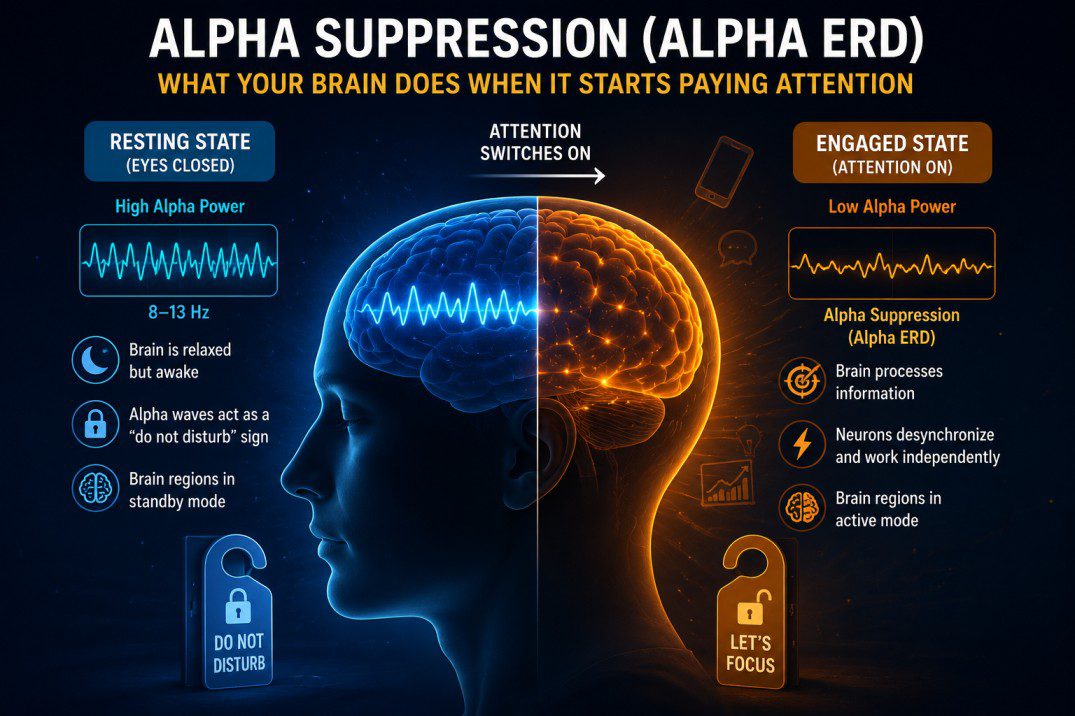
What is Alpha Suppression? In Simple Terms
For example - It is like your computer screen lighting up from standby after clicking on the mouse. Alpha suppression happens when a brain region shifts from resting to activation mode. As an EEG researcher, I can say that it simply shows: How deeply the brain is actually engaging with something.
Alpha Waves:
In my brain waves article I have already explained about alpha waves. If you have read that you will know that - alpha waves are most prominently seen when the brain is calm but awake, especially with the eyes closed.
Nevertheless, this does not mean that alpha waves are simply “relaxation waves.” In the current times, alpha activity is seen as a type of gating mechanism.
Meaning, alpha waves act as a regulator for which brain regions are actively processing information and which are temporarily held in standby mode.
As an analogy we can think of this as a "do not disturb" sign hanging on the door of a brain region.
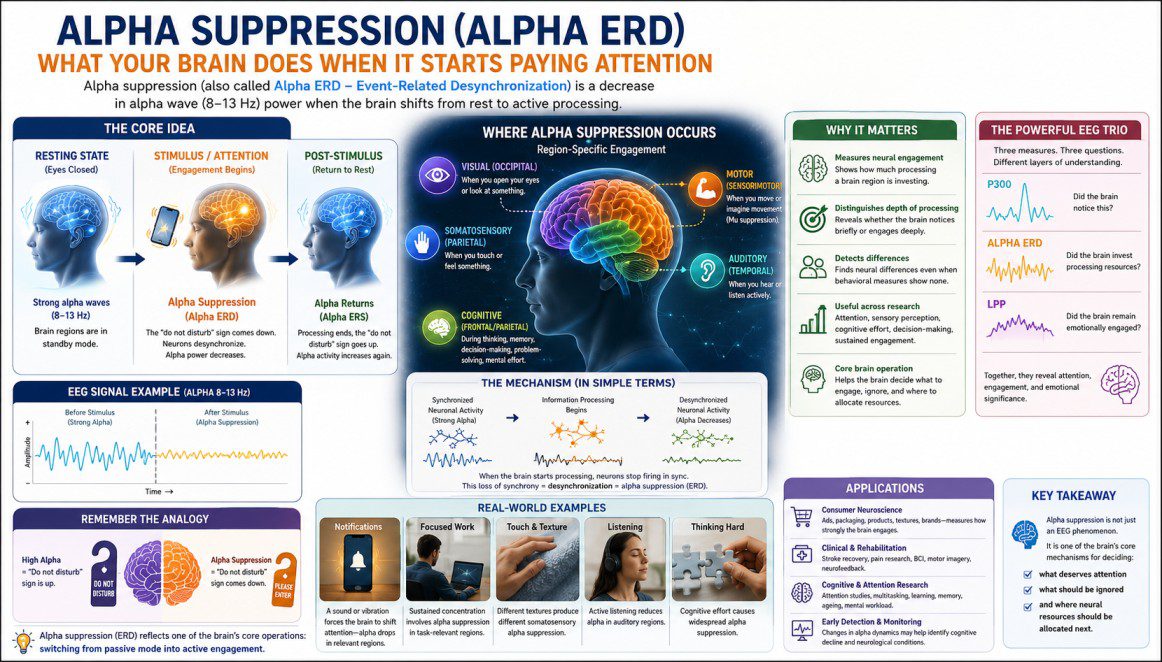
However this implies that when alpha activity is high, the region is functional, available, and ready to act if needed but it is not actively processing much information. Then arrives a stimulus. The “do not disturb” sign comes down, the brain becomes active and the alpha waves fade away. This shows the brain active engagement and a decrease in alpha power is known as alpha suppression.
What is Alpha Suppression - Mechanism:
It simply refers to a reduction in alpha-band power that occurs when the brain begins actively processing information.
It has various names like:
- Alpha ERD (Event-Related Desynchronization)
- Alpha desynchronization
- Alpha blocking
However, all these terms describe essentially the same process.
Mechanism in Simple Terms:
When the brain is at rest, a group of neurons fire rhythmically together in synchronized patterns. This synchronized activity produces an alpha rhythm activity on EEG.
As soon as the brain regions start processing information, the synchronization of neuron activity is disturbed. They start working independently and as a result the alpha wave becomes weaker. This interruption of the rhythm or loss of synchronization is why it is known as desynchronization. On EEG, desynchronization is seen as a drop in alpha power.
Conclusion - Larger the alpha suppression seen on EEG, the more actively that brain region is typically processing.
The Brain Also Reverts Back - The Process:
Alpha suppression is one part of the story. After the active processing is over, alpha activity often increases again. And this is known as:
- Alpha ERS (Event-Related Synchronization)
- Alpha synchronization
- Alpha rebound
According to our previous analogy - The “do not disturb” sign goes up. The brain goes on a standby mode again. Throughout the day, your brain is constantly going through cycles of this process - deciding which systems should remain active and which should temporarily quiet down.
Why is Alpha Suppression Crucial For Research?
We have already learnt about ERP components like P300 or N170. They demonstrate that the brain responds to a specific event at a specific moment. They are like precise and time locked responses. Whereas, alpha suppression tells us something different, it tells us how much neural processing a brain region invested over time.
Alpha Suppression - It helps distinguish whether the brain notices something briefly or did the brain engage deeply with it?
Alpha Event-Related Synchronization helps to measure neural resource allocation, sensory engagement, cognitive effort, sustained attention and ongoing information processing.
Stronger ERD = Greater cortical activation, deeper engagement, or increased processing demands.
It plays a very crucial role when two stimuli or products are being compared. Answers questions like:
- Which stimuli did the brain engage with more?
- Which stimulus required more cognitive effort?
- Did any kind activity (touch/ smell) activate corresponding regions in the brain? If so, for which stimuli particularly?
These are the questions that alpha suppression can answer. Most often, it reveals neural differences even when behavioural measures like surveys or ratings show almost no difference at all.
Note: Alpha ERD is not the same as LPP
Let me explain how:
The most common point of confusion arises between the Late Positive Potential and Alpha ERD. The LPP also reflects sustained processing but it captures the emotional and motivational significance the brain assigns to a stimulus.
Whereas, Alpha ERD reveals about the cortical work being done. LPP - tells you the brain cares and ERD tells that the brain works. Both of them are important, but they are not interchangeable.
Alpha Suppression Region & Activity Being Done:
Apart from being sensitive to activity, alpha suppression is also very region-specific. Suppression does not appear everywhere equally, it decreases primarily in the brain regions currently involved in processing.
Visual Processing -
Alpha Suppression: When you open your eyes, alpha suppression occurs strongly over the occipital cortex at the back of the head. This is also known as the Berger effect, as it was originally observed by him. Among the most crucial findings in EEG research.
Even something as simple as opening the eyes in a dim room produces measurable occipital alpha suppression.
- Motor Processing - Mu Suppression: When you think about moving your arm or actually move your arm, alpha suppression occurs over motor regions near the top of the scalp. This phenomenon is known as mu suppression. Mu is very closely related to alpha but the suppression in this case occurs specifically over the sensorimotor cortex.
Researchers use of mu suppression:
- Movement studies
- Brain-computer interfaces
- Motor imagery
- Stroke rehabilitation
- Mirror neuron research
- Somatosensory Processing - Response to Touch: One of the reasons for alpha suppression is touch. If you touch something actively or if something touches you, alpha decreases over somatosensory regions responsible for tactile processing.
This becomes crucial for research involving:
- Product textures
- Sensory perception
- Fabrics
- Skincare
- Haptic feedback
- Packaging materials
Interestingly, the brain responds to tactile differences far more strongly than people consciously realize.
- Auditory Processing - When you listen to something, alpha suppression occurs over temporal regions involved in auditory processing. This happens because sound also disturbs the resting state of your brain. It is the transition within milliseconds, where the auditory regions become more active and alpha decreases as your brain shifts from passive hearing into focused listening.
- Cognitive Processing - Actively thinking about something or cognitively demanding tasks can produce widespread alpha suppression across frontal and parietal regions.
For example, activities like:
- Focused concentration
- Mental calculation
- Memory retrieval
- Decision-making
- Problem-solving
In short, the harder the brain works, the more the “do not disturb” signs come down across relevant regions.
Alpha Suppression & Consumer Neuroscience:
The trend towards use of alpha ERD in consumer neuroscience is increasing due to its ability to provide a relatively direct measure of neural engagement. Alpha ERD has become one of the most valuable EEG measures available. It is useful especially when someone:
- Sees an advertisement
- Checks out the packaging
- Explores a product actively
- Experiences a brand
In the above mentioned cases, alpha suppression reveals how strongly relevant brain regions became engaged during that experience.
Higher alpha suppression = More neural resource allocation
1. Visual Cues:
Helps brands for packaging, branding, advertising, and visual design. Researchers often examine alpha ERD over occipital and parietal regions. Higher suppression means a stronger visual engagement.
2. Tactile Products
For textures, materials, fabrics, skincare, and packaging feel, alpha suppression over somatosensory cortex becomes especially informative.
A material that produces stronger somatosensory alpha ERD may be engaging tactile processing more deeply even when participants verbally describe products similarly.
3. Cognitive Evaluation
Frontocentral alpha suppression can indicate cognitive effort during evaluation, comparison, decision-making and product judgment.
The Powerful EEG Trio
Alpha ERD becomes even more informative when combined with other ERP measures like:
- P300: Asks - Did the brain notice this?
- Alpha ERD: Asks - Did the brain invest processing resources?
- LPP: Asks - Did the brain remain emotionally engaged?
All of them combined reveal different layers of processing like attention, engagement, and emotional significance. A stimulus that scores well on all these parameters suggests that the stimulus most likely captured the brain at multiple levels simultaneously.
What Makes Alpha ERD Crucial?
Alpha ERD has helped in the most interesting ways in my everyday work. Let me explain how. Many times, two different stimuli behaviorally perform the same. Participants sometimes rate two experiences almost identically on surveys.
In such cases EEG is the only tool that can differentiate between the two stimuli. One stimuli may produce substantially greater alpha suppression over somatosensory or attentional regions, suggesting the brain processed it more deeply even though the conscious experience felt similar. This is what helps distinguish between the two stimuli.
Alpha ERD demonstrates that the brain is making distinctions long before or even without conscious awareness catching up. The most compelling thing about alpha suppression is how often it reveals processing that people themselves are unaware of.
Alpha Suppression - Clinical and Cognitive Research:
Apart from its uses in consumer neuroscience, alpha ERD is widely used across clinical and cognitive neuroscience.
1. Stroke Rehabilitation
Post-stroke, motor alpha suppression helps physicians to assess whether the brain is attempting for movement control. Some BCI devices use motor alpha ERD to help paralyzed patients communicate or control devices.
2. Pain Research
After painful stimulation, alpha suppression is seen over the somatosensory cortex. These patterns are studied to better understand chronic pain conditions and altered sensory processing.
3. Attention Research
Plays a crucial role in attention studies. When the brain focuses strongly on one sensory function, alpha may actually increase in irrelevant regions effectively suppressing distracting information. In short, the brain may sometimes raise the “do not disturb” sign in areas it wants to ignore.
4. Ageing and Memory
During memory tasks, older adults often show altered alpha suppression patterns. It helps to identify early cognitive decline.
To Summarize:
Alpha suppression is one of the brain's core mechanisms to decide what deserves attention, what should remain ignored, and where neural resources should be allocated next.
FAQs - Alpha ERD
- What is the difference between alpha ERD and alpha suppression?
Both the terminologies refer to the same phenomenon - a reduction in alpha-wave power when the brain becomes active. Whereas, “Alpha ERD” is a research term used when suppression is measured relative to a stimulus or event.
- Why do alpha waves wean off during attention?
Alpha activity is reduced when a brain region becomes actively involved in processing information, neurons stop firing in synchronized alpha rhythms and begin processing dynamically, causing alpha power to decrease. In short, it reflects functional inhibition or standby states.
- Is alpha suppression good or bad?
Neither good nor bad, alpha suppression is a normal and healthy part of brain function. It demonstrates that a brain region has become actively engaged in processing.
- Can alpha suppression detect lying?
No, it only indicates cognitive engagement or processing demands, not the content of thoughts. Nevertheless, some deception studies suggest lying may involve stronger frontal alpha suppression because deception requires increased cognitive effort.
- Is alpha suppression permanent?
It is temporary and task-dependent. Alpha activity returns post-processing. Abnormalities in alpha rhythms may indicate neurological issues and would require clinical evaluation.
Written and edited by - Vaishnavi Bagayi, Neuroscience Research Associate specializing in EEG, neonatal neurophysiology, and brain-behaviour research.
If this article helped you understand something about the brain, consider supporting independent science writing.