Table of Contents:
- The "Brain Develops at 25" Claim — Is It True?
- Where Did the "Age 25" Myth Come From?
- What Does Current Neuroscience Actually Say About Brain Development?
- A Myth vs Reality - Brain Development at 25
- Why Did This Myth Become So Popular?? (Why do we love it?)
- Your Prefrontal Cortex Isn't "Inactive" Before 25
- When the Brain Myth Enters the Courtroom: Roper v. Simmons and Policy
- So, What Does All this mean 25?
- FAQs - About Brain Development and Age 25
1. The "Brain Develops at 25" Claim — Is It True?
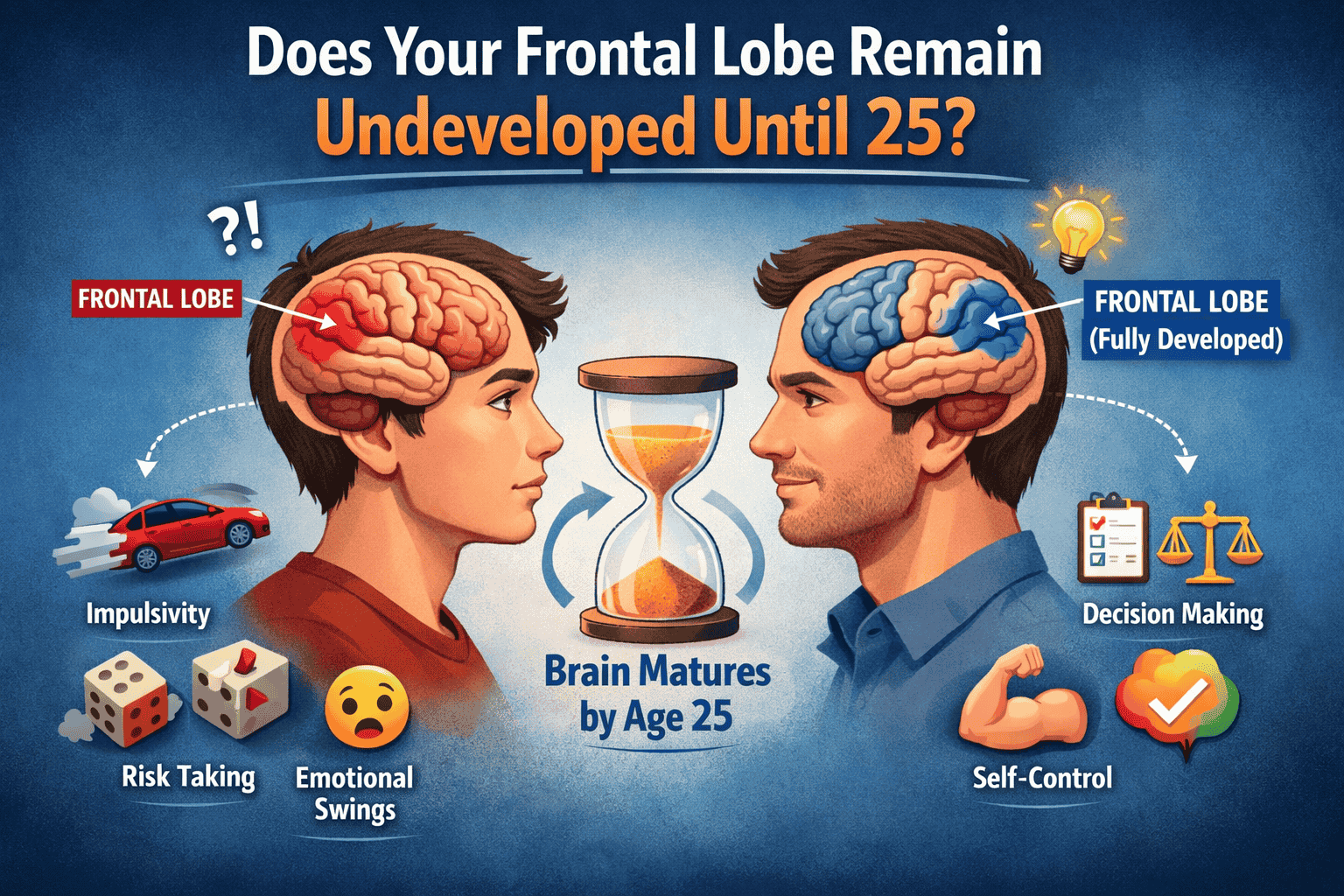
Have you also come across the viral claim, which says that "Your frontal lobe isn't fully developed until 25." It is rapidly becoming one of the easiest excuses for everything — impulse purchases, terrible exes, career indecision, and questionable 2 a.m. texts. And then there are a bunch of memes which are chaotic decisions captioned as "me at 24" versus suddenly responsible behavior captioned "frontal lobe: unlocked."
But here's something you must know about - this idea of your brain flipping a switch on your 25th birthday and suddenly handing over the keys to rational adulthood? All of this is certainly a myth. The real neuroscience behind it is far more interesting, and honestly far more scientific than the meme.
The real truth is that your brain development does not have a finishing line. Development starts at birth and it is gradual and is influenced by everything from your genetics to your daily habits. Research also suggests that the process continues well past 25, potentially into your early 30s.
2. Where Did the "Age 25" Myth Come From?
The claim might not be completely true but isn't completely made up. It has been mentioned in neuroscience, which is why it spreads so effectively.
The Early MRI Studies (Late 1990s – Early 2000s):
During the late 1990s and early 2000, scientists and researchers started using MRI to scan the brains of children and teenagers over time. One of the landmark studies conducted in 1999, tracked brain changes in young people and found something interesting - during a person's adolescent ages, their brain's grey matter (also called the thinking tissue), made up of neuron cell bodies goes through a major cleanup process called synaptic pruning.
Here's what it means in simple words:
At birth or during early years of life, the brain builds a massive web of neural connections, far more than needed. As one grows older, it starts cutting its connections that one doesn't make use of and strengthens the ones that are needed. It similar to clearing the clutter at home, you keep the clothes you actually wear and donate the rest, making the whole system neater and tidier.
The Gogtay Study: Back-to-Front Maturation
A follow-up research study led by neuroscientist Nitin Gogtay discovered that the frontal lobe, specifically the prefrontal cortex matures from back to front. They had scanned brains of children as young as four were scanned every two years. The regions responsible for basic motor functions develop first. Whereas the more complex regions involved in judgment and social behavior were still changing at the time of the final scans, which occurred around age 20.
How "Around 20" Became "Exactly 25"?
Something interesting that most people miss is the fact that the studies stopped scanning participants around age 20. Because the researcher data ended at age 20, they might have estimated that development might complete somewhere in the mid-20s. Eventually, the roughly estimated age solidified into something definitive sounding claim we know today.
Developmental Psychology Supports the Complexity:
The idea of the brain developing in predictable stages amplifies what developmental psychologists have argued for decades Jean Piaget's Theory of Cognitive Development mapped how children move through distinct stages of thinking, from concrete to abstract. Kohlberg's Theory of Moral Development made a similar case for moral reasoning. Neither of them claimed development finishes at a neat, fixed age.
What the Researchers Themselves Say?
When asked about it to one of the most cited researchers in adolescent development, Larry Steinberg, he said - he doesn't quite know where the specific number 25 came from, joking that maybe it caught on because it's a round number divisible by five.
3. What Does Current Neuroscience Actually Say About Brain Development?
Ever since those early MRI studies, neuroscience has advanced enormously. In today's world researchers focus more on the brain networks and how efficiently different areas communicate with each other rather than examining isolated brain regions.
The 2025 Nature Communications Study:
A study published in Nature Communications (2025) examined the brain scans of about 4,200 people ranging from infancy to 90 years old. Instead of just looking at the grey matter researchers analyzed white matter topology — essentially mapping the brain's wiring system.
Key Findings of the Study:
| What researchers studied | What they found |
|---|---|
| Sample size | 4,200+ people, age range - infancy to age 90 |
| Focus Region | White matter (brain's wiring), not just grey matter |
| Developmental window | Age 9 to 32 (labelled as the "adolescent" period) |
| Does development stop at 25? | No, network efficiency continues improving into the early 30s. |
| Is there a single "finish line"? | No, the development is gradual, individual, and ongoing. |
What "Small-Worldness" tells us?
The study also discovered something called as "small-worldness" which is a measure of network efficiency. It was the strongest predictor of brain age during this developmental window. Imagine of it like a transit system: early on, your brain routes require many stops and transfers. Over time, as development progresses, your brain adds express lanes, giving more complex thoughts more efficient pathways.
However, this construction does not last forever. After around age 32, these developmental trends begin to reverse its direction.
What This Means?
This suggests that your brain might still be undergoing an important period of reorganization and optimization well into your early thirties. This also doesn't suggest that you are a teenager at the age of 32, but it simply means that the brain continues refining its communication networks. Keeps becoming more efficient and specialized, long after the age most people have been told everything is "done."
If you're interested to know about how our understanding of cognitive development from childhood to adulthood has evolved over time, this might be what you are looking for.
4. A Myth vs Reality - Brain Development at 25
| The Myth | The Fact |
|---|---|
| The brain "completes" developing at exactly at age 25 | The development is gradual and continues into the early 30s. |
| The prefrontal cortex is "inactive" before 25 | It has been active since birth and is refining connections over time |
| There's a sudden switch that happens on your 25th birthday | There is no single moment of completion or a finish line, it is a spectrum |
| Every brain follows the same timeline | Brain maturation varies based on genetics, environment, experience, and health |
| You cannot make mature decisions before 25 years of age | Teens at age15 can also reason through hypothetical decisions. |
| After age 25 your brain is "complete" | Neuroplasticity - your brain keeps adapting and changing throughout life |
5. Why Did This Myth Become So Popular? (Why do we love it?)
This idea is more appealing than actual neuroscience. It gives a deep sense of relief and comfort, especially to younger adults navigating a turbulent world.
Imagine, you are in your early your early twenties dealing with career choices, economic uncertainty, relationship chaos, and the overall feeling that you have absolutely no idea what you're doing at the same being told that it's fault of your age is incredibly reassuring. It just externalizes the struggle and says that you're not failing, you're just biologically incomplete.
4 reasons why the myth remains valid:
- It sounds more scientific because the brain scans look like hard evidence, and neuroscience carries an air of objectivity.
- It is easy to share because a specific number like "25" is cleaner and more relatable than "sometime in your twenties or thirties, depending on individual factors."
- It is also comforting because it removes personal responsibility and promises that wisdom arrives automatically.
- It aptly feeds the identity narratives, especially for Gen Z, the "brain birthday" offers a milestone to look forward to in a world that feels unpredictable.
The Dark Side of the Myth:
However, the myth also has its dark side. If it is used in policy matters, it oversimplifies the real damage, some jurisdictions have begun codifying 25 as a neurological cutoff in their legal systems. On the other hand, the same logic has been used to restrict rights or delay access to healthcare for young adults under the guise of "protecting developing brains."
6. Your Prefrontal Cortex Isn't "Inactive" Before 25
One of the most misleading claims is that the prefrontal cortex is somehow dormant before 25. It sounds like it's a locked feature waiting to be activated.
But in reality, your prefrontal cortex has been active since birth. Instead, it gradually refines its connections, becoming more efficient over time through:
- Myelination - The process of speeding up signal transmission between neurons
- Synaptic pruning - Cutting off unused connections and strengthening the active ones
- Circuit refinement - Meaning fine-tuning the networks that support complex decision-making
Teenagers Can Already Think Abstractly:
According to research, by the age of 15 most adolescents are already capable of abstract thinking, visualizing outcomes, and understanding cause and effect. They can reason about hypothetical scenarios nearly as well as adults. The only visible gap is the inability to think things through, it is also the consistency of applying that reasoning under real-world pressure, when emotions run high and social stakes are involved.
This is exactly when the neural tug-of-war between logic and emotion becomes relevant, as the PFC constantly negotiating with the limbic system.
Brain Development Varies Hugely Between Individuals:
The most important twist is that the brain development varies hugely between individuals. One of the research studies has also shown that an 8-year-old has a higher "maturation index" in brain connectivity than some 25-year-olds (Somerville, 2016 — Neuron). Your development is entirely personal, and the timeline is decided by genetics, childhood experiences, environment, substance use, mental health, and much more.
Somerville stated that the idea of pointing towards a single age for brain maturity is problematic. She wrote in her that different brain regions reach adult-like states at different paces and different ages. The brains' ability to constantly grow, to form new connections, interact with the environment, and reorganize throughout life, means that a simple measure of brain volume or connectivity patterns cannot define a static baseline for "maturity."
The brain development timelines are entirely influenced by genetics, childhood experiences, nutrition, sleep quality, substance use, mental health, socioeconomic environment, and education. Hence, there is no universal brain deadline.
When the Brain Myth Enters the Courtroom: Roper v. Simmons and Policy
The myth of the brain maturation by age 25 has not just lingered around social media, in fact it has entered courtrooms and policy debates, sometimes with significant consequences.
The Roper v. Simmons Case (2005)
In year 2005, Roper v. Simmons, a significant and a landmark case, the U.S. Supreme Court decided that death penalty should be stopped for offenders who committed crimes under the age of 18. The court had cited three important differences among adolescents and adults: their lack of maturity and increased impulsivity, their vulnerability to external pressures, and the fact that their personalities are still forming.
Attorney Seth Waxman, during his arguments in the court referenced neuroscience claim that neurobiological science had shown that adolescent character is not yet hardwired. The case also showed an increasing trend of neuroscience entering legal reasoning, a field now known as neurolaw.
The Risk of Oversimplification in Policy
Although neuroscience genuinely shows that adolescents brains are in the developing age, many neuroscientists warn against using a rough estimate age if "25" for making a policy suitable for everyone. Somerville cautioned that the idea of maturity cannot be treated as static. There is a high individual level difference, and different brain systems mature on different timelines.
Some jurisdictions have made use of the "age 25 claim" to increase the thresholds in criminal sentencing. While some others have argued that it could lead to restriction of rights and delay the autonomy for young adults. The biggest uncertainty is in treating a population-level average as an individual diagnosis something that neuroscience does not support.
7. So, What Does All this mean about 25?
If your brain does not magically stop developing at 25 or even at 32, here's what you need to know:
1. Do not believe the idea of a "deadline of 25." - Brain maturity is not dependent on the age or in terms of a number. It is an ongoing process from birth influenced by biology, choices, experiences, and environment. At every age you are ought to make some wise and some foolish decisions.
2. Reframe in your head that continued development is strength. If you brain remains adaptable throughout your twenties and thirties means you have the capacity to learn, grow, and rewire your thinking is called neuroplasticity and it is one of the most powerful features of the human brain.
3. Do not wait for a "real adult feeling" moment, it's not coming. It will not come at 25, not at 30, not at 40 and however, adulthood is not a milestone to complete. It is something you build through daily choices, even when your brain is still under construction.
4. Always be skeptical of any narratives about the brain, because neuroscience is messy, evolving, and full of nuances. Consider reading list of 6 neuroscience books that change how you understand the mind.
Personal Reflection on Age 25:
Here's what I have to say about from my personal life - I never felt that my maturity came all of sudden at 25, the number was never a thing. It started off when I handled situations better, with clear understanding and not merely by age as number. Maturity was built everyday with realities of life and with every conversation and with every difficult step.
However, neuroscience also validates it.
8. FAQs - About Brain Development and Age 25
1. Is there any truth to the "brain develops until 25" claim?
Yes, but it is oversimplification. Because 25 was always a rough estimate, not a scientifically precise cutoff. However, newer MRI studies do show the prefrontal cortex is one of the last brain regions to mature, and development continues into the mid-20s and suggests that key development continues into the early 30s.
2. What is the prefrontal cortex responsible for?
The PFC is the brain's command center responsible for executive functions including planning, decision-making, impulse control, emotional regulation, social behavior, and goal-directed action.
3. Can you make good decisions before 25?
Absolutely and research shows that teenagers as young as 15 can reason through hypothetical decisions as effectively as adults.
4. Does your brain stop changing after 25 or 32 or any age?
No, all credits to neuroplasticity, your brain continues to adapt, form new connections, and reorganize itself throughout your entire life. What really changes are the type and speed of development.
5. Where did the number "25" specifically emerge from?
It came as a rough estimate because early brain studies stopped scanning participants around age 20, and researchers thought that development might stop in the mid-20s.
6. Should the idea of "age 25" influence laws or policies?
The topic is debatable, but many neuroscientists warn against encoding a rough estimate into binding policy, since brain maturation varies dramatically from person to person.
7. What are the factors affecting how quickly the brain develops?
Many factors including genetics, childhood experiences, nutrition, sleep quality, substance use, mental health conditions, socioeconomic environment, and levels of education and stimulation.