What is the P300 Wave and Why Does It Matter?
Somewhere around 300 milliseconds after you see something unexpected, your brain produces a sharp spike of electrical activity. You don't feel it. You're not aware of it. But it happens every single time — and it reveals something remarkable about how the brain processes attention, surprise, and decision-making. This spike is called the P300, and it is the most studied brain signal in the history of neuroscience
Let's talk about what happens when your brain detects something surprising or meaningful. It generates a specific electrical response approximately 300 milliseconds later. This electrical response is known as the P300 wave.
The P300 wave reveals something remarkable about how the brain processes attention, surprise, and decision-making. Since the time of its discovery in 1965, the P300 has been used for everything, from detecting lies to diagnosing ADHD, from testing how consumers respond to advertisements to letting paralysed patients type with their thoughts.
This is currently one of the most important signals in cognitive neuroscience. In this article we will explore what the P300 actually is, why it appears, and the three areas where it's making the biggest impact today: consumer neuroscience, clinical medicine, and brain-computer interfaces.
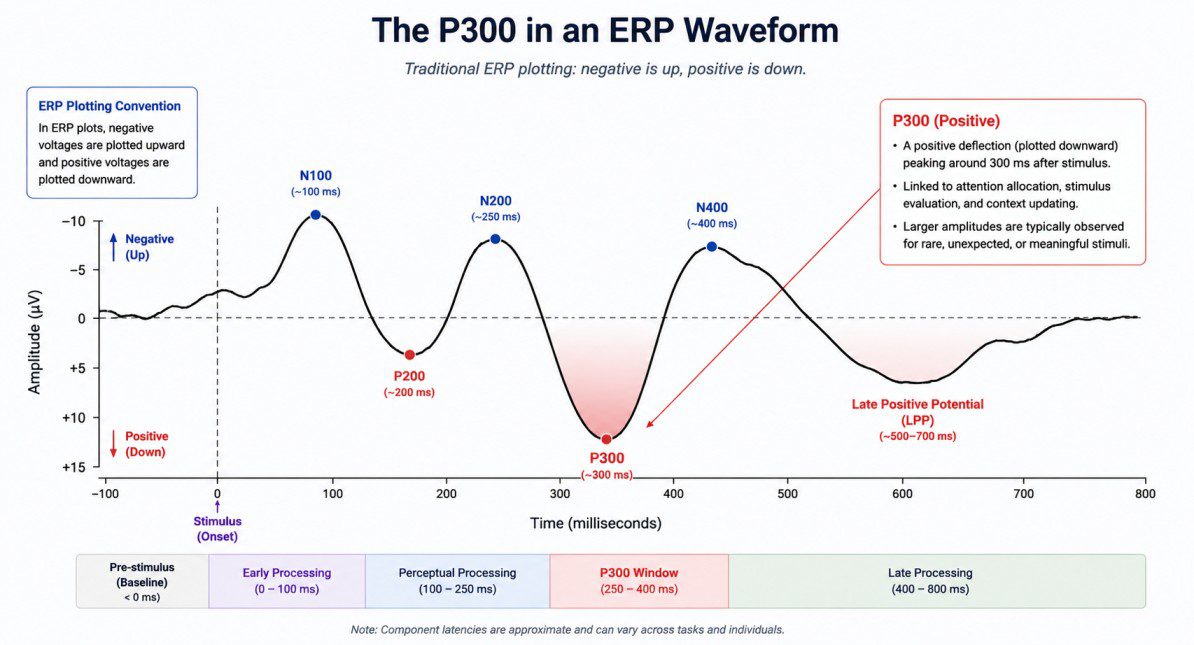
What is the P300?
Let's try to understand it in very simple words:
- P reflects a Positive voltage deflection
- The number 300 means appears approximately 300 milliseconds after a stimulus
- It was first discovered in 1965 by Sutton, Braren, Zubin, and John
- It is one the ERP components
- Seen when the brain encounters something rare, unexpected, or task-relevant
- P300 is measured most strongly at parietal electrodes (Pz) and the peak typically falls between 250–500 ms (not always exactly at 300 ms).
How is it measured?
Using the Oddball Paradigm:
- One of the standard ways to produce a P300 is using the "oddball paradigm"
- To achieve this you need to present a frequent stimulus (e.g., a low tone) repeated many times, for instance, 80% of trials.
- Later occasionally present a rare stimulus (e.g., a high tone), for 20% of trials.
- Now ask the participant to count or respond to the rare one.
- In case of rare stimulus this produces a large P300; whereas, the frequent one does not.
- However, in short, the rarer the stimulus, the larger the P300 response recorded.
The two sub-components:
- P3a: Is when there is automatic attention capture — "something changed!" - seen in the frontocentral region. This means that the person does not have to actively pay attention.
- P3b: reflects controlled attention and memory updating — "I need to process this" - captured by the parietal region. Implying that the person needs active engagement in the task.
For anyone who initially starts working with ERPs, P300 is the easiest one to identify. Even in my case during work it became my starting point into understanding how the brain prioritises information.
It reveals what the brain finds important before the person has time to consciously decide what they think. In consumer neuroscience, this is irreplacable.
P300 in Consumer Neuroscience
How Brands Use Your Brain's Attention Signal?
Here are some of the reasons where P300 becomes commercially powerful:
It Outdates the Surveys:
- When a person is asked "Which stimulus do you prefer?"people rationalise and their responses get biased.
- They automatically start considering colour, smell, social desirability, price etc and not their true, raw response.
- P300 is one which bypasses all of this and it captures what the brain ACTUALLY found attention-worthy.
- However, a stimulus that generates a larger P300 captures more cognitive resources, regardless of what the person says afterwards.
Uses of P300 in Ad Testing:
- Companies can display different versions of the same product ad while recording EEG.
- The ad element or the ad version that produces the largest P300 is the one that captured the most attention
- This helps companies or digital marketing firms to identify various factors like:
- Which scene in an ad is the most impactful part?
- Which product angle works best?
- Which packaging design stands out on a shelf, in a lot of multiple products?
- Most studies have revealed that the P300 amplitude to ads correlates with later purchase intent and brand recall.
P300 in Product Experience Testing
- Direct experience, when participants evaluate products (for example - textures or fragrances)
- P300 directly demonstrates which product created a stronger "this is different" type of response.
- Higher the P300 amplitude, greater the brain allocated more attentional resources to that particular product.
- Lower P300 latency simply means that there was a faster cognitive processing and more intuitive engagement
P300 and the Perception of Pricing
- Research shows that an unexpected price range generates a larger P300, when the price violates the consumers expectations.
- For example: a luxury brand priced low = surprise = large P300 OR a budget friendly brand priced high = surprise = large P300
- The unexpected price triggers a larger P300 response in both the cases because the brain is automatically comparing:
- Prior expectations,
- Brand reputation,
- Versus the actual price shown.
- A stronger P300 response therefore indicates:
- Greater surprise,
- Violated expectations,
- Or an increased attention toward the price.
- Later, brands or companies use this information to understand:
- To see if the pricing feels “right” to consumers,
- At times when a price creates confusion or distrust,
- And also how strongly consumers notice price inconsistencies.
- To conclude this simply implies that P300 tells us the exact moment when a consumer’s brain says, “That price does not match my prediction.”
Limitations in Consumer Neuroscience
- P300 demonstrates that the brain found something that grabs attention, but it does not imply whether the attention was good or bad
- It needs to be combined with other ERP measures like - LPP for emotion, alpha ERD for engagement to give us the combined picture.
- Lab settings for testing differ from the real using environment of a product and that creates an inherent bias.
In most neuroscience or psychology labs, P300 is one of the important outcome measures. It is used to check which product had a greater P300 and was it necessarily in favour of the product. Since, a large P300 could mean the brain found something surprisingly good OR surprisingly bad.
This is the reason why it is always combined with other ERP components like the LPP (which reflects sustained emotional processing) and alpha ERD (which reflects neural engagement). All of them together answer broader questions.
P300 in Clinical Diagnosis
What Hospitals or Doctors Learn From Your Brain's Response?
For cases of ADHD:
- In research studies, children with ADHD usually show significantly reduced P300 amplitude compared to controls
- Whereas, their P300 latency is often longer meaning slower cognitive processing
- One of the studies from Xi'an Children's Hospital found that P300 parameters at the Pz electrode could differentiate ADHD children from controls with high diagnostic accuracy.
- To complement behavioural assessments, P300 is currently being explored as an objective biomarker for ADHD diagnosis.
- It is just being used as a supporting tool, not a standalone diagnostic test until now.
In Epilepsy Research Studies:
- In patients with Epilepsy routine EEG doesn't capture cognitive impairment that P300 can.
- While routine EEG is normal, P300 can detect subtle cognitive changes.
- In epilepsy patients, reduced P300 amplitude correlates with attention and memory deficits.
- It is also useful for monitoring cognitive side effects of anti-epileptic medications.
- P300 also allows clinicians to distinguish epilepsy-related cognitive decline from normal variation.
Schizophrenia and P300:
- P300 is linked to attention allocation, detecting important events and updating information in working memory.
- However, when the P300 is reduced, researchers interpret it as evidence that the brain may be processing important information less efficiently.
- Because research from 1965 to 2025 consistently shows this pattern, it may reflect an underlying biological feature of the disorder and not just a temporary symptom.
- Therefore P300 reduction is called a biomarker associated with psychosis risk or schizophrenia.
- There is a P300 reduction present even in relatives of patients, suggesting a genetic component.
Association of Alzheimer's / Cognitive Decline and P300:
- The latency of P300 increases with age in normal older adults.
- Although in Alzheimer's disease, the increase is much steeper than expected in normal ageing.
- Latency of P300 can serve as an early biomarker of cognitive decline
- In addition to this, some clinics also use P300 to monitor treatment response in dementia patients.
P300 and Coma / Disorders of Consciousness
- In a comatose patient if we can see P300 in response to oddball stimuli, it suggests residual cognitive processing.
- It has crucial implications for prognosis and end-of-life decisions
- Presence of P300 response in an unresponsive patient may indicate potential for recovery.
- This is by far one of the most important clinical applications of P300.
My background in clinical neurophysiology gives me an idea of P300's medical applications. During my work as a Neonatal EEG Research Fellow, I saw how brain monitoring can guide critical treatment decisions for newborns.
P300 in most clinical cases of adults serves a similar purpose - it provides information into cognitive function that no questionnaire or interview can match.
P300 in the Real World - Labs and Projects:
Brain-Computer Interfaces (BCI) — P300 Spellers
- Letters appear on the screen and the user focuses on the letter they want
- When they see a target letter, the brain produces a P300 and the system detects which letter triggered the largest P300 and types it.
- This allows completely paralysed patients (e.g., ALS/locked-in syndrome) to communicate and most modern systems achieve 95-98% accuracy
- Active Labs Using P300: University of Sheffield (P300 BCI for elderly cognitive assessment), University of Málaga (speller size optimisation), and teams at Wadsworth Center (New York).
Lie Detection Research
- Brain Fingerprinting - Showing suspects crime-scene details they shouldn't know and if their brain produces a P300 to these details, they recognise them.
- It is used in limited legal cases in the US and India
- Indian courts have used P300-based tests (BEOS — Brain Electrical Oscillations Signature) in criminal investigations, though this remains controversial.
- Currently proven to be promising but not yet reliable enough for widespread legal use.
Neuromarketing Research Labs
- Behavior and Brain Lab (IULM University, Milan) which combines P300 with machine learning for consumer insights
- Neurons Inc. Denmark for commercial neuromarketing using EEG/ ERP including P300
- Various academic labs worldwide use P300 in ad testing, packaging design, and brand perception research.
Gaming and Neurofeedback
- It is also integrated into gaming for neurofeedback-based attention training.
- To train sustained attention in children with ADHD, some educational apps use P300 paradigms.
Summary
- P300 is a positive ERP component appearing ~300 ms after a rare and unexpected or task-relevant stimulus.
- Measured using the oddball paradigm.
- Reflects the brain's working memory updating and attention allocation.
- For consumer neuroscience fields answers which products, ads, or experiences capture the most brain attention bypassing conscious thinking and rationalization.
- In clinical cases, serves as a biomarker for ADHD, schizophrenia, epilepsy-related cognitive decline, Alzheimer's, and consciousness assessment
- BCI allows paralyzed patients to type using brain signals alone.
- Among the most studied ERP components in history, still the gold standard after nearly 60 years.
Frequently Asked Questions
- What does a large P300 mean?
A huge P300 amplitude response tells us that the brain allocated significant attentional resources to a stimulus. It also suggests the stimulus was unexpected, task-relevant, or cognitively significant. However, the attention could be either positive or negative, suggesting the stimulus was attention-worthy.
- Can P300 alone diagnose ADHD?
No, P300 is being explored as a supporting diagnostic tool for ADHD, because children with ADHD typically show reduced P300 amplitude and longer latency. However, it is not yet used as a standalone diagnostic test, it merely complements behavioural assessments and clinical interviews.
- How is P300 used in BCI?
In BCIs, letters flash on a screen while the user focuses on their target letter. When the target flashes, the brain produces a P300. The system detects this signal and types the corresponding letter. This allows people with severe motor disabilities, such as ALS, to communicate.
Unlike alpha or beta, P300 is not a continuous brain wave. It is an ERP, a brief electrical response that occurs in reaction to a specific stimulus. Brain waves are continuous whereas, it is a momentary spike triggered by a specific event.\
Written and Curated By - Vaishnavi Bagayi (EEG Research Associate)
References:
- [1] Polich, J. (2007). Updating P300: An integrative theory of P3a and P3b. Clinical Neurophysiology, 118(10), 2128-2148. https://pubmed.ncbi.nlm.nih.gov/17573239/
- [2] Sur, S., & Sinha, V. K. (2009). Event-related potential: An overview. Industrial Psychiatry Journal, 18(1), 70-73. https://pubmed.ncbi.nlm.nih.gov/21234168/
- [3] Tan, C., et al. (2025). P300 event-related potentials as diagnostic biomarkers for ADHD in children. Frontiers in Psychiatry, 16. https://www.frontiersin.org/articles/10.3389/fpsyt.2025.1590850/full