What is the N170? How Your Brain Recognises Faces in 170 Milliseconds
When you are walking on a crowded street, within a few seconds, your brain has already identified every face, differentiating them from vehicles, shops, lanes, and every other visual object. This happens very effortlessly without your conscious awareness about it.
The processing happening in your brain behind the scenes is incredibly fast; around 170 milliseconds after you see a face, your brain produces a distinct electrical signature. However, on the screen, we can see a sharp negative dip called the N170.
In short, this is your brain signaling that it is a face and it has processed it differently in comparison to other visual objects in the environment. This wave is one of the most reliable and face-specific brain signals that is used in studies. It tells us how human perception works. In this article we will explore N170 in detail.
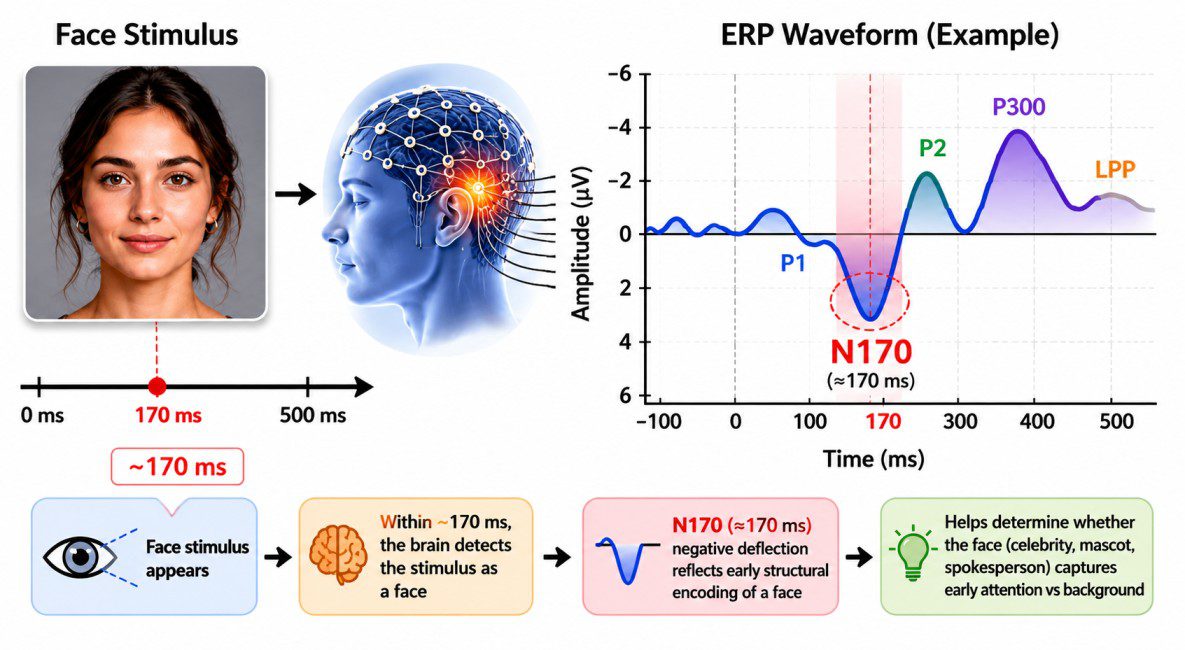
What is the N170 component?
Let us understand the naming in simple terms:
- N denotes a negative voltage deflection and 170 because it appears approximately 170 milliseconds after seeing a face.
- It is one of the ERP components and appears specifically and most strongly in response to FACES
- Whereas, other objects (cars, houses, tools) produce a much smaller response at this time point
- Captured more strongly at the occipitotemporal electrodes (P7, P8, PO7, PO8).
- Located in the fusiform gyrus and inferior temporal gyrus, the brain regions known as the "face processing network"
What makes N170 special:
- It shows that the brain responds to faces, but it also responds DIFFERENTLY to faces than to anything else.
- The N170 produces a larger, more negative, and slightly earlier response for faces compared to non-face objects.
- It is one of the clearest "category-selective" brain responses ever found.
Why Does the Brain Treat Faces Differently?
- Since birth, neonates have shown a strong preference for face-type patterns.
- Faces also hold a special status in the human brain.
- Humans can extract identity, emotion, age, gender, trustworthiness, and intention all from a human face.
- From an evolutionary perspective, the brain has a dedicated, specialized neural mechanism for face processing.
- The temporal lobe, namely the fusiform face area (FFA), is selectively connected to faces.
Configural processing theory:
- The theory tells us that the faces are configurally processed, meaning processed as a whole pattern and not as individual features.
- If you have ever thought about it, you never see "two eyes, a nose, a mouth" separately; your brain sees the GESTALT (something that is made of different parts but is seen as a whole.)
- While recognizing an upside-down house is easier than recognizing an upside-down face.
- Proof to this is that inverted faces produce a LARGER and LATER N170 because the brain struggles when configural processing is disrupted
- However, this “face inversion effect" on the N170 wave is one of the strongest pieces of evidence for face-specific processing.
Factors Affecting the N170 Response:
- Face vs Non-Face Objects
- As already discussed, faces consistently produce a larger N170 than cars, houses, furniture, and animals.
- Although some schematic face drawings, like smiley faces, also produce some N170 responses.
- This narrative is not only true for faces but also true in the case of words and letters, which produce an N170-like response. This suggests that the component is involved in processing "expert" visual categories, not just faces.
- Upright vs Inverted Faces
- The classic "face inversion effect": the inverted (upside-down) faces produce a delayed and larger N170
- Nevertheless, proving that N170 is sensitive to how the brain configures facial features.
- Emotional Expression
- Fearful faces produce a larger N170 than neutral faces because the brain prioritizes detecting threat-related expressions more sensitively.
- The above-mentioned theory was once debated, that the traditional view said N170 only reflects structural encoding, not emotion. On the contrary, multiple studies now confirm emotional modulation.
- Familiarity
- One among the controversial factors is familiarity—some studies suggest that N170 is NOT affected if the face is familiar or unfamiliar
- Studies also suggest that self-face vs. stranger-face differences appear in later components like P200 and N250 and not always at N170.
- Nonetheless, in some paradigms, it is seen that self-faces can modulate N170 amplitude
- The familiarity factor has implications for self-awareness research.
- Age and Development
- Neonates do not show an adult-like N170. As an alternative, they show related components: the N290 and P400
- That said as the visual system matures, these gradually develop into the adult N170
- N170 starts becoming fully adult-like by late childhood/adolescence.
Self-Face Recognition and N170:
What Happens When You See Your Own Face?
- Among the most interesting questions: Does the brain respond differently to your own face vs someone else's?
- Since one's face is the most personally significant visual stimulus that an individual can encounter.
- There is ambiguity in various research findings; some studies show N170 differences for self-face, whereas others don't.
- The scientific disagreement is: Does self-recognition happen at the structural encoding stage (N170) or later?
- Preliminary evidence suggests that self-face processing engages additional frontal areas and later ERP components (P200, P300, LPP).
In my routine work, I have seen how people engage with their own face versus someone else's face. For this, we measured five ERP components, including the N170.
Something that I found particularly interesting is how self and unfamiliar faces created distinct neural patterns. The N170 demonstrated that the brain's initial structural encoding of faces was intact across conditions. While later components revealed where the real differences in self vs. other processing emerged.
While working with a face as a stimulus, it helped me understand that the difference between “detecting a face” and "recognizing it as yours” happens in stages.
To simply state, the N170 handles the first part by instantly identifying the stimulus as a face. Although the role of personal significance of that face emerges later, particularly in the P300 and LPP time windows.
Real-World Uses of N170:
- Autism Spectrum Research
- ASD individuals often show atypical N170 responses to faces
- A delayed N170 latency and reduced specificity to face.
- However, it also reveals differences in early face processing, which may point towards social communication challenges.
- Currently being explored as a potential early biomarker for ASD in infants.
- In the case of neonates, N290/P400 shows atypical patterns; it could flag developmental risk before behavioral symptoms appear.
- Face Blindness (Prosopagnosia)
- People with face blindness cannot recognise faces despite normal vision
- Acquired prosopagnosia caused due to brain injury shows a severely reduced N170 or may be absent.
- Developmental prosopagnosia, meaning neonates born with it, N170 is often present but may lack normal face specificity.
- This distinction in face perception reveals that N170 reflects face DETECTION; nevertheless, full recognition requires additional downstream processing.
- Forensic and Security Applications
- There is ongoing research on using N170 for identity verification.
- Even though debatable, we know that the brain's N170 response to a known face differs from the response to unknown faces in certain paradigms.
- Could potentially be used in security contexts, yet it is in its experimental stages.
- Very similar in concept to P300-based lie detection but primarily focused on visual recognition systems.
- Consumer Neuroscience and Advertising
- In an ad, when a brand mascot, celebrity endorser, or spokesperson is included N170 reveals if the brain instantly allocated its early visual attention to it.
- If a product ad features a human face, N170 confirms the face captured early visual processing. This helps understand whether the face or the product draws attention first
- Cross-Cultural Face Processing
- The effect of other races: people are better at recognizing faces from their own racial group.
- Studies which used N170 show differences in processing own-race vs other-race faces
- This has future implications for eyewitness identification research
N170 Research Perspective:
Among all the ERP components that I have worked with so far, N170 has the clearest 'personality. 'It is very consistent; you show a face, and there it is at 170 ms, every time, in every participant. This reliability factor makes it an important research tool.
With all the experiments conducted, I have learned that N170 is just the beginning; the real insights often come from what happens after N170, in the P300 and LPP windows.
In short, N170 confirms the brain detected a face, and the later components tell you what the brain did with that face stimuli information, whether it paid attention, felt emotion, or recognized personal significance.
The sequence from detection to attention and meaning is the fundamental basis of how we perceive the social world. And all of it starts with a small negative dip at 170 milliseconds.
References
- Bentin, S., Allison, T., Puce, A., Perez, E., & McCarthy, G. (1996). Electrophysiological studies of face perception in humans. Journal of Cognitive Neuroscience, 8(6), 551-565. https://pubmed.ncbi.nlm.nih.gov/20740065/
- Eimer, M. (2011). The face-sensitive N170 component of the event-related brain potential. In The Oxford Handbook of Face Perception. Oxford University Press.
- Blau, V. C., Maurer, U., Tottenham, N., & McCandliss, B. D. (2007). The face-specific N170 component is modulated by emotional facial expression. Behavioral and Brain Functions, 3(7). https://pubmed.ncbi.nlm.nih.gov/17244364/
Summary:
- N170 is the brain's earliest face-specific electrical response
- It is a negative ERP component emerging ~170 ms after seeing a face.
- Among the brain's earliest face-specific electrical response
- Captured by the occipitotemporal electrodes and it is located in the fusiform gyrus
- It is larger and earlier for faces than non-face objects
- Gets modulated by face inversion, emotional expression, and visual expertise
- Applied in autism research, prosopagnosia studies, self-face recognition, and consumer neuroscience
- N170 reflects face detection; recognition of who the face belongs to happens in later ERP stages
Frequently Asked Questions
N170 is a negative brain response seen ~170 ms after seeing a face, whereas P300 appears ~300 ms after any attention-worthy stimulus and reflects attention allocation and cognitive evaluation. N170 says this a face and P300 helps in evaluating if that face is important/surprising
- Does N170 respond to photos and drawings the same way?
Although N170 responds strongest to realistic photographs of faces, it also responds to schematic faces, cartoon faces, and even face-like patterns. To simplify, the response is strongest when the stimulus has a clear face-like configuration, two eyes above a nose above a mouth.
- Can N170 be used to diagnose autism?
Abnormal N170 characteristics are seen in many studies of individuals with ASD, including delayed latency and reduced face-specificity. There is ongoing research if infant N170 equivalents (N290/P400) could serve as early biomarkers. Nevertheless, N170 is not yet a clinical diagnostic tool; it remains a research measure.
- Does the brain process familiar and unfamiliar faces differently at N170?
This topic remains controversial as many studies find that N170 is similar for familiar and unfamiliar faces, suggesting it reflects face detection rather than recognition. Although some studies do show small N170 modulations for self-faces or highly familiar faces. The clearer familiarity effects appear in later components like N250 and P600.