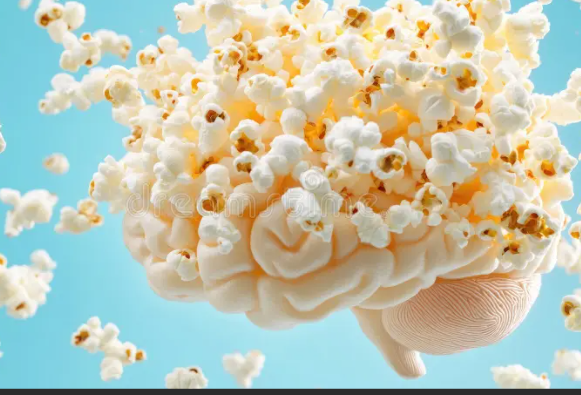
Are you also one among those who opens their phone to check one message and 30 minutes later you are in a rabbit hole of Instagram. Following this you are shopping for scented candles, watching cat videos, and wondering why you picked up your phone in the first place? If all of these sounds familiar to you, congratulations (or maybe condolences), you might have Popcorn Brain Syndrome. Yes, you read that right.
In today's age our brains are constantly jumping from one app, one thought, one notification to the next, like the popcorn seeds bouncing in hot oil. We are unknowingly and unwillingly scrolling, swiping, tapping and refreshing endlessly, chasing the next dopamine hit. Therefore, our attention spans, focus, and memory are taking a serious hit. Why, Popcorn Brain concept becoming so common, and how can you stop your mind from constantly “popping”? Let's read the complete article to know more.
Popcorn Brain is described as the state of mental hyperactivity and distraction caused by constant digital stimulation. The term was coined in 2011 by University of Washington researcher David Levy.
Making it harder to stay focused, remember things, or feel calm, like popcorn seed popping in rapid speed, our thoughts keep jumping from one topic to another.
There are rising alarms about the effects of digital overload, as screen time has skyrocketed among both youngsters and adults.
From multiple notifications to binge-watching our brains are being rewired to crave for more screen time.
Neuroscience Behind Popcorn Brain:
As described by Clinical Psychologist and Founder of Headspace Healing, Dr Jaya Sukul,
“Popcorn Brain isn’t your brain literally popping. It’s the sensation of your neural circuits being overstimulated by constant digital inputs.”
Life seems slower than the rapid-fire pace of the internet, and this constant overstimulation makes people feel restless when they are offline.
Neuroscientists say that these stimulations deliver a dopamine hit, the same neurotransmitter that fuels addictive behaviors.
The brain in turn learns to expect more of these quick bursts of pleasure, reinforcing compulsive checking habits.
Why Brains Crave Digital Stimulation?
Social connection is getting wired into the human brain. This social connection triggers a rush of feel-good chemicals with every like, comment, or notification on social media taps into our primitive need for social reinforcement.
Instant rewards: You get a hit of dopamine (the brain’s reward chemical) and oxytocin (the bonding hormone), each time you check your phone.
Algorithmic hooks: To keep us scrolling by showing emotionally charged, hyper-relevant content, social media platforms and websites use personalized algorithms.
Information incentives: Reinforcing the scroll-refresh-scroll loop, the quick gratification of seeing something new every few seconds tricks our brain into craving more.
In other words, the more you keep scrolling, the more your brain wants to keep scrolling.
The Impact on Focus and Memory
Gloria Mark, University of California researcher Gloria Mark, in her book Attention Span, reveals that our attention span has dropped from 2.5 minutes in 2004 to just 47 seconds in recent years. This implies that most of us switch tasks more than 20 times per hour, a habit which leads to:
Lesser productivity
Higher levels of stress and fatigue
Impaired memory retention
Difficulty in sustaining deep thoughts
Digital Reference Library’s DataReportal’s, the 2024 Global Overview Report found that Americans now spend over seven hours per day on screens. This is equivalent to 17 years of an adult's life. Nearly a fifth of our lifetime is lost to scrolling, tapping, and clicking.
For constant engagement, popcorn Brain thrives in an environment designed for constant:
Real-time notifications and Infinite scrolls keep our attention span fragmented.
Algorithms and Targeted ads have exploited curiosity, made interactions shallower and rewarding quicker.
Multitasking between apps and work instead of sustained focus has trained our brain to favor short bursts of stimulation.
This pattern over time has rewired cognitive circuits, encouraging passive consumption overactive engagement. It has also worsened skills like decision-making, learning, and emotional regulation.
Why Isn’t Multitasking Helping?
We believe that we can multitask, jump between messages, emails, and work, but neuroscience says otherwise.
Switching between tasks uses a significant amount of cognitive energy and leads to attention fatigue, the brain is not built for multitasking.
Every time we try to shift our focus, from maybe a spreadsheet to a text, for example, our brain needs to refocus, this takes time and drains our mental resources. Switching attention is expensive.
It is a vicious cycle of distractibility creating more distractibility. The more our attention is fragmented, the easier it becomes to get distracted again. Distractions create more distractions.
This constant mental ping-ponging, over time, makes it harder to focus deeply, feel mentally rested, or even remember information.
How to Regain Focus in a Distracted World?
It is not difficult as it may seem to be, you can use technology to your advantage, instead of letting it control you. Here’s how you can achieve it:
1. Use Focus Mode and Notification Filters
On your smartphone, enabling Do Not Disturb or Focus Mode.
Silence all but essential notifications, choose specific time blocks (e.g., during work hours or before bed). This will reduce the urge to check every alert.
Your phone will block them after you hit your quota, if you set daily time limits for social media apps.
Keep your phone away in the designated tech-free zones, like while having meals, meetings, or study sessions.
Digital detox weekends will give you a full break, help rebalance dopamine levels and reduce mental clutter.
These simple tweaks drastically help your brain stay in single-task mode and reduce interruptions.
2. Practice Mindfulness with Your Tech
Placing your phone out of reach or even placing it in another room reduces temptation.
Return to your task without judgment, this will strengthen your attention muscle over time and help in refocusing your attention.
Monitor how long you can concentrate before drifting and gradually increase it.
Cultivate self-awareness by being honest about your attention capacity and plan around it.
In a distraction-free environment, set a consistent routine, work on one task at the same time each day, add mindfulness or brief exercise to refresh mental clarity between sessions.
If you need to structure your habits, try the Pomodoro Technique:
25 minutes of completely focused work
Keep 5-minute breaks
Take a longer break of 15–30 minutes, after 4 rounds.
To work with focus, this rhythm trains your brain and not against it.
Overview:
Popcorn Brain is not a medical term, nor is it a neurological disease, but it’s a modern world's mental reality and cognitive consequence of modern living. Digital life overwhelms the senses, it fragments thought, impairs memory, and heightens anxiety. Always the first step towards anything worrisome is awareness. You can train your brain to slow down, refocus, and reconnect with the real world, by creating tech boundaries, using focus tools, and practicing mindfulness. We can restore balance and prevent our minds from popping out of control.