Why Is Your Brain Always Negotiating?
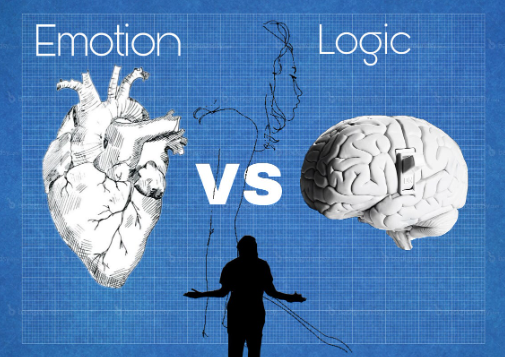
Do you also experience ambiguity while deciding something? What food do you want to order? What clothes do you want to purchase? Every choice you make is influenced by an internal battle between two powerful neural systems: Logic and Emotion. This battle between logic and emotions is called the neural tug-of-war, determining how you think, act, react, and make decisions.
You will always hear people saying that they are either “logical” or “emotional,” but neuroscience has a different perspective to offer. Neuroscience says that your brain is designed to use both, constantly negotiating between rational analysis and emotional instinct. In this article below let us read to know how the brain balances Logic and Emotion, and why these systems sometimes clash.
Where does Logic Live in the Brain?
The prefrontal cortex (PFC), specifically the dorsolateral prefrontal cortex (DLPFC) is the region responsible for logic, reasoning, and deliberate thought.
The DLPFC region handles planning, problem-solving, evaluating consequences, resisting impulses, critical thinking and long-term decision making. It also represents itself as the “rational” voice inside the brain. Thus, the PFC is deliberate, slow and expensive in terms of energy.
Where does Emotion Live in the Brain?
Emotion is handled by three systems:
- Amygdala is responsible for fear, threat and emotional reactions.
- Insula handles your gut feelings, discomfort and intuition.
- Ventral Striatum looks after reward, pleasure and desire.
The emotion processing systems are fast, instinctive, and automatic. They prioritize survival, immediate rewards, threat detection and emotional memory. Therefore, the emotional brain reacts in milliseconds faster than the rational brain.
The Neuroscience Behind the Conflict:
This process has been described by neuroscientists using the logic–emotion interaction using dual-process models of cognition, where fast, automatic systems (emotion-driven) coexist with slower, reflective systems (logic-driven). The brain constantly tries to maintain a balance between speed - accuracy, safety - flexibility.
The two systems start competing and send signals as fast as they can, when you have to make a decision.
- The amygdala says, “Act now! This feels urgent!”
- The prefrontal cortex then replies: “Slow down. Think and analyze the consequences.”
This internal battle between the Amygdala and the Prefrontal Cortex becomes more intense when the decisions involve relationships, money, fear or uncertainty, reward vs delayed gratification, moral dilemmas and risk-taking behavior. The fastest system at that moment decides your action.
When Emotion Wins:
From the perspective of evolution this once kept humans alive. Emotion usually overtakes logic when you are stressed, tired, excited or afraid. The reward is immediate, when a situation feels threatening and the social pressures are strong.
Pushing you into impulse decisions, fear-based reactions, emotional outbursts, regretful purchases, overeating and fight-or-flight responses, the amygdala takes control in milliseconds.
Therefore, this is the reason why people make poor decisions when overwhelmed.
When Logic Wins:
Logic dominates when you have time to think, the environment is calm, there is low emotional pressure, you activate your analytical skills, and you consider long-term goals.
The PFC (prefrontal cortex excels) at delaying gratification, evaluating options, solving complex problems and overriding emotional impulses
Requiring active effort, the PFC is slower than the emotional brain.
The Secret of Co-Existing Logic and Emotion:
Both of them are supposed to work together because the goal is not to eliminate emotion or logic either of them. Emotions usually guide us towards values, motivations, intuition, and social understanding.
The most accurate or best decisions come when emotion provides meaning and logic provides structure. Thus, together, they create balanced and intelligent behavior.
With the prefrontal cortex damage people may act impulsively and people with reduced emotional processing (due to trauma) may struggle to make choices or form relationships.
Logic vs Emotion in the Brain:
|
Feature |
Logic |
Emotion |
|
Handled By |
Prefrontal Cortex |
Amygdala and the Limbic System |
|
Processing Speed |
It is slow and deliberate. |
The speed is fast and automatic. |
|
Purpose |
Best suited for Long-term planning. |
In case of Survival & immediate reactions. |
|
Strengths |
It helps in analysis, control, reasoning |
Good at intuition, motivation and quick detection |
|
Weaknesses |
It takes time and has a high energy demand |
Can overwhelm logic and impulsive |
|
Dominates When |
Situations are calm, stable and less stressful. |
During high stress, reward, fear and excitement |
|
Areas responsible |
DLPFC (Dorsolateral), VLPFC (Ventrolateral) |
Amygdala, Insula and Striatum |
|
Decision Type |
Rational and calculated. |
Emotional and instinctive. |
FAQs About Logic and Emotion:
- Why is logic overpowered by emotion?
This happens only because the prefrontal cortex needs time to analyze whereas the amygdala activates in milliseconds. Thus, the emotional brain reacts much faster than the logical brain.
- Can a person rely only on logic?
Not effectively because emotion gives decisions meaning, motivation, and social awareness. And in most cases people without emotional processing struggle with empathy and decision-making.
- Why do I make impulsive decisions when stressed?
Making logic harder to access, stress hormones suppress the prefrontal cortex and boost the emotional brain.
- Is intuition emotional or logical?
Built from patterns stored in the brain, intuition is often emotional, but through experience and training it can become more accurate.
- How can I strengthen logical thinking?
Strengthening the prefrontal cortex by sleeping well, practicing mindfulness, reducing chronic stress, engaging in problem-solving tasks and taking a pause before reacting. This in turn strengthens the logic.
- Is emotional decision-making always bad?
No, not always. Emotions help you to navigate relationships, detect danger, and understand your values. Balance between logic and emotion is the key.
Conclusion:
The conflict between Logic and Emotion is a feature of human design and not a flaw.
While logic keeps you rational and forward-thinking, emotion keeps you alive, connected, and motivated.
The real power is activated truly only when the two systems collaborate, not compete.
Understanding the neural tug-of-war between Logic and Emotion helps you make smarter choices, manage impulses, and improve emotional intelligence.
Explore Relevant Brain Mechanism Topics: