Cognitive Restructuring Worksheet: Step-by-Step Guide to Challenging Negative Thoughts
Cognitive restructuring is one of the main techniques used in Cognitive Behavioral Therapy (CBT). It is designed to help people identify, challenge, and replace unhelpful or distorted thoughts. The worksheet provides a structured way to work through these distorted thoughts and develop more balanced, realistic perspectives.
The cognitive restructuring worksheet is commonly used by therapists. It can also be helpful for individuals who want to better understand their thinking patterns and emotional responses. Let's read through the article to know more about cognitive restructuring.
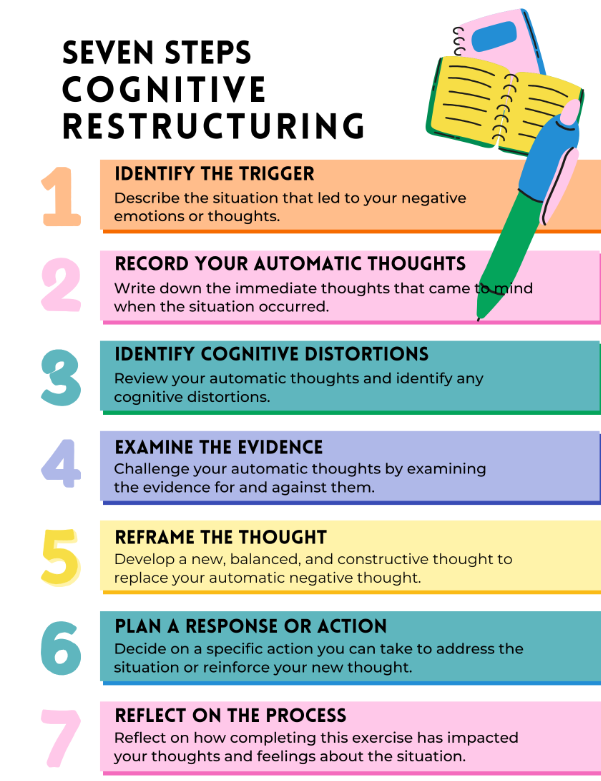
Click Here to download the Cognitive restructuring worksheet.
What Is Cognitive Restructuring?
Cognitive restructuring is a CBT strategy that contributes to emotional distress such as anxiety, sadness, frustration, or overwhelm and it focuses on changing unhelpful thinking patterns.
CBT is strongly based on the idea that:
- Our core beliefs are influenced by our thoughts
- Our thoughts influence our behaviors and emotions.
When certain thoughts, especially negative or inaccurate ones, repeat over time, they can distort how we see ourselves, others, and the world. These distorted thought patterns are known as cognitive distortions.
Cognitive restructuring, as a technique, helps individuals to slow down, examine their thoughts, and replace them with more helpful alternatives.
Common Cognitive Distortions
Some of the frequently seen cognitive distortions include:
- Catastrophizing means assuming the worst possible outcome
- All-or-nothing thinking: Seeing things as total failure or complete success. The black or white kind of thinking.
- Emotional reasoning: Believing in something that it is true only because it feels true.
- Minimization or magnification: Exaggerating negatives and downplaying positives.
- “Should” statements: Forming rigid rules about how things should be. Nonflexible behavior.
In these cases, a cognitive restructuring worksheet helps bring awareness to these patterns and gently challenges them.
What Is a Cognitive Restructuring Worksheet?
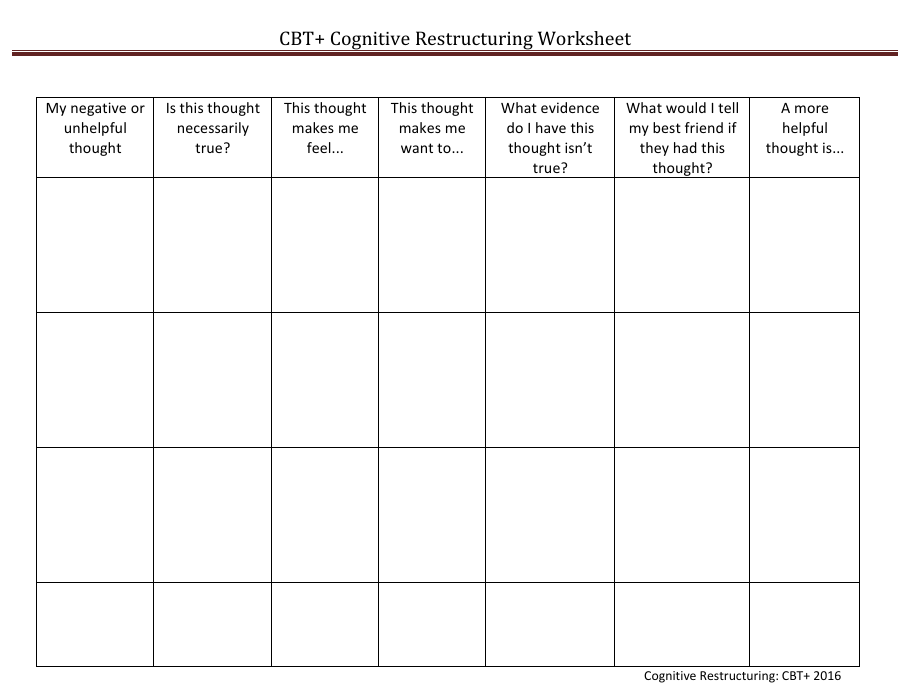
A cognitive restructuring worksheet is a guided and elaborate tool. It takes a person through the process of identifying an upsetting situation, examining the thoughts behind it, and later developing a more balanced way of thinking. Over time, it encourages reflection rather than judgment and supports emotional regulation.
CBT+ Cognitive Restructuring Worksheet
Steps in a Cognitive Restructuring Worksheet
Most of the cognitive restructuring worksheets follow the steps mentioned below:
1. Identify the Upsetting Situation
Try to describe the situation in detail that triggered distress. The situation could involve an interaction, event, or internal thought.
2. Identify Feelings and Emotions
During this event, note the emotions experienced like anxiety, sadness, anger and their intensity.
3. Identify Automatic Thoughts
Write down all the thoughts that come up. And check whether the thoughts reflect a cognitive distortion.
4. Examine the Evidence
In this scenario now ask yourself whether the thought is completely accurate. Introspect for evidence for and against the thoughts.
5. Generate Alternative Thoughts
Develop a realistic or more balanced way of viewing the situation.
6. Plan a response or action
Plan a specific response or action to address the thoughts or reinforce new thoughts
7. Reflect on the process
Later on, reflect how completing this process helped you to deal with distortion of thoughts.
What Is Socratic Questioning?
Alongside cognitive restructuring, Socratic questioning is a CBT technique often used. To help individuals examine their beliefs and reach new insights on their own, it involves asking thoughtful, open-ended questions.
Socratic questioning helps clients:
- Reflect more deeply
- Reduce extreme or rigid thinking
- Consider alternative perspectives
Examples of Socratic Questions:
Socratic questioning worksheets includes prompts such as:
- When was the first time this thought occurred?
- Is there another way to interpret this event?
- What evidence supports this thought?
- What would you say to a friend in this situation?
- What evidence goes against it?
The goal is to understand it more clearly and not to argue with the thought.
Other CBT Worksheets Related to Cognitive Restructuring
Alongside other CBT tools, cognitive restructuring worksheets are often used, such as:
- Cognitive distortions worksheet – Helps identify common thinking errors.
- Core beliefs worksheet – Assists in exploring deeper belief systems.
- Thought record worksheet – Tracks emotions, thoughts, and behaviors.
- CBT worksheets for anxiety – Focus on fear-based and worry thinking
Also read more about brain and its creativity - Click Here
How to Use a Cognitive Restructuring Worksheet
In different ways, individuals and therapists can use these worksheets:
- To guide discussion, during therapy sessions
- About cognitive distortions as psychoeducation.
- For self-reflection, as a take-home exercise.
- For emotional processing and journaling.
Consistency is the key, over time, regular practice helps make balanced thinking more automatic.
Sample Cognitive Restructuring Questions
What typical worksheet questions look like:
- What is the thought?
- Is there a more helpful way to view this?
- Is this thought factual or an assumption?
- What might someone else say about this situation?
- What evidence supports or challenges it?
Final Thoughts
For building awareness around thought patterns, a cognitive restructuring worksheet is a powerful yet simple tool. Individuals can reduce emotional distress and respond to situations more effectively, by learning to question unhelpful thoughts rather than automatically believing them.
Cognitive restructuring helps create greater emotional flexibility, self-compassion, and resilience, over time.
Frequently Asked Questions (FAQ)
What is a cognitive restructuring worksheet?
It is used to identify unhelpful thoughts, evaluate their accuracy, and replace them with more balanced and realistic alternatives. It helps reduce emotional distress by changing negative thought patterns.
How does cognitive restructuring work in CBT?
By helping individuals recognize cognitive distortions, examine evidence for and against their thoughts, and develop healthier ways of thinking, cognitive restructuring works. This process improves emotional regulation and coping skills, over time.
Who can use a cognitive restructuring worksheet?
The worksheets can be used by counselors, therapists, and individuals. Many people also use them independently for self-reflection, stress management, and emotional awareness, although it is commonly used in therapy.
What types of thoughts can cognitive restructuring help with?
Cognitive restructuring as a technique can be helpful with thoughts related to depression, anxiety, stress, self-doubt, perfectionism, and negative self-talk. Useful especially for addressing cognitive distortions such as catastrophizing and all-or-nothing thinking.
Is cognitive restructuring effective for anxiety and depression?
Cognitive restructuring is a well-established CBT technique shown to be effective in reducing symptoms of anxiety and depression. It works by helping individuals challenge unhelpful thinking patterns.
What is the difference between cognitive restructuring and positive thinking?
Cognitive restructuring does not focus on forced positivity, but it focuses on realistic and balanced thinking. Rather than simply thinking positively, the goal is to replace inaccurate or unhelpful thoughts with more accurate perspectives.
How often should I use a cognitive restructuring worksheet?
The cognitive worksheet can be used as many times as needed. Especially when experiencing strong emotions or recurring negative thoughts, many people find it helpful to practice regularly.
What is Socratic questioning in cognitive restructuring?
To encourage reflection and critical thinking, Socratic questioning is a technique used in CBT that involves asking open-ended questions. It helps individuals consider alternative viewpoints and examine the validity of their thoughts.
Can one use the cognitive restructuring worksheet without a therapist?
Yes, many people on their own use cognitive restructuring worksheets. Especially for more complex or persistent emotional challenges, working with a therapist can provide guidance, deeper insight, and support.
Are cognitive restructuring worksheets suitable for all mental health conditions?
Cognitive restructuring worksheets may not be appropriate for everyone but are helpful for many situations. Under the guidance of a qualified mental health professional, individuals with severe mental health concerns should use these tools.
- INTP Cognitive Functions: Into the Ti–Ne Mind
- Addenbrooke’s Cognitive Examination (ACE)
- Neurotypical Meaning: What It Really Means in Neuroscience
- Sluggish Cognitive Tempo (SCT): Understanding Cognitive Disengagement Syndrome (CDS)
- Cognitive Empathy: Neural Mechanisms, Functional Roles, and Development
- Brain on Fire Condition: Anti-NMDA Receptor Encephalitis
- Jean Piaget’s Theory of Cognitive Development