Cognitive Polarity: Why Some Minds Think Only in Extremes
Cognitive polarity is the tendency of some individuals to keep swinging between psychological extremes of thoughts and beliefs. A psychological thinking pattern in which the mind interprets experiences in extreme, opposing categories rather than on a continuum. Very closely related to black-and-white thinking, all-or-nothing cognition, and certain cognitive distortions described in cognitive psychology.
Individuals with cognitive polarity tend to evaluate situations, relationships, and decisions as success or failure, good or bad, safe or dangerous, leaving little room for nuance. Most of the human brains try to keep a balance of thoughts, they live comfortably in the middle, some minds operate at psychological extremes — rapidly swinging between opposing beliefs, emotions, or desires.
According to psychology, this pattern often develops as a protective adaptation, shaped by emotional sensitivity, early conditioning, trauma, or chronic stress. It is not a mental disorder but it can significantly affect emotional regulation, relationships, and decision-making. Through this article let's explore the meaning of cognitive polarity, its impact on daily life and relationships, and evidence-based ways to reduce its intensity and move toward balance.
Key Takeaways
Cognitive polarity is the tendency to rather think in psychological extremes than have a balanced view of life.
It often develops from emotional sensitivity, early conditioning or trauma.
It can impair relationships and emotional health, while protective in origin.
Cognitive polarity can be reversed through mindfulness, awareness, and therapy.
Balance does not mean perfection, it means allowing self-compassion and nuance.
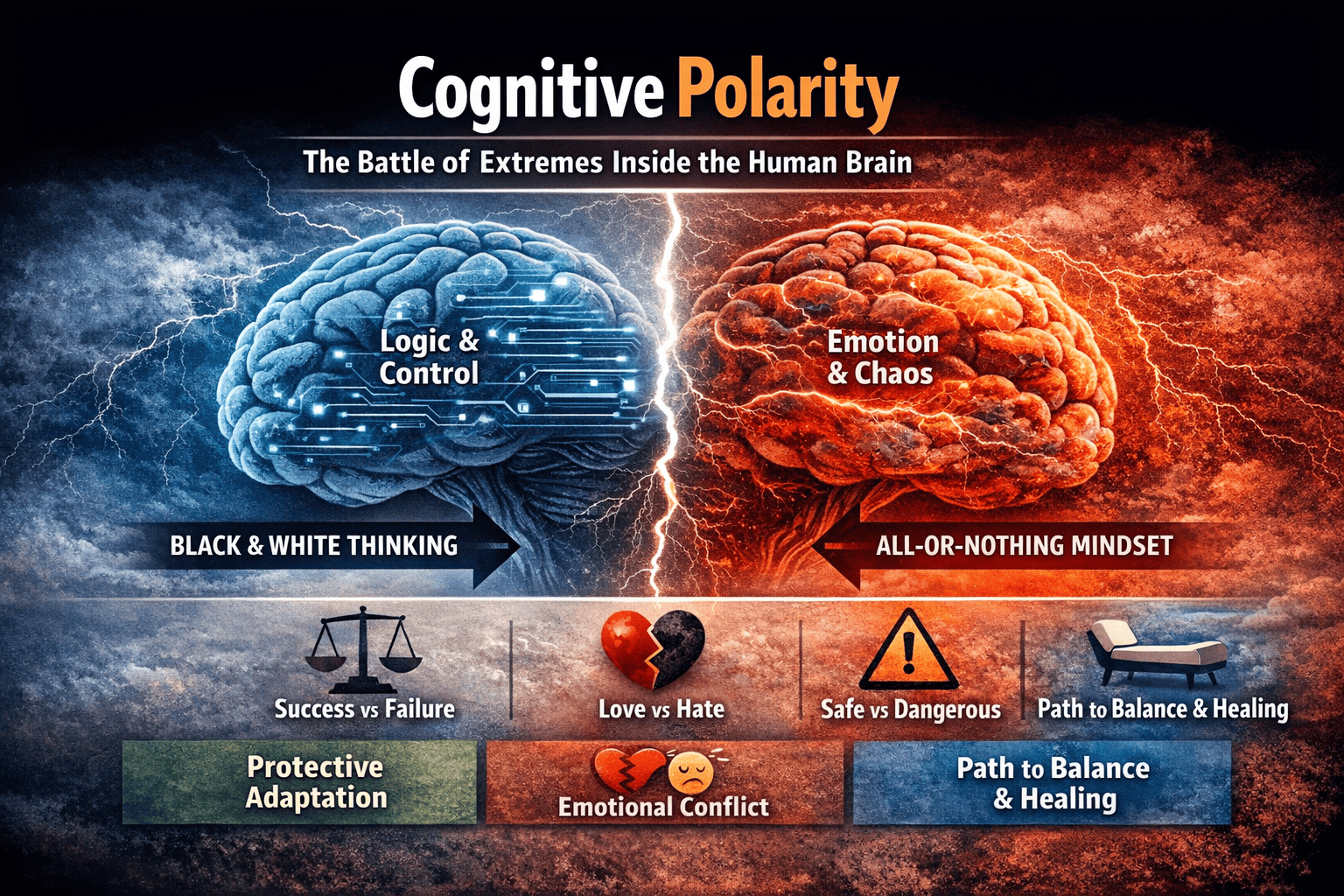
Cognitive polarity is the tendency of the human brain to swing between opposing mental extremes, such as control vs chaos, certainty vs doubt, or logic vs emotion.
What Is Cognitive Polarity? (Psychological Meaning)
Cognitive polarity is the persistent tendency of the mind to organize thoughts, emotions, and decisions into binary opposites rather than graded possibilities; think and belief that there are only two possibilities. The mind splits experience into opposing categories instead of perceiving situations on a spectrum, such as:
Success vs Failure
Love vs Hate
Desire vs Fear
Attachment vs Avoidance
Right vs Wrong
Cognitive polarity often overlaps with polarized thinking the all-or-nothing thinking, or what is famously called the black-and-white thinking. However, cognitive polarity does not limit itself towards momentary thought errors and extends beyond that. Often shaped by early experiences, emotional sensitivity, and survival-based adaptations, it reflects a deeply ingrained mental style.
The Battle of Extremes Inside the Mind:
For individuals with such thoughts, it feels like being pulled in two directions at once. While simultaneously fearing or rejecting it, the individual may strongly desire something. This battle between extremes creates mental fatigue and chronic tension.
The dominant experience is inner opposition, rather than uncertainty. Choosing only one side feels like betrayal to the other. And not able to choose feels equally painful. Over a period of time, this mental tug-of-war can lead to indecision, emotional exhaustion, self-criticism, and difficulty sustaining commitments.
Most importantly, cognitive polarity it is often a protective strategy developed in response to unpredictable or emotionally unsafe environments and not a sign of weakness.
What Causes Cognitive Polarity?
1. Strict Upbringing and Perfectionism
The brain learns that choices have emotional consequences, when children grow up in environments where approval is conditional. guilt or withdrawal of affection is the result when wanting something “wrong”. Eventually to avoid mistakes the brain adopts extreme evaluations.
2. High Emotional Sensitivity
When it comes to highly sensitive individuals they process every emotional information very deeply. While absorbing the expectations of others, they feel their own needs strongly. This increases polarized decision-making and amplifies internal conflict that often operates below conscious language.
3. Trauma and Life Instability
Research shows that the likelihood of cognitive distortions is increased due to early life adversity. A 2017 study in Stress & Health linked rigid thinking patterns to childhood adversity. The brain may adopt extremes as a way to maintain control, when stability is absent.
4. Anxiety and Depressive Disorders
Cognitive polarity commonly seen as a symptom in anxiety and depression conditions involving heightened emotional reactivity. The brain shifts toward threat-based interpretations, under stress, increasing black-and-white judgments and reducing cognitive flexibility.
Cognitive Polarity vs Normal Decision-Making:
| Aspect | Balanced Cognition | Cognitive Polarity |
|---|---|---|
| Style of thinking | Spectrum-based thinking | Binary or extreme |
| Emotional tone | It is regulated | Intense and conflicted |
| Decision-making | Flexible approach | Rigid or paralyzed |
| Response to mistakes | It is learning-oriented | Vey self-defining |
| Relationships | Nuanced | Either idealized or rejected |
Real-Life Examples:
A tiny setback at work that leads to the belief: “I am a complete failure and not good at any task.”
A partner’s mistake rather than imperfect results in labeling them as “bad”.
Fear of total career collapse is triggered by being passed over for promotion.
One political disagreement defines an entire group as dangerous or wrong.
In each of the above cases, absolutes are replaced by complexity.
Is Cognitive Polarity Recognized by Psychology?
Cognitive Polarity is not a formal diagnostic term yet, but it describes a thinking pattern well documented in psychological research under related constructs such as cognitive distortions, dichotomous thinking, and reduced cognitive flexibility.
Studies in clinical psychology and cognitive neuroscience consistently show that stress, trauma, and emotional dysregulation increase rigid, binary thinking patterns, the core mechanism underlying cognitive polarity.
Impact of Cognitive Polarity on Daily Life:
Relationships: This type of thinking reduces compromise and empathy. Rather than overall behavior, people are categorized based on single events leading to conflict and emotional distance. Mistakes at times become personal definition.
Self-Identity: Mistakes in this case become personal definitions. The thought becomes “I am flawed" instead of “I made an error.”
Emotional Regulation: Making it harder to calm down or self-correct, extreme thinking intensifies emotional reactions.
Decision Fatigue: Leading to avoidance or overthinking, every choice feels high stakes.
The Neuroscience Behind Cognitive Polarity
Cognitive polarity reflects an imbalance between the Prefrontal cortex (reasoning and regulation) and the Limbic system (emotion and threat detection). The brain prioritizes safety over nuance when emotional circuits dominate. The result is reduced cognitive flexibility and rigid categorization.
1. The Brain’s Moderator: The Prefrontal Cortex
Particularly the dorsolateral and ventromedial regions of the prefrontal cortex (PFC), plays a central role in:
- Decision-making
Cognitive flexibility
Perspective-taking
Inhibitory control
Emotional regulation
The PFC in a more balanced state allows the mind to, hold multiple possibilities at once, evaluate outcomes probabilistically rather than absolutely, tolerate ambiguity and uncertainty. To pause before reacting.
Slowing down impulsive responses and introducing nuance, this region acts like a mental referee. It enables graded thinking instead of binary judgments, when functioning optimally.
2. The Limbic System: The Brain’s Alarm Network
Especially the amygdala, hippocampus, and related structures of the limbic system are responsible for:
- Rapid survival-oriented responses
Encoding the emotional memories
Detecting salience and threat
The limbic system activates quickly, when a situation resembles past emotional pain or uncertainty. Its priority is protection and not accuracy. The limbic system simplifies information into approach vs avoid, safe vs unsafe or good vs bad.
Limbic responses tend to be hyper-reactive, especially under stress, fatigue, or emotional load, in individuals with cognitive polarity.
3. What Happens When Emotion Overrides Regulation
When the emotional circuits dominate and emotions are dominant:
Activity in the amygdala increases.
Inhibitory control of the prefrontal cortex weakens.
From analysis to defense neural resources shift.
This shift from analysis to defense results in:
Instead of nuanced appraisal rigid categorization.
From single events overgeneralization.
There is a reduced cognitive flexibility.
Beliefs once formed, difficulty revising.
Nuance requires time and energy and from the brain’s perspective, this is efficient. Speed matters more than accuracy in perceived threat states.
4. The Role of Stress Hormones
While sensitizing the amygdala, chronic stress elevates cortisol, promoting shallow processing and reducing cognitive flexibility which directly impairs prefrontal cortex functioning. Eventually, this creates a brain state where:
The emotional responses become faster and stronger
And the reflective thinking becomes slower and weaker
This neurochemical environment makes them feel “true” rather than biased and reinforces polarized thinking patterns.
5. Memory and Past Experience
Hippocampus stores all the emotionally tagged memories. The brain may react as if the past is repeating, when current situations resemble unresolved past experiences. The brain applies old rules to new situations when cognitive polarity often emerges from these memory-driven shortcuts.
6. Why Does It Feel Automatic?
Polarized thoughts often appear before conscious awareness because limbic processing is faster than cortical regulation. The emotional conclusion has already formed, by the time the individual notices the thought.
This is the reason why telling someone to “think logically” rarely works in that moment. Before cognitive flexibility can return, regulation must first calm emotional circuitry.
7. Restoring Balance in the Brain:
The interventions that reduce cognitive polarity work by strengthening prefrontal control and reducing limbic overactivation. Improving connectivity between emotional and regulatory networks.
Practices like cognitive behavioral therapy, emotional labeling, mindfulness, and controlled breathing have been shown to:
Decrease the amygdala reactivity.
Increase the prefrontal engagement.
Restore graded and spectrum-based thinking.
Cognitive Polarity versus Black-and-White Thinking
Cognitive polarity reflects a chronic internal conflict, where opposing mental states coexist and compete. Whereas black-and-white thinking refers to momentary cognitive distortions that occur under stress. The individual feels pulled between extremes simultaneously, in case of cognitive polarity rather than simply judging situations as good or bad.
How to Reduce Cognitive Polarity?
1. Identify Triggers: Notice which type of situations provoke extreme reactions, for example rejection, criticism, or uncertainty.
2. Practice Mindfulness: Mindfulness weakens automatic extremes and increases awareness of thoughts without judgment.
3. Avoid Absolute Language: Reduce the usage of words like failure, always, never, and bad instead replace them with descriptive and neutral terms.
4. Use the Word “But”: For example: “I was not productive today, but I have succeeded before.”
5. Separate Identity from Mistakes: A mistake is not a definition but an event.
6. Step Away Temporarily: Distance helps to restore balance and deactivate emotional overload.
7. Seek Professional Support: Cognitive Behavioral Therapy (CBT) is effective in restructuring the polarized thought patterns.
Cognitive Polarity as a Protective Adaptation:
Cognitive polarity for many individuals, develops to prevent loss. Nothing can be taken away if nothing is fully owned or committed to. Even if it no longer serves well-being this strategy once served survival. Understanding this reframes cognitive polarity as a signal of unmet emotional needs and not as a flaw.
FAQs About Cognitive Polarity:
1. Is cognitive polarity a mental disorder?
No, it is a cognitive pattern that may appear within depressive or anxiety conditions.
2. Is it the same as indecisiveness?
No. It is lack of preference and it reflects internal conflict.
3. Can cognitive polarity be changed?
Yes, cognitive polarity can be weakened with practice and therapy.
4. Why does stress worsen polarized thinking?
Stress increases emotional dominance reduces prefrontal control.
5. Does cognitive polarity affect creativity?
Depending on regulation, it can both hinder and fuel creativity.
Some Other Cognitive Concepts to Explore:
Also read more about brain and its creativity - Click Here