Cognitive Defusion Explained: Practical Techniques, Benefits, and Real-Life Examples
We are a slave to our minds at all times, and most of us go through life assuming that our thoughts are facts. If our brain says, “I’m not good enough,” we start to believe it. If it says, “I can’t handle this,” we stop trying further. But these thoughts are not commands or truths; they might just be mental events according to cognitive defusion. It is a psychological skill that teaches you how to step back from your thoughts instead of getting tangled up in them.
Majority of people throughout their life assume that the thoughts they get are facts. For instnace when the the mind says “I’m not good enough” or “I can’t handle this,” behavior often follows automatically. For cases like cognitive defusion comes at play, it is a techniques that challenges this assumption by teaching a crucial psychological skill: how to notice thoughts without obeying them.
Cognitive defusion, rather than arguing with your mind or trying to force thoughts away, instead helps you change your relationship with your thoughts so they have less power over your emotions and behavior. This is a concept that comes from Acceptance and Commitment Therapy (ACT), a modern, evidence-based therapy that complements approaches like CBT. The technique is especially helpful for people struggling with anxiety, depression, addiction, intrusive thoughts, and emotional distress. In this article, we will walk through cognitive defusion from the basics, explain how it works, why it matters, and how it can be practiced in everyday life.
Treating thoughts merely as thoughts and not instructions or facts.
Key Takeaways:
- Cognitive Defusion helps the individual to step back from useless thoughts rather than aiming to eliminate them.
- The technique reminds that thoughts are not facts but are mental events.
- Defusion increases psychological flexibility by reducing the impact of negative thinking on behavior.
- Adapted from Acceptance and Commitment Therapy (ACT) and is also used across modern CBT approaches.
- Regular practice can reduce depression, rumination, self-critical thinking and anxiety.
What Is Cognitive Defusion?
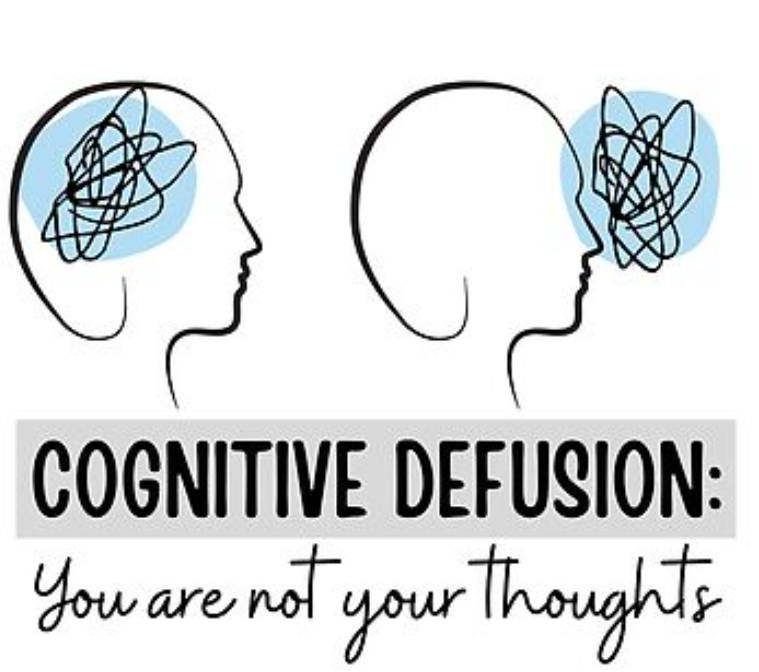
Cognitive defusion is a psychological technique in which instead of changing the thoughts themselves, it involves changing how a person relates to their thoughts. Cognitive defusion teaches individuals to see thoughts as temporary, passing mental events, rather than viewing thoughts as literal truths that must be obeyed.
Humans experience a constant stream of internal dialogue in everyday life. And research suggests that a large proportion of these internal thoughts are negative or self-critical. Thus, in this case comes cognitive defusion. It does not aim to suppress or replace these thoughts, instead, it reduces their influence over emotions and behavior.
For Example:
- Cognitive Fusion - “I am what my thoughts are.”
- Cognitive Defusion = “I’m having this thought but I’m noticing this thought first.”
In short, “You can have a thought without letting the thought have you.” Instead of being “fused” with a thought and believing it completely and acting on it automatically, defusion allows you to observe the thought without obeying it.
What Is Cognitive Defusion in ACT?
One of the six core processes in Acceptance and Commitment Therapy is cognitive defusion that promotes psychological flexibility.
Cognitive Defusion Involves:
- Rather than immersing yourself in your thoughts observing them.
- Creating distance between cognitive and identity.
- Without struggle, allowing thoughts to come and go.
- Responding based not on internal narratives but based on values.
Cognitive defusion does not mean ignoring thoughts, forcing positive thinking or arguing with the mind, instead, it is about letting go of the struggle with thoughts.
What Is Cognitive Fusion?
In order to understand cognitive defusion, it is important to first understand cognitive fusion.
Cognitive Fusion:
Cognitive fusion happens when individuals become entangled with their thoughts. Instead of treating them as mental experiences they treat them as facts. When fused, thoughts feel true, urgent and personally defining.
For example, thoughts like:
- “I will definitely fail”
- “People are judging me”
- “I’m not good enough”
**Note - These are useful defusion exercises and not humor-based avoidance.**
People often avoid meaningful activities, withdraw socially and make decisions based on fear rather than values, when fused with such thoughts. It is strongly associated with anxiety disorders, depression, low self-esteem, and chronic stress.
How Does Cognitive Defusion Work?
Works by shifting attention from the content of thoughts to the process of thinking itself.
Mechanism of defusion:
|
Fused Thinking |
Defused Thinking |
|
Thoughts feel like facts - “What I think is true” |
Thoughts are seen as mental events - “It might be true or false, but I am noticing the thought.” |
|
Thoughts control actions and behavior is reactive. |
Behavior is values-based. Actions are chosen consciously |
|
Emotional Reactivity - Emotions feel overwhelming |
Psychological flexibility - Emotions feel manageable |
|
Avoidance |
Willingness |
Encouraging individuals to notice thoughts without judgment, defusion techniques are often rooted in mindfulness.
For Example:
It is like hearing background music while reading, the music is still there, but it no longer commands attention or dictates your actions.
Cognitive Defusion Techniques and Exercises:
-
Notice the Thought:
When a distressing thought appears, adding this phrase before a thought helps create distance:
- Original Thought - “I’m a failure”
- Modification - “I’m noticing the thought that I am a failure.”
This simple linguistic distancing change reminds you that a thought is something you’re experiencing and not who you are.
-
Slow Down the Thought:
Repeat the thought slowly until it becomes a string of sounds rather than meaning, this weakens the emotional grip of the thought. Also try to label recurring thoughts as stories.
- Instead of the original thought - “This is my failure story.”
- Say - “This is my not-so-good story.”
By slowing down and labeling thoughts reduces emotional intensity and makes patterns easier to recognize.
-
Sing the Thought or Repeating the Thought Out Loud:
Sing out your thoughts to a familiar tune. The technique here is defamiliarization, it reduces the authority of the thought, even if the thought remains.
Saying out loudly in an exaggerated or cartoon-like voice can reduce its emotional charge and disrupts automatic seriousness. For example, repeating “I am a failure” for 30 seconds often makes it lose meaning and impact.
-
Visualizing Thoughts as Objects
Try imagining thoughts as:
- Words on a screen scrolling down.
- Clouds passing in the sky.
- Leaves floating down a water stream.
Without chasing or fighting the thoughts, you observe them.
-
Thanking the Mind
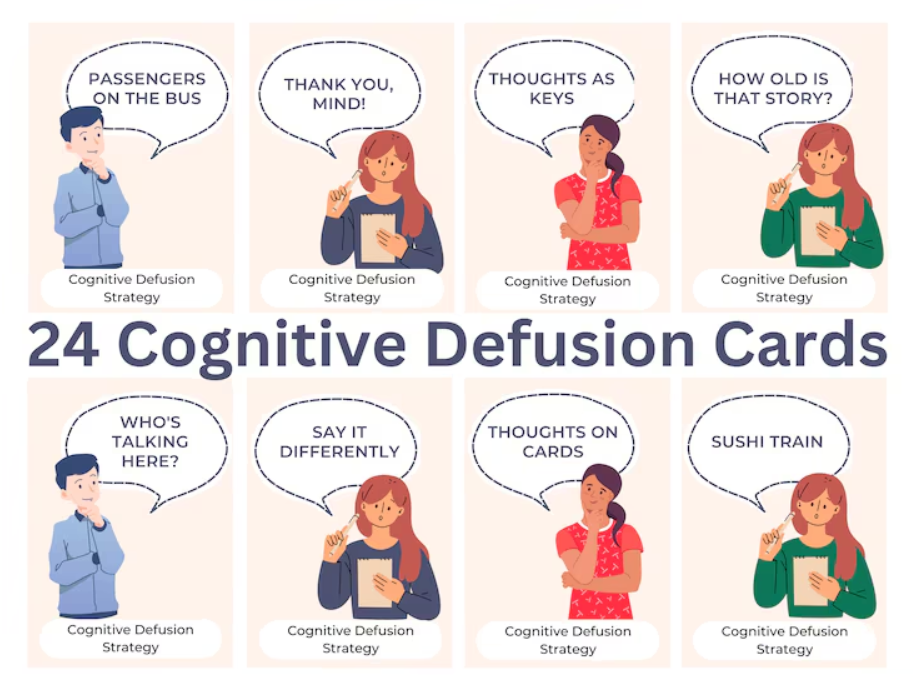
Instead of resisting a thought, acknowledge the thought with: “Thank you, mind.”
Without giving it control, this acknowledges the thought and rather than resistance, this reinforces acceptance.
Benefits of Cognitive Defusion
Across multiple psychological conditions, cognitive defusion has been shown to be effective. Consistent practice leads to a deeper insight, over time: “Thoughts are not instructions.”
Clinical Benefits:
|
Area |
Effect |
|
Anxiety disorders |
It reduces reactivity to worry |
|
Depression |
Reduced negative thoughts or overthinking |
|
Social anxiety |
Self-criticism is reduced. |
|
Self-esteem |
Reduced identification with negative beliefs |
|
Stress |
An improved emotional regulation. |
Common Misconceptions About Cognitive Defusion
-
It is not about positive thinking
-
Does not imply that one should believe that thoughts are false
-
Cannot not eliminate useless thoughts
-
Focuses on changing the relationship to thoughts, not their content
Once these misconceptions are clarifies it improves engagement and prevents misunderstanding of ACT-based techniques.
Why Do Our Thoughts Have So Much Power?
Because the human brain is designed to predict danger, solve problems and avoid pain. The mind constantly produces thoughts, many of them repetitive, negative, or fear-based. The problem is not the thought itself, but how seriously we take it.
For example:
- “Everyone is judging me”
- “I can’t cope without this substance”
- “I’m going to fail”
When we are fused with these thoughts, often leading to avoidance, anxiety, or unhealthy coping strategies, they drive emotions and behavior. However, cognitive defusion helps break this automatic loop.
Cognitive Defusion vs Cognitive Reappraisal
|
Feature |
Cognitive Defusion |
Cognitive Reappraisal |
|
Goal |
Change relationship towards thoughts |
Change the content of thoughts |
|
Approach |
More acceptance-based |
Is evaluation-based |
|
Origin |
Acceptance and Commitment Therapy |
Cognitive Behavioral Therapy |
|
Focus |
Psychological flexibility |
Accuracy of thoughts |
Both the techniques are effective and often complementary to each other.
When Is Cognitive Defusion Most Effective?
Cognitive defusion is particularly useful when:
- When thoughts are intrusive or repetitive.
- Testing a thought using logic and evidence increases distress.
- In cases where emotional avoidance is present.
- Action based on values is blocked by fear.
It is most effective when combined with mindfulness, values clarification, behavioral activation and other CBT strategies.
Also read more about brain and its creativity - Click Here
Cognitive Fusion vs Cognitive Defusion
Understanding the difference between cognitive fusion and cognitive defusion is central to Acceptance and Commitment Therapy. The table below highlights how each process influences thinking, emotion, and behavior.
Cognitive Fusion vs Cognitive Defusion :
| Aspect | Cognitive Fusion | Cognitive Defusion |
|---|---|---|
| Relationship with thoughts | Thoughts experienced as facts and truths | Thoughts experienced as mental events |
| Self-identity | “I am my thoughts” | “I am noticing the thought that…..” |
| Behavioral control | Behavior driven by thoughts | Behavior guided by values |
| Emotional response | High emotional reactivity | Improved emotional regulation |
| Flexibility | Rigid and avoidant | Psychologically flexible |
Cognitive Fusion makes individuals believe in thoughts like "I will fail” or “I am not good enough” feel compelling and urgent. Whereas, cognitive defusion creates space between the thinker and the thought, allowing responses based on values rather than fear.
Frequently Asked Questions (FAQs)
Is cognitive defusion the same as ignoring thoughts?
No. Cognitive defusion is not suppressing or ignoring them, it involves acknowledging thoughts without engaging with them.
Can cognitive defusion stop negative thoughts?
The answer is no because the goal is to reduce their impact on behavior and emotion and not to stop thoughts.
Is cognitive defusion evidence-based?
Yes. Supported by extensive clinical research, it is a well-established component of Acceptance and Commitment Therapy.
How long does it take to work?
Long-term benefits develop with regular practice, but many people experience immediate reduction in distress.
Can I practice cognitive defusion on my own?
Yes, especially in clinical conditions, guidance from a trained therapist can improve effectiveness.
- Cognitive Behavioral Therapy for Addiction
- Cognitive Restructuring Worksheet
- INTP Cognitive Functions: Into the Ti–Ne Mind
- Addenbrooke’s Cognitive Examination (ACE)
- Neurotypical Meaning: What It Really Means in Neuroscience
- Sluggish Cognitive Tempo (SCT): Understanding Cognitive Disengagement Syndrome (CDS)
- Cognitive Empathy: Neural Mechanisms, Functional Roles, and Development