Cognitive Dissonance: Meaning, Examples & Why It Happens
Cognitive behavioral dissonance is a situation in which a person’s thoughts, beliefs, and values disagree with their actions or habits. It is the inner clash when the mind pulls toward ideals, while behavior drifts toward convenience, emotion, or habit.
The foundation for cognitive behavioral dissonance is cognitive dissonance, but it goes further. It is the specific moment when rational thinking and real-life behavior refuse to match. It creates a mental friction that can shape decisions, emotions, and long-term well-being.
Neuroscience considers cognitive behavioral dissonance as an important driver of personal change. An understanding of this topic gives an idea about emotional regulation, decision-making, and mental resilience.
Key Takeaways:
- Cognitive behavioral dissonance is the clash between a person beliefs and actions.
- It is not a flaw or failure, but it is a normal psychological process.
- This conflict between beliefs and actions can influence emotions, relationships, identity, and decisions.
- The brain eventually attempts to resolve this conflict through behavior change, belief adjustment, or rationalization.
- Addressing and understanding dissonance improves emotional health, self-control, and long-term well-being.
- Coping strategies like goal alignment, self-awareness, and emotional regulation.
- When recognized early and handled constructively, dissonance can be a powerful motivator for growth.

Neuroscience Behind Cognitive Behavioral Dissonance:
The human brain is trained for internal consistency. Humans' beliefs are a personal compass, pointing toward certain choices. The mind registers a mismatch when actions do not follow that compass. The individual is pushed to correct when this mismatch produces discomfort.
Cognitive dissonance involves three core steps:
1. Internal conflict is detected
The person notices consciously or unconsciously that their behavior contradicts their beliefs.
Example:
Belief: “You tell yourself that you value honesty.”
Behavior: But you are hiding a small mistake at work.
2. Emotional discomfort rises
Emotional circuits arise due to this conflict, generating feelings such as guilt, anxiety, embarrassment, or defensiveness. This discomfort is a neuropsychological signal and not a punishment.
3. The person attempts to restore balance
The human brain tries to reduce cognitive dissonance by:
- Trying to change actions according to beliefs.
- According to our current needs, changing beliefs.
- Rewriting the old justifications.
- If the change seems too difficult, avoid reminders of the contradiction.
- Selective attention only to the supportive information.
These responses reveal how people avoid responsibility and sometimes make sense of their choices.

What Causes Cognitive Behavioral Dissonance?
1. Value-based contradictions
When people act against their strong morals, they experience sharp cognitive dissonance.
Example: Reacting harshly under stress but believing in compassion.
2. Social expectations
External pressure created from parents, elders, workplaces, and society can force certain behaviors that don’t match inner beliefs.
For example, while doubting oneself internally but acting confident in front of colleagues.
3. Habitual patterns
New goals are often overridden by old habits, especially in health, productivity, and relationships.
For example, impulsively shopping online while wanting to save money.
4. Emotional impulses
Emotionally driven feelings like anger, fear, and excitement can momentarily overpower reason.
For example, reacting instantly during conflict, knowing that yelling is unhelpful.
5. Fear of consequences
Certain situations create a fear of consequences, and people sometimes behave against their values to avoid punishment or rejection.
For example, agreeing with a group even when disagreeing internally.
Examples of Cognitive Behavioral Dissonance in Everyday Life
Health and Lifestyle
- A person who keeps skipping workouts and who values fitness.
- A person after a stressful day buys cigarettes, but wants to quit smoking.
- While being fully aware of the long-term risks, a person who eats junk food.
Work and Career
- Procrastinating on important tasks but values productivity.
- Staying silent when witnessing unfair practices but supporting ethical work culture.
- Refusing to collaborate but believing in teamwork.
Relationships and Social Behavior
- Losing temper frequently but teaching children about patience.
- Hiding financial decisions from a partner while promoting honesty.
- Scrolling on the phone during quality time but wanting meaningful conversations.
Ethical Choices
- Frequently buying disposable products while supporting environmental care.
- Engaging in harsh comments but advocating kindness online.
When these contradictions accumulate, emotional fatigue can grow, even though the contraindications are normal.
Cognitive Dissonance in Relationships
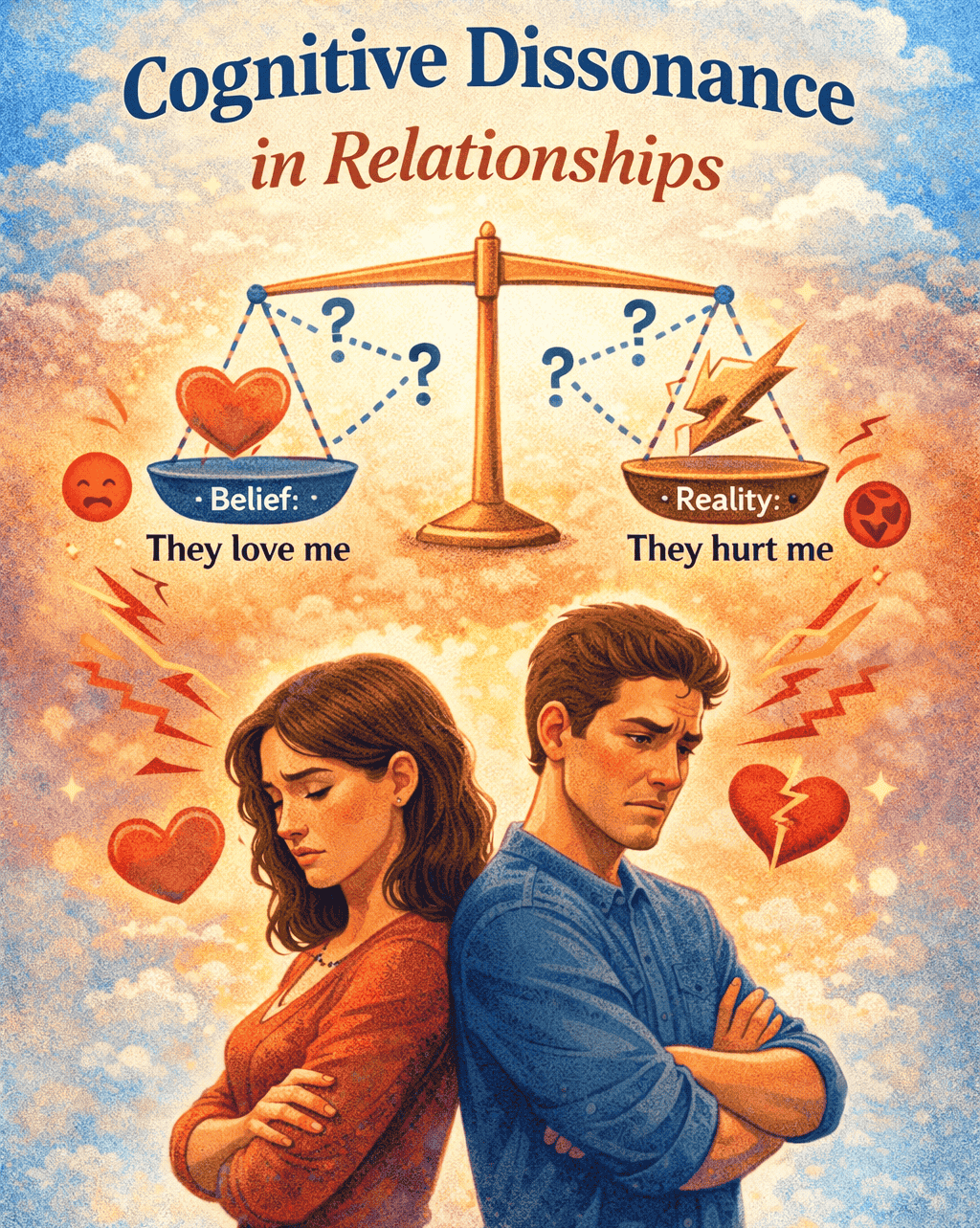
One of the most powerful environments where cognitive behavioral dissonance appears is romantic and close relationships. This happens only because relationships directly involve attachment, identity, self-esteem, and emotional safety. An important situation in relationships where cognitive dissonance occurs is when what we believe about a person or relationship clashes with what we experience from them.
Common Relationship-Based Dissonance Conflicts
- “Love requires effort” vs “I am the only one trying”
- “They love me” vs “They repeatedly hurt me”
- “This relationship is healthy” vs “I feel anxious, unheard, or diminished”
Because emotional bonds amplify the brain’s need for consistency, this contradiction creates intense psychological discomfort.
Why Cognitive Dissonance Is Stronger in Relationships
Making dissonance harder to resolve, relationships trigger deep emotional and neurobiological investment. What happens is:
- ACC signals ongoing conflict between belief and emotional pain.
Limbic system strengthens fear of loss and emotional attachment.
Prefrontal cortex attempts to justify confusing or harmful behavior harmful.
The brain often chooses belief distortion over behavioral change, because emotional loss feels threatening.
How Cognitive Dissonance Comes Up in Relationships
1. Rationalizing Harmful Behavior
The mind starts explaining that behavior, instead of addressing the contradiction.
For example:
- “Every relationship has problems.”
“They didn’t mean it.”
“They are stressed.”
For that instance or moment this reduces emotional discomfort but delays necessary change.
2. Staying in Unhealthy Relationships
Leaving threatens self-esteem, when someone has invested time, emotions, or identity into a relationship.
An example of conflict:
Belief: “I make better relationship choices.”
Reality: “But this relationship is hurting me.”
The brain may choose to stay and justify rather than leave and confront loss, to reduce dissonance.
3. Ignoring Red Flags
We start paying attention selectively and this plays a major role in relationship dissonance.
People may often:
- Avoid conversations that expose inconsistency
Focus only on positive moments
Downplay repeated warning signs
Ignoring the warning signs comes along with the earlier point on selective attention as a dissonance-reduction strategy.
Cognitive Dissonance, Attachment, and Self-Esteem in Relationships
Relationship dissonance is very closely tied to self-esteem protection.
Example:
Belief: “I deserve respect.”
Behavior: “But at the same time I tolerate disrespect.”
The mind may alter the belief to protect self-esteem:
- “This is normal in relationships.”
“Maybe I’m asking for too much.”
This is a replica of the self-esteem mechanisms already explained, now it is applied to relational contexts.
Emotional Consequences of Unresolved Relationship Dissonance
If the cognitive dissonance in relationships remains unresolved, it can further lead to:
- Difficulty leaving unhealthy dynamics
Chronic anxiety or emotional exhaustion
- Confusion about personal values
Self-doubt and reduced self-trust
Emotional dependency
The brain adapts to discomfort, normalizing emotional pain, over time.
Healthy Resolution of Cognitive Dissonance in Relationships
Healthy resolution involves tolerating discomfort long enough to regain clarity and does not mean immediate decisions.
Some of the constructive approaches include:
- Strengthening emotional regulation before decision-making
Acknowledging emotional discomfort without justification
- Reflecting on patterns instead of isolated incidents
Separating behavior from idealized beliefs
Relationship-based dissonance can lead to boundary setting, growth, or necessary change, when handled consciously.
Why Understanding Cognitive Dissonance in Relationships Matters
Understanding Cognitive Dissonance helps people to:
- Make clearer relational decisions
Recognize emotional self-deception
- Maintain self-respect and identity
Protect long-term mental health
Cognitive dissonance in relationships reflects the brain’s attempt to protect emotional investment while maintaining identity and does not mean weakness in love.
Why Cognitive Behavioral Dissonance Matters in Mental Health?
1. Emotional overload: Repeated dissonance creates an emotional overload because of chronic stress, irritability, self-doubt, or guilt.
2. Identity confusion: People may question who they are and their identity when beliefs and actions stay out of sync.
3. Impact on self-esteem: A person feel inconsistent or unreliable due to unresolved internal conflict.
4. Relationship strain: Contradictions especially in trust and communication, can weaken relationships.
5. Behavioral change: The positive side is that these contraindications can motivate people towards healthier habits.
How the Brain Responds to Cognitive Behavioral Dissonance?
Modern neuroscience links dissonance to the anterior cingulate cortex (ACC) for conflict detection, the prefrontal cortex for decision-making, and the limbic system for emotional responses
When cognitive dissonance happens:
- A conflict is then signaled by the ACC.
- The limbic system reacts by showing discomfort.
- In this case the prefrontal cortex tries to correct the mismatch.
This three-part circuitry explains why dissonance feels emotionally uncomfortable and mentally urgent.
Cognitive vs Behavioral Dissonance Components:
Aspect | Description | How It Creates Conflict | Common Examples |
Cognitive | Self-guiding principles, thoughts and beliefs. | When beliefs are not reflected in behavior, mismatch occurs. | “I value healthy habits.” |
Behavioral | Choices, actions and habits. | Emotional tension is intensified by the contradicting actions. | Despite valuing health goals, eating junk food. |
Emotional | Feelings are triggered due to the mismatch. | This signals discomfort and leads to correction | Irritation, guilt and anxiety. |
Social | Peer influence and external societal standards. | Pressure can cause behaviors against personal values | To avoid conflict acting agreeable. |
Moral | Judgments based on ethics. | Stronger dissonance creates violations. | Hiding mistakes, lying and cheating. |
Strategies to Reduce Cognitive Behavioral Dissonance:
1. Align actions with values by creating consistent and small habits that reflect your beliefs.
2. Reevaluating unrealistic beliefs, and sometimes beliefs are too strict or idealized.
3. Strengthening emotional regulation by techniques like deep breathing, grounding, or structured reflection helps reduce impulsive reactions.
4. Use goal-setting frameworks and set measurable, realistic goals to reduce the gap between intention and action.
5. Seek feedback or therapy when needed; professional help can guide the unraveling of deeply rooted conflicts.
Types of Cognitive Behavioral Dissonance
1. Forced compliance dissonance: When your beliefs are opposed and you have to behave against your beliefs.
2. Decision-making dissonance: Decision-making dissonance happens especially when both options have pros and cons after making a difficult choice.
3. Effort-based dissonance: Effort-based dissonance is when someone invests effort into something and feels unworthy later.
4. Induced-discrepancy dissonance: It is triggered when external information or advice contradicts past behavior.
Relationship Between Cognitive Dissonance and Self-Esteem
There is a relationship between cognitive dissonance and self-esteem, and it is purely based on how the brain protects a person’s sense of self-worth.
Cognitive dissonance occurs only when a person holds two conflicting attitudes, beliefs, or behaviors and this conflict in turn creates psychological discomfort. And one of the strongest triggers created by this discomfort is a threat to self-esteem.
In short, “The more you feel that yourself image is important, the stronger is the cognitive dissonance felt when that self-image is challenged.”
How Self-Esteem Triggers Cognitive Dissonance
Human beings have a basic psychological need to see themselves as competent, moral, intelligent and consistent.
The brain experiences dissonance, when an action, decision, or piece of information threatens this self-view.
For example:
A person who constantly believes “I am a good and an honest person” sees himself in an important situation and this creates a clash between:
self-esteem belief - “I am honest”
And behavior - “I just lied”
The resulting discomfort between self-esteem and behavior is cognitive dissonance.
To protect self-esteem, the brain often:
Tries to justify the behavior by saying, “Everyone lies sometimes”.
By doing this it minimizes responsibility.
And changes the belief to - “Honesty isn’t always practical.”
High Self-Esteem vs Low Self-Esteem: How Dissonance Differs
The relationship between cognitive dissonance and self-esteem differs between each individual and is not necessarily the same for everyone.
People with High Self-Esteem:
When their self-image is threatened, they experience strong dissonance.
They are more likely to defend their behavior or rationalize.
To protect identity, use dissonance reduction.
For example: “I made a mistake, but that doesn’t define who I am.”
People with Low Self-Esteem:
They tend to experience cognitive dissonance as self-confirmation.
And are more likely to internalize blame towards themselves.
They may accept negative beliefs about themselves.
For example: “I have failed because I’m not good enough.” Therefore, while both of them experience cognitive dissonance, the coping strategy differs in both the cases.
Neuroscience Behind Cognitive Dissonance and Self-Esteem
Neuroscientific studies show that cognitive dissonance activates brain regions involved in emotional pain, self-evaluation and conflict monitoring.
The main brain regions include:
The Anterior Cingulate Cortex (ACC) detects conflict between actions and beliefs.
The Prefrontal Cortex helps to rationalize and reinterpret events.
The Amygdala processes emotional threat and especially self-esteem.
These regions work together to reduce discomfort, often by changing beliefs rather than behavior, when self-esteem is threatened. The brain prioritizes psychological stability over objective accuracy, and this explains why people may defend their poor decisions instead of admitting fault.
Why Cognitive Dissonance Protects Self-Esteem
Cognitive dissonance is a defense mechanism and not a flaw. It helps to preserve a stable sense of identity. Prevent emotional collapse, to maintain confidence and motivation.
However, when overused, it can block self-growth, reinforce unhealthy beliefs and prevent accountability. Leading to learning and change, healthy self-esteem allows a person to tolerate dissonance without distortion.
Everyday Examples of Cognitive Dissonance and Self-Esteem
While believing “I deserve respect” and staying in a toxic relationship.
To avoid feeling foolish, defending a bad purchase.
To maintain moral self-image, justifying unethical behavior.
Avoiding or rejecting feedback that threatens competence.
In all of these cases, self-esteem decides how dissonance is resolved.
Cognitive Dissonance vs Self-Esteem:
Aspect | Cognitive Dissonance | Self-Esteem |
Role | It creates mental discomfort. | Protects self-worth. |
Trigger | Conflicting actions or beliefs. | A threat to identity. |
Brain Response | Belief changes or rationalization. | Emotional regulation |
Healthy Outcome | Adjustment & Learning | Stable self-esteem |
Unhealthy Outcome | Distortion & denial | A fragile identity |
Frequently Asked Questions (FAQs)
1. Can cognitive behavioral dissonance cause anxiety?
Yes, cognitive dissonance often surfaces as worry, guilt, or stress.
2. Is this the same as hypocrisy?
Not necessarily, while hypocrisy involves intentional contradictions, everyone experiences dissonance.
3. Why does the conflict feel so strong?
From evolution, internal consistency helped humans maintain coherent identity and social trust.
4. Can dissonance be ignored?
Yes, dissonance can be ignored but ignoring it often leads to unhealthy coping strategies like denial.
5. How does dissonance appear in therapy?
To guide behavior change, therapists often highlight contradictions between thoughts and actions.
6. Who experiences it the most?
People with high self-awareness or strong belief systems may sense cognitive dissonance more intensely.
Other Topics Covered by Us:
- Cognitive Biases: How are we tricked to misjudge?
- Cognitive Distortions: How the Brain Tricks Itself?
- Domains of Cognitive Psychology and the Cognitive Revolution
- What is Bandura’s Social Cognitive Theory? And we must know of
- Cognitive Arbitrage: Bias, Prediction, and Decision-Making.
- Neural Portfolio Theory: How Your Brain Diversifies Risk?
- What Is a Cognitive Walkthrough?
- What is Shallow Cognitive Processing?
- Neural Tug-of-War Between Logic and Emotion