The Billion-Neuron Theory: Understanding Brain Energy & Human Potential
Imagine your brain, like a busy city buzzing, which runs all round the clock. The signals are rushing like traffic, ideas are forming like construction, and memories are stored like buildings. When all the roads in the city are smooth and the power supply is constant, the city functions efficiently. What happens when there are a power cut or the roads aren’t smooth?
Despite having everything, a lack of a single factor like a power supply can cause a shutdown in the city. Similarly, although the brain weighs only a small fraction of our body, it consumes nearly a quarter of our total energy just to keep our bodies functioning. This is the core idea of the Billion-Neuron Theory.
The Billion-Neuron Theory says human potential is defined by how well the billions of neurons are connected, fueled, and synchronized and not determined by how many neurons we possess. Let’s read further to understand “A deep scientific exploration of how neural power shapes intelligence, creativity, and peak performance.”
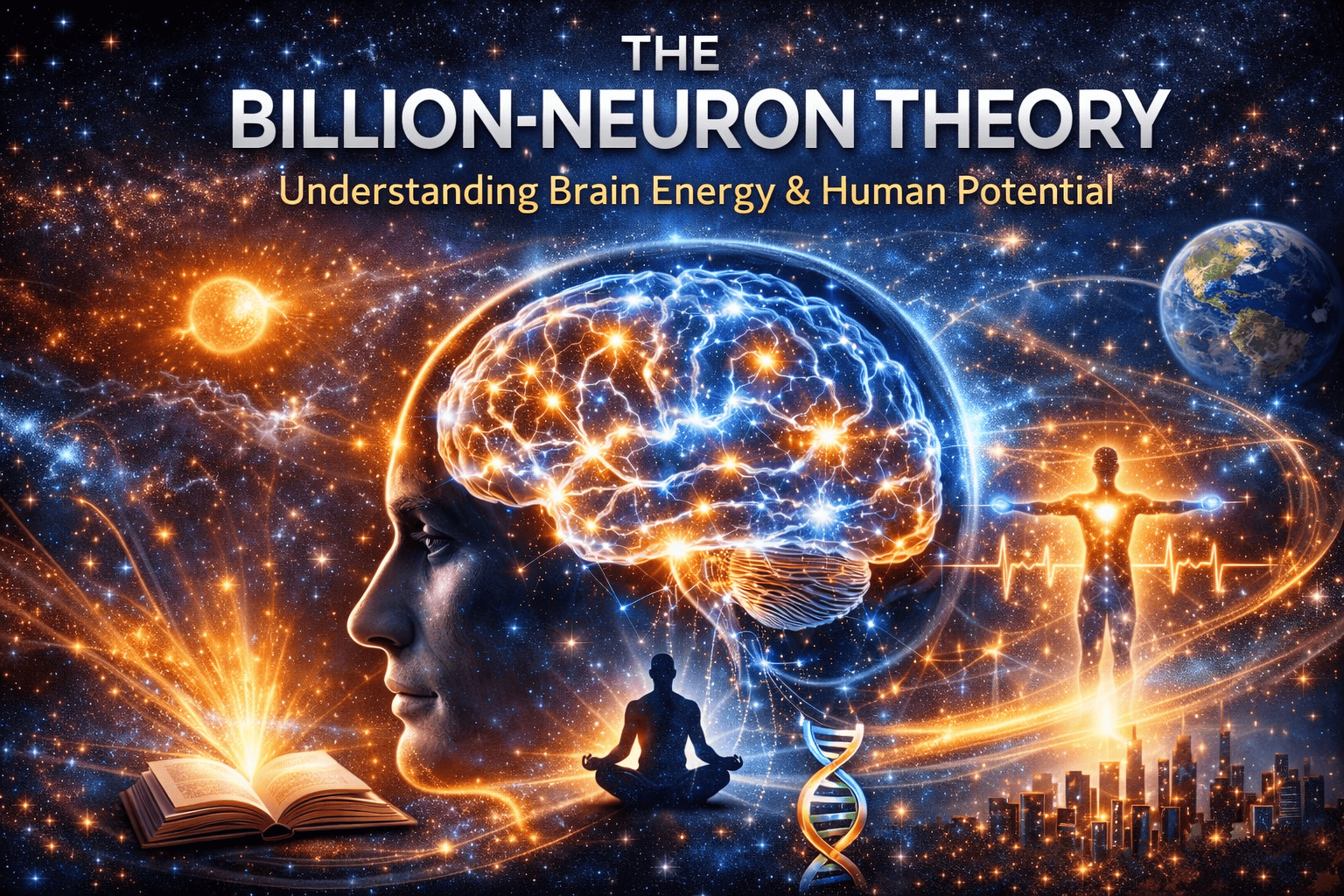
What is the Billion-Neuron Theory?
The Billion-Neuro Theory is based on a very simple idea about how the brain reaches its highest potential. It explains that the brain, instead of focusing on how many neurons (about 86 billion) we have, works efficiently based on how well these neurons are connected and how much energy they receive.
In short, when the neurons have enough fuel, the neurons communicate smoothly, and the brain thinks faster, learns better, remembers more, and becomes more creative. Vice versa, when there is not enough fuel or the energy is low or connections are weak, thinking slows down and performance drops.
Therefore, according to the theory, improving brain energy and neural connectivity can unlock the full power of human intelligence and capability.
Let’s Simplify:
- The neurons consume a lot of energy, oxygen, and blood flow to work efficiently.
- Strong neural connectivity means faster thinking, better learning, and stronger memory.
- In turn, brain energy levels have an impact on how well we focus, make decisions, and stay creative.
- We can boost our productivity through sleep, exercise, nutrition, learning, and mental training.
- Most of the human limitations are a result of energy shortages and not lack of intelligence.
- Humans can expand human potential beyond what we believe is possible by improving neural fuel and connectivity.
**Short Disclaimer About Terminology: The “Billion-Neuron Theory” is not a standalone medical or clinical theory; it is just a conceptual framework that integrates established neuroscience findings on neuroplasticity, brain energy metabolism, and network efficiency.
What does the Billion-Neuron Theory explain?
The Billion-Neuro Theory explains how the brain achieves peak performance and is built on three foundational neuroscience principles.
Principle 1—Network Efficiency Over Neuron Count
- Human cognitive power is defined by how efficiently the neurons can communicate more than by how many neurons exist.
- Rapid firing along with dense networks produces advanced reasoning, creativity, planning, and language.
Principle 2—Neurons Adapt Through Challenge
The stronger the synapses become, the more our neurons are exposed to new situations and challenges and forced to learn.
- Processing speed
- Working memory capacity
- Problem-solving ability
This potential of our neurons to learn and adapt throughout one's lifetime is known as neuroplasticity. It is the brain’s ability to rewire and keep upgrading itself.
Principle 3—Constant Energy Supply Helps Neural Performance
Brain energy is responsible for every cognitive function. When the neurons lack energy or oxygen, performance decreases, which causes:
- Memory errors
- Anxiety and emotional imbalance
- Reduced motivation
- Brain fog or fatigue
Human Potential and the Billion-Neuron Theory:
The billion-neuron theory simply suggests, “Human Limits Are Mostly Due to Energy Constraints and Not Intelligence Limits.”
We unlock the following features when neurons receive optimal stimulation and fuel:
- High-speed decision-making
- Long-term learning power
- Emotional resilience
- Deep creativity
- Exceptional productivity
The future implications of the Billion-Neurons theory include:
- Brain-computer augmentation
- Reversal of aging
- Advanced neurorehabilitation
- AI-enhanced cognition
Billion-Neuron Brain Optimization Methods:
1. Cognitive Load Training
Training the brain for tasks like chess, math, dual-task exercises, and new languages.
2. Aerobic Exercises
Aerobic exercises are known to boost BDNF (brain-derived neurotrophic factor) and improve neuroplasticity.
3. Deep Sleep Cycles
An 8-hour sleep duration cleans neural waste and recharges circuits.
4. Nutritional Strategies
- Consumption of Omega-3, flavonoids or ketones
- Proper hydration throughout the day and glucose control
5. Meditation & Focus Routines
Practices like meditation improve neural synchronization and decrease noise.
The Brain versus Supercomputer:
The brain rivals the world’s fastest computers and can perform 10^16 operations per second, but it uses millions of times less energy.
|
Feature |
Human Brain | Supercomputer |
|
Processing method |
Parallel, distributed networks | Serial processing |
| Energy usage | 10–20 watts |
Millions of watts |
| Fault tolerance | Self-repair and adaptation |
No self-repair |
| Memory | Synaptic plasticity |
Physical storage devices |
Conclusion:
With the right stimulation and energy, the brain becomes capable of extraordinary performance: rapid learning, deep creativity, superior decision making, emotional control, and breakthrough innovation.
The real frontier of human evolution is within the neural networks we carry every day.
The human brain is an efficient biological supercomputer. It is powered by nearly 86 billion neurons and trillions of synaptic connections. Although it weighs only 2% of body mass, it consumes almost 25% of the body’s glucose and oxygen. This suggests a sign of its extraordinary energy demands.
What This Theory Does Not Claim?
- Emphasizes optimization, not exaggeration
- Does not suggest intelligence is unlimited
- It does not guarantee “superhuman” abilities.
- Not replace genetics or education
FAQs—Billion-Neuron Theory:
1. What does the term "billion-neuron" actually mean?
Ans: It is an idea that cognitive power depends on the functional efficiency of billions of neurons and their energy systems, not just on the neuron count.
2. Is the Billion-Neuro Theory scientifically supported?
Ans: Yes, it aligns with current neuroscience research on neuroplasticity, mitochondrial function, and energy-based cognitive capacity.
3. Can brain energy really increase intelligence?
Ans: Yes, improving neural efficiency, blood flow, and synaptic connectivity can elevate measurable IQ, memory, learning speed, and decision accuracy.
4. Who benefits most from billion-neuron methods?
Ans. Anyone seeking peak mental performance can benefit, mainly students, researchers, athletes, creative professionals, and entrepreneurs.
5. Can billion-neuron optimization slow aging?
Ans: Current evidence shows that exercise, sleep, learning, and metabolic optimization can protect neurons and extend cognitive lifespan.
To read more about the brain and its creativity - Beneath The Stars and Beyond
Read About—The Illusion of Normalcy