Beck’s Cognitive Triad: Negative Thinking in Depression
Beck’s Cognitive Triad was developed by psychiatrist Aaron T. Beck in the 1960s. It is one of the most influential concepts in modern psychology and psychotherapy. It explains how persistent negative thinking patterns shape emotional distress, particularly in depression.
The cognitive triad decades later remains as the core idea behind Cognitive Behavioral Therapy (CBT) and continues to influence clinical practice, research, and mental health education worldwide.
In this article we provide a comprehensive, easy-to-understand, and evidence-based explanation of Beck’s Cognitive Triad. We will cover its theory, components, cognitive distortions, biological correlates, assessment tools, criticisms, and real-world relevance.

What Is Beck’s Cognitive Triad?
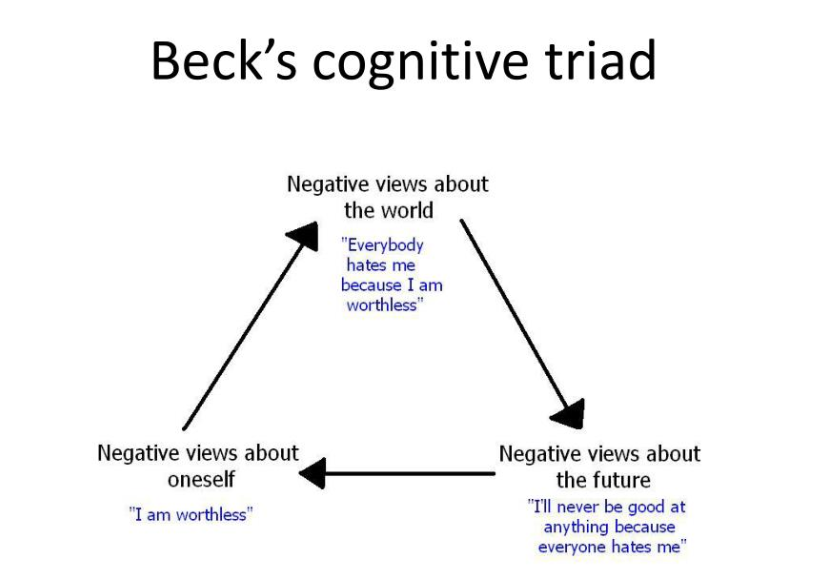
Beck’s Cognitive Triad consists of three interconnected patterns of negative thinking that are commonly observed in people with depression:
-
Negative beliefs - About the self
-
Negative interpretations - Of the world
-
Negative expectations - About the future
The triad mentions that these three belief systems interact continuously, reinforcing each other and creating a cycle that maintains depressive symptoms.
These thoughts often occur without conscious intention, automatically, and they strongly influence emotions, behavior, and motivation.
The Cognitive Triad - Summary
|
Component |
Core Belief |
Emotional Impact |
|
Self |
“I am not capable/inadequate" |
Shame, guilt and low self-esteem |
|
World |
“The world is unfair towards me” |
Anger, withdrawal and mistrust |
|
Future |
“Nothing in my life will improve” |
Hopelessness and despair |
Origins of Beck’s Cognitive Triad
Aaron T. Beck was originally trained as a psychoanalyst but later he was dissatisfied with its effectiveness in treating depression. He noticed that depressed individuals, rather than unconscious conflicts, frequently expressed spontaneous negative thoughts. He observed that the negative thoughts are the main drivers of their emotional pain.
This approach about negative thoughts led to the development of Cognitive Behavioral Therapy (CBT), a structured, evidence-based approach focused on identifying and modifying maladaptive thought patterns.
The cognitive triad, first formally described in 1967 became a core component of Beck’s cognitive model of depression.
The Three Components of Beck’s Cognitive Triad
We already know that the Beck’s Triad had 3 components that are interrelated. The 3 components and their interpretations are as follows:
1. Negative View of the Self
In this case the individuals see themselves as defective, inadequate, unlovable, or worthless. They often blame themselves excessively and attribute failures to internal flaws.
For example:
-
“I’m a complete failure.”
-
“I am inadequate.”
-
“There is something wrong with me.”
These negative views about oneself lead to low self-esteem, guilt, shame, and withdrawal from social and professional opportunities.
-
Negative View of the World
This component involves individuals who believe that the world is unfair, hostile, rejecting, or devoid of support. This scenario may lead to neutral or even positive events that may be interpreted negatively.
Examples:
-
“Nothing ever works out for me.”
-
“People don’t care about me.”
-
“The world is cruel.”
These strong opinions can lead to social isolation, mistrust, and a sense of alienation.
-
Negative View of the Future
Here, there is only persistent pessimism and hopelessness. The individual’s expectations of their future are expected to bring continued suffering, failure, or disappointment.
Examples:
-
“My life is already ruined.”
-
“Things will never get better.”
-
“There’s no point in trying.”
The feeling of hopelessness is strongly associated with suicidal ideation and reduced motivation.
Beck’s Cognitive Model of Depression
He also proposed the idea that depression arises not directly from life events, but from how individuals interpret those events. Any two individuals can experience the same stressor, but only one becomes depressed due to negative cognitive processing. The key features of the cognitive model include:
-
Negative self-schemas
-
Dysfunctional beliefs
-
Cognitive distortions
-
Automatic negative thoughts
All of these features together, shape emotional responses and behavioral patterns that perpetuate depression.
Cognitive Distortions Associated with Beck’s Cognitive Triad
Systemic errors in thinking reinforce negative beliefs and are known as cognitive distortions. He identified several cognitive distortions commonly seen in depression.
|
Cognitive Distortion |
Definition |
Example |
|
Arbitrary inference |
Without evidence drawing conclusions |
“They didn’t reply, they are ignoring me” |
|
Selective abstraction |
Focus is only on negative details |
Ignoring praise and fixating on criticism |
|
Overgeneralization |
From one event, broad conclusions |
“I failed once and I will always fail” |
|
Magnification |
Exaggerating only the negatives |
“This single mistake ruined everything” |
|
Minimization |
Trying to downplay the positives |
“It doesn’t really matter” |
|
Personalization |
Blaming themselves for negative events |
“It’s my fault and they’re upset because of me” |
CBT, which has Beck’s Cognitive Triad as the central idea, teaches individuals to identify, challenge, and reframe these distortions.
Click Here to read more about Cognitive Distortions.
Negative Self-Schema and Early Life Experiences
Beck suggested that during childhood or adolescence, many individuals develop negative self-schemas due to adverse experiences such as:
-
Chronic failure experiences
-
Emotional neglect
-
Abuse
-
Harsh criticism
-
Bullying
These negative self-schemas function as mental templates that influence how new information is interpreted, making individuals more vulnerable to depression later in life.
Neurobiological and Genetic Correlates
Modern neuroscience studies show evidence of interaction between cognition and biology in depression.
Genetic Vulnerability
Studies have identified genetic variations, such as the short allele of the serotonin transporter gene (5-HTTLPR). The 5-HTTLPR increases sensitivity to stress and negative emotional processing.
Brain Structures Involved in This Mechanism:
-
The amygdala is hyperreactive to negative stimuli
-
HPA Axis has dysregulated stress hormone (cortisol) release
-
In the prefrontal cortex there is reduced regulation of emotional responses
Reinforcing the cognitive triad, these biological factors may amplify negative cognitive biases.
Measuring Beck’s Cognitive Triad
Many cognitive assessment tools contain aspects of the cognitive triad:
|
Instrument |
Purpose |
|
Beck Depression Inventory (BDI) |
It measures depression severity |
|
Beck Hopelessness Scale |
Helps assess negative future beliefs |
|
Rosenberg Self-Esteem Scale |
Measures self-evaluation |
|
Cognitive Triad Inventory (CTI) |
Assessment for self, world, future beliefs |
These are the measures that are widely used in both clinical practice and research.
Beck’s Cognitive Triad in Therapy
In Cognitive Behavioral Therapy, therapists help clients:
-
Practice behavioral experiments to test beliefs
-
To identify automatic negative thoughts
-
Evaluate evidence for and against these thoughts
-
Develop balanced alternative interpretations
This process, over time, weakens negative schemas and improves emotional well-being.
Applications Beyond Depression
Although the Beck’s triad was originally developed for depression, has been applied to:
-
Chronic pain conditions
-
Anxiety disorders
-
Substance use disorders
-
Post-traumatic stress disorder (PTSD)
-
Eating disorders
This is because negative beliefs about self, world, and future often underlie many forms of psychological distress.
Criticisms of Beck’s Cognitive Triad
The model has several limitations despite strong empirical support:
-
Biological mechanisms remain complex and multifactorial
-
Not all depression cases show clear cognitive distortions
-
Cognitive changes may sometimes follow, rather than cause, depression
-
Cultural factors influence belief systems
Modern approaches in neuroscience rather than relying on a single explanation integrate cognitive, biological, and social perspectives.
FAQs About Beck’s Cognitive Triad
-
What is Beck’s cognitive triad?
The triad explains depression as negative thinking about yourself, the world, and your future.
-
Is Beck’s cognitive triad proven?
Yes, decades of research support its relevance, especially in CBT effectiveness.
-
Can Beck’s cognitive triad be changed?
Definitely yes, therapy, self-reflection, and structured cognitive techniques can modify these thought patterns.
-
Is Beck’s cognitive triad used today?
Absolutely, it remains central to CBT and modern psychotherapy.
-
Who developed Beck’s cognitive triad?
Psychiatrist Aaron T. Beck, founder of Cognitive Behavioral Therapy.
- Awareness of Cognitive Biases: First Step to Overcome Them
- How Essay Writing May Create Cognitive Debt
- Cognitive Defusion: Techniques, Benefits, and Exercises
- Cognitive Behavioral Therapy for Addiction
- Cognitive Restructuring Worksheet
- INTP Cognitive Functions: Into the Ti–Ne Mind
- Addenbrooke’s Cognitive Examination (ACE)
- 6 Neuroscience Books That Change How You Understand Mind
- 7 Books That Reveal How Cognitive Biases Shape Your Thinking
- ESFJ Cognitive Functions