ESFJ Cognitive Functions (Fe-Si-Ne-Ti) Explained with Examples
What does ESFJ Cognitive Functions mean or what does one infer by ESFJ personality type? Have you ever met someone who can walk into a room and instantly sense what everyone needs, who remembers the little details that make people feel seen, and who feels most alive. Then you're looking at an ESFJ Cognitive Function type of individual. The real reason behind that warmth and structure is not just personality traits, it’s the ESFJ’s cognitive functions. The mental processes that shape how they absorb information and make decisions.
ESFJs, in the Myers–Briggs framework, are typically described with the function stack: Fe (Extraverted Feeling) → Si (Introverted Sensing) → Ne (Extraverted Intuition) → Ti (Introverted Thinking)
In this article we will break down what each function looks like in real life. How the functions interact, what happens under stress, and how ESFJs can grow into a more balanced, confident version of themselves.

What Are ESFJ Cognitive Functions, and Why Do They Matter?
Cognitive functions help us in describing how the mind processes information and how it decides what to do. The Myers-Briggs Type Indicator (MBTI) system has four broad mental processes:
Thinking and Feeling responsible for decision-making
Sensing and intuition handle information processing.
Each of these functions can be expressed as inwardly (introverted) or outwardly (extraverted). Hence, the “feeling” becomes either:
Fi (Introverted Feeling), tuned to internal values and personal authenticity
Fe (Extraverted Feeling), which is tuned to the emotional/social environment
By its top two functions, your personality type is often described, because they drive your default behavior and worldview. For ESFJs, that pair is Fe–Si.
Cognitive Function (Order) | Name | Orientation | What it does? | ESFJ strengths | Blind spots |
Dominant | Fe – Extraverted Feeling | External | Reads people and social atmosphere; decides based on harmony and shared values | Warmth, empathy, relationship-building, conflict-smoothing | People-pleasing, approval sensitivity, taking responsibility for others’ emotions |
Auxiliary | Si – Introverted Sensing | Internal | Stores lived experience and details; creates stability through routines and “what worked before” | Reliability, strong memory for people, tradition/routine, practical care | Rigidity, discomfort with change, “should” thinking, stuck in past reference points |
Tertiary | Ne – Extraverted Intuition | External | Spots possibilities, alternative perspectives, and potential in people/situations | Adaptability, creative problem-solving, optimism, seeing options | Overthinking choices, scattered focus, difficulty committing when many options exist |
Inferior | Ti – Introverted Thinking | Internal | Analyzes logic/consistency; clarifies definitions and “what’s objectively true” | Stronger boundaries with growth, clearer reasoning, better decision confidence | Ti-grip stress (nitpicky/ harsh), struggle with abstract theory, over-justifying decisions |
ESFJ Cognitive Functions at a Glance
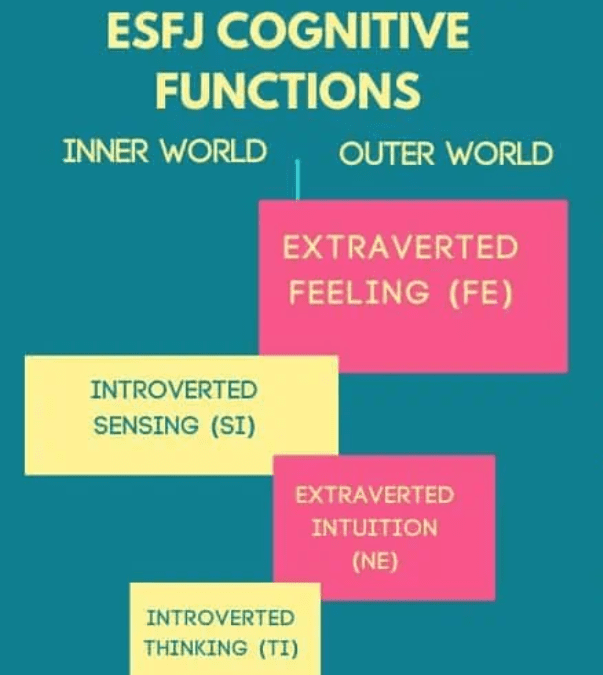
ESFJ = Fe–Si–Ne–Ti
Dominant - Extraverted Feeling (Fe)
Auxiliary - Introverted Sensing (Si)
Tertiary - Extraverted Intuition (Ne)
Inferior - Introverted Thinking (Ti)
All these elements are like a “team” inside the ESFJ mind:
Fe- holds responsibility and decides what matters socially
Si- assists memory, structure, and consistency
Ne- provides options and fresh perspectives
Ti- looks for logic, when it has enough energy to show up
1) Dominant Function: Extraverted Feeling (Fe)
ESFJ’s core function is Fe; it is how they connect, decide, and often how they “read” the world.
What does "Fe" mean?
Fe asks basic questions:
“What choice creates the most harmony (or least harm)?”
“What’s the emotional climate here?”
“What do people need right now?”
ESFJs with a strong Fe often tend to make quick, socially informed judgments. The decisions are based on tone, body language, context, and group values.
What does Fe look like in real life?
An ESFJ individual who is using Fe well might:
Notice that someone is quiet and check in gently
Always remember who needs space vs who needs encouragement
Before it becomes conflict, smooth tension in a group
By making them feel included and capable, motivate people
Fe offers an explanation as to why ESFJs tend to be community-oriented and feel fulfilled when they’re useful to others.
Strengths of Fe:
Strong relational commitment and loyalty
High social awareness
Conflict resolution instincts
Natural supportiveness and encouragement
Blind spots of Fe
Since Fe is outward and focused, ESFJs can sometimes:
Struggle with “I don’t know what I want” until they get feedback
Overprioritize approvals
Absorb other people’s moods like a sponge
This is Fe orienting to external data and can look like insecurity from the outside.
2) Auxiliary Function: Introverted Sensing (Si)
An ESFJ’s internal library is Si, a system that stores experience and organizes it into usable knowledge.
What does Si do?
Si keeps record of:
Internal “rules” that are built from experience
The routines and what works
Details about people and past events
Familiar sensory preferences in comfort, environment, stability, etc.,
Based on what was previously proven safe, meaningful, or effective helps ESFJs decide what’s “right” or “wrong”.
How Si supports Fe
This is how the combination works: Fe notices what people need and Si remembers what has helped according to the past experience..
That is exactly why ESFJs often excel at:
Managing practical responsibilities in relationships and teams
Remembering birthdays, preferences, triggers, and boundaries
Creating traditions that make people feel grounded
Si strengths:
Strong sense of responsibility
Dependability and follow-through
Comfort-building (home, routine, rituals)
Detail memory for people and events
Si pitfalls:
Under stressful conditions, Si can become rigid:
“Change feels like a risk.”
“This is how it should be.”
“We’ve always done it this way.”
This is exactly where the next function Ne becomes important.
3) Tertiary Function: Extraverted Intuition (Ne)
Among the ESFJ’s Ne is the “idea explorer” however, it is not their main role but it adds flexibility and creativity especially as they mature.
What does Ne do?
Ne looks for:
“What could be” rather than “what has been”
Patterns
Alternative interpretations
Possibilities
For ESFJs the Ne often shows up as:
Finding creative ways to solve interpersonal problems
Playful brainstorming
Seeing potential in people
Ne’s main job in the ESFJ stack
Ne prevents the Si from turning into a cage. A developed Ne helps an ESFJ think:
“Maybe I can adapt instead of forcing control.”
“Maybe there’s another explanation.”
“Maybe this conflict isn’t personal.”
During phases of uncertainty, this makes ESFJs more resilient like, new jobs, changing friendships, moving cities, shifting identity.
Pitfalls of Ne:
Ne can also feel scattered, because its tertiary:
“If I choose one path, I lose the others”
Too many options → decision fatigue
ESFJs may retreat back into Si routines or Fe reassurance-seeking, when they feel overwhelmed by possibilities.
4) Inferior Function: Introverted Thinking (Ti)
The weakest conscious function of ESFJ is Ti, meaning it often feels effortful, slow, or uncomfortable. But the twist here is that -Ti is also a huge growth doorway.
What does Ti do?
Ti focuses on:
Asking “Does this actually make sense?”
Internal logic and precision
Spotting inconsistencies
Defining terms clearly
Ti helps separate:
What is logically coherent
What feels true socially from
How inferior Ti shows up
If the Ti remains underdeveloped, ESFJs may struggle with:
Over-explaining or second-guessing, because they’re trying to “prove” something logically
Abstract debate without a “real-world purpose”
Being pressured to justify a decision with pure logic
Advantage of developing Ti
A developing or developed Ti helps ESFJs:
Evaluate criticism without collapsing into shame
Set boundaries without guilt
Avoid people-pleasing spirals
Think independently even when the group disagrees
In short: Ti helps the ESFJs to keep their kindness without losing themselves.
You can also read more about - INTP Cognitive Functions: Into the Ti–Ne Mind
How the ESFJ Cognitive Functions Work Together (Fe–Si in Real Life)
If you want to know the standard ESFJs then it's this loop:
Fe scans the environment: What’s the vibe? Who needs what?
Si references from memory: What’s appropriate here? What has worked before?
Ne suggests various possibilities and options: Maybe this time we can try a new approach.
Ti checks for the structure: Is this fair? Does this add up? Is this consistent?
ESFJs live strongly in Fe–Si, with Ne and Ti supporting in the background, most of the time.
ESFJ Cognitive Functions Under Stress: The “Grip” Pattern
Stress as described by many functional models is like a moment when the inferior function takes over in an unbalanced way, often called an inferior “grip”.
For most ESFJs, this can look like Ti-grip stress:
Feeling disconnected from people but also craving reassurance
Suddenly becoming harshly critical
Replaying conversations for flaws
Obsessing over details and “being right”
It is like the ESFJs mind tries to restore control using a function it doesn’t normally lead with and not that they “turn into thinkers.”
What helps in this situation?
Simple logic checks (“What evidence do I have?”) rather than over-analysis
Reducing overwhelm (sleep, food, movement)
One trusted conversation (Fe in safe mode)
Grounding routines (healthy Si)
How ESFJ Cognitive Functions Can Grow, Without Changing Who They Are
For ESFJs in terms of growth it's not about becoming cold or detached instead it’s about balance.
1) Keep Fe, but add boundaries - Ti support
ESFJs can practice phrases like:
“That doesn’t work for me.”
“I care, but I can’t take this on.”
“I need time to think.”
2) Make Si the foundation and not prison
Keep the rituals intact but intentionally add small experiments:
Learn something purely for curiosity
Try a new route
Talk to someone outside your usual circle
This is exactly Ne strengthening.
3) Train Ne to reduce black-and-white social interpretations
When one feels rejected try asking these questions:
“What would I tell a friend in this situation?”
“What are 3 other explanations?”
4) Use Ti moderately or gently
Do not “prove it,” instead think “clarify it.”
Separate facts from interpretations
Define what you mean
Write your reasoning in 3 bullet points
ESFJ Cognitive Functions & Relationships
ESFJs often show love practically and love deeply:
Making you feel included
Remembering what matters to you
Providing stability
Potential friction points of ESFJs:
Feeling responsible for others’ emotions
Conflict avoidance to preserve harmony
Resentment if giving isn’t appreciated
Relationship advice for ESFJs:
Let Ti help you name what’s fair
Ask for appreciation directly (it’s allowed)
Don’t confuse “peace” with “silence”
ESFJ Cognitive Functions at Work
The ESFJs often are better off in environments that involve:
Visible impact
Coordination
Practical systems
People-care
Fe–Si gives them strengths in:
Operations and organization
Team morale
Client relationships
Onboarding/training
Note: If ESFJs want leadership that lasts, cultivate Ti for decision clarity and Ne for change-readiness.
FAQs: ESFJ Cognitive Functions
1) What are the ESFJ cognitive functions in order?
Fe → Si → Ne → Ti dominant to inferior.
2) Are ESFJs emotional or logical?
ESFJs often decide using Fe, social values and harmony, but they can be logical especially when Ti is developed.
3) Why do ESFJs hate conflict?
Many ESFJs experience conflict as a threat to relational stability (Fe), and they work hard to restore balance. With maturity, they learn that honest conflict can create deeper harmony.
4) What does inferior Ti look like in ESFJs?
Overthinking, sudden nitpicking, harsh self-criticism, or getting stuck trying to justify a decision logically under pressure.
5) Can an ESFJ become more independent?
Yes—by strengthening Ti boundaries and Ne flexibility while keeping Fe warmth intact.
Also read more about brain and its creativity - Click Here