Why Awareness of Cognitive Biases Is the First Step to Change
The first step to overcome cognitive biases is awareness, the brain cannot correct a thinking error it does not recognize. Cognitive Biases occur automatically and unconsciously, they shape judgments, beliefs, and decisions without our awareness. Rather than distorted, the brain treats it as accurate until a bias is detected.
According to neuroscience, awareness activates metacognition, the brain’s ability to monitor and evaluate its own thinking. This involvement allows higher-order control systems, particularly in the prefrontal cortex, to interrupt automatic biased responses and introduce reflection, doubt, and alternative interpretations.
In short,
- If a bias cannot be identified and it feels like truth, it cannot be corrected.
- It becomes negotiable, only when it becomes visible.
Therefore, this is the reason why awareness is not the solution itself, but it is the essential starting point for reducing the influence of cognitive biases.
We make lots of decisions in a single day, what to believe, who to trust, what to ignore, and how to act. To us most of these decisions feel deliberate and rational. Despite this feeling neuroscience and psychology tell a different story: much of our thinking is shaped by invisible shortcuts known as cognitive biases. Cognitive biases are an important factor that decide how we perceive reality, evaluate information, and judge ourselves and others. They are a fundamental feature of the human brain and are not flaws. This helps us raise a major question: “Why is awareness of cognitive biases considered the first step toward overcoming them?” The answer to this question lies in how the brain monitors itself. Read further to know more about Cognitive Biases.
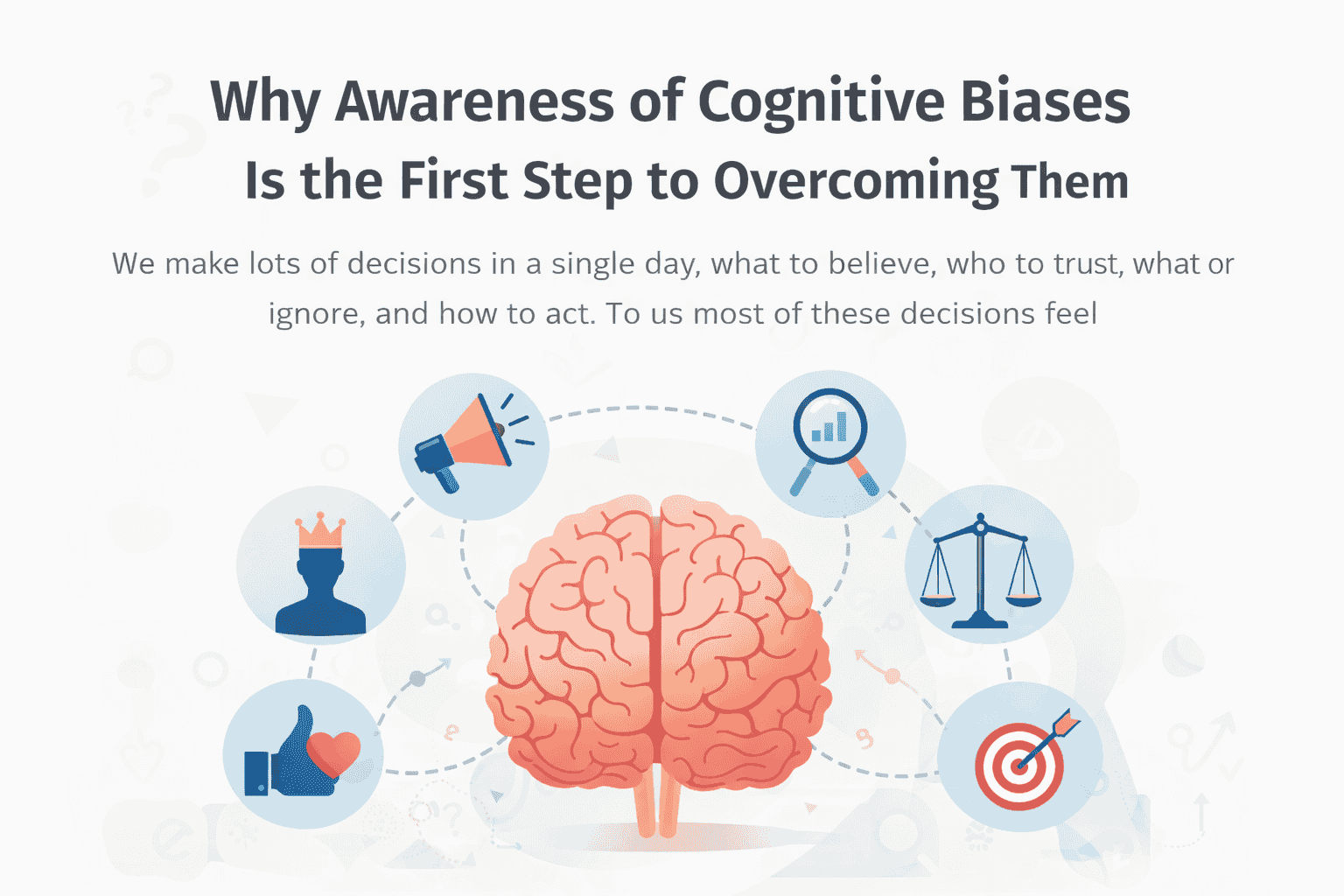
The first step to overcome cognitive biases is awareness, because it enables error detection, metacognition, and conscious regulation of automatic thinking. Biased judgments feel correct and remain unchallenged, without awareness.
What Are Cognitive Biases?
Systemic patterns of diversions from rational judgement are known as Cognitive Biases. They are a result of our brain's natural tendency to make fast and efficient decisions under uncertainty. There are types of Biases:
Anchoring bias
Overconfidence bias
Availability heuristic
They help our brains to conserve energy, but most often at the cost of accuracy. Interestingly, these biases operate below conscious awareness, automatically. This is one of the main reasons why awareness of biases matters.
Cognitive Bias | Roles | How Awareness Aids |
Confirmation Bias | Prefers and favors information that supports the preexisting beliefs | Promotes to look for contradictory evidence |
Availability Bias | Overweighs examples that are simple to remember | Encourages verifying actual data and base rates |
Overconfidence Bias | Increases our confidence in judgments | Promotes uncertainty and verification |
Anchoring Bias | Fixates on preliminary data | Aids in independent decision reevaluation |
Hindsight Bias | Makes results appear predictable after the fact | Enhances the ability to learn from errors |
Negativity Bias | Gives unpleasant experiences more weight | Balances the interpretation of emotions |
Authority Bias | Overvalues the opinions of those in positions of authority | Promotes independent assessment |
The Brain Cannot Correct What It Cannot Detect
The most crucial factor is awareness because the brain cannot correct something that does not appear like a problem to it. Behavior change needs an important step of - error detection. The brain is dependent on the monitoring systems, particularly in the prefrontal cortex and anterior cingulate cortex. They help in detecting conflicts between expectations and reality. These systems are never activated, if a bias remains unconscious.
In short: If you brain doesn’t register it as an error, you simply cannot correct a thinking error. Awareness about biases brings them into conscious processing where they can be evaluated, questioned, and regulated.
Brain Region | Role in Bias Awareness |
Prefrontal Cortex | Reflective thinking, inhibition of automatic responses |
Anterior Cingulate Cortex | Error detection and conflict monitoring |
Insula | Awareness of internal states and emotional bias |
Default Mode Network | Self-referential thinking and belief maintenance |
Awareness Activates Metacognition
Conscious awareness about cognitive biases is like thinking about thinking and is a form of metacognition. It allows us to step back and ask ourselves:
Could I be wrong?
Why do I believe this?
What assumptions am I making?
Neuroscientific research about cognitive biases shows us that when people are aware of biases, they are more likely to:
Engage in slower, more analytical thinking
Pause before responding
Consider alternative explanations
This step back engages with System 2 thinking (as described by Daniel Kahneman), which is more deliberate and less error-prone than intuitive responses.
Biases Feel Like Truth — Awareness Creates Distance
Another important reason why cognitive biases are powerful is that they feel true. For instance:
Hindsight bias feels like insight
Confirmation bias feels like “common sense”
Overconfidence feels like certainty
Awareness about biases brings in psychological distance between the thought and the thinker. Instead of: “This must be right.” The mind learns to say: “This might be my bias speaking.” This tiny shift in thinking is transformative.
Awareness Reduces Overconfidence in Judgment
Many cognitive biases are based on the belief that our perceptions are objective and accurate and they thrive on overconfidence. Studies have shown that only being aware about biases:
Increases openness to correction
Reduces excessive certainty
Encourages information-seeking behavior
When an individual recognizes that everyone is vulnerable to bias, they become more careful about their conclusions and more willing to revise them. This humility towards our decisions is essential for rational decision-making.
Awareness Enables Strategic Intervention
Biases operate automatically, without awareness. With the help of awareness, individuals can make use of bias-reduction strategies, such as:
Actively consulting diverse perspectives
Seeking disconfirming evidence
Using structured decision frameworks
Considering base rates
Slowing down decision-making
These strategies reduce the impact of biases but do not eliminate them completely. Awareness helps turn bias from an invisible force into a manageable influence.
Element | Without Awareness | With Awareness |
Decision speed | Fast, automatic | Slower, deliberate |
Error detection | Rare | More frequent |
Openness to feedback | Low | High |
Confidence calibration | Overconfident | More realistic |
Long-term learning | Limited | Improved |
Awareness Changes Long-Term Behavior, Not Just Single Decisions:
Repeated awareness can reshape habits of thought, over time. Research shows that:
New decision patterns can become habitual
Repeated conscious reflection strengthens prefrontal control
Automatic responses become easier to interrupt
It is not just a momentary insight; it is the foundation for long-term cognitive change.
Awareness Improves Social Understanding and Communication
Cognitive biases shape how we interpret others and do not only affect individual thinking. It helps them recognise:
Misinterpretations of intent
Attribution errors
In-group/ out-group biases
Stereotyping
This in turn leads to:
More constructive dialogue
Better listening
Reduced defensiveness
This awareness is critical for collaboration and leadership, in social and professional contexts.
Why Awareness Alone Is Not Enough but Still Essential
It is very important to be honest with yourself: Cognitive biases are not magically eliminated by awareness. Even experts fall prey to them, and biases are deeply rooted in neural architecture and evolutionary history. However:
Change is impossible, without awareness.
Improvement becomes possible, with awareness.
Awareness is not the solution itself, instead it's one step towards improvement.
From Invisible Bias to Informed Choice
Cognitive biases are signs of a brain optimized for survival, speed, and efficiency does not sign of intellectual weakness. Blind reliance on intuition is no longer enough in a world that demands critical thinking, complex decisions, and social understanding. It is the reason why awareness of cognitive biases is the first and most essential step toward overcoming them.
Frequently Asked Questions (FAQs)
1. Why is consciousness considered the initial step rather than subsequent ones?
Because awareness triggers metacognition, the brain's capacity to keep an eye on and assess its own thought processes. Corrective measures cannot be implemented without first identifying a prejudice. Conscious control systems can see bias when they are aware of it.
2. Is it possible to totally eradicate cognitive biases?
No, neurological and evolutionary limitations are the source of cognitive biases. However, awareness and intentional tactics might lessen their impact, particularly in high-stakes or thoughtful decision-making.
3. Does conduct alter when one is aware of biases?
Indeed, but gradually. According to research, awareness enhances decision quality over time, decreases overconfidence, and increases pause-and-reflect behavior—especially when combined with structured thinking tools.
4. Are those with higher levels of education or intelligence less prejudiced?
No, because people become more adept at defending their opinions, intelligence can sometimes exacerbate prejudices. The influence of bias is lessened by awareness rather than intelligence alone.
5. Why do prejudices seem so plausible even when they are false?
due to the natural and emotionally reinforced nature of prejudices. Biased conclusions are seen by the brain as subjective truth. Awareness creates a gap between emotion and reality.
6. Can confirmation bias be addressed with awareness alone?
Although essential, awareness is insufficient. It needs to be paired with deliberate actions like looking for contradicting facts and interacting with different points of view.
7. What is the connection between critical thinking and awareness?
A fundamental component of critical thinking is awareness of cognitive biases. It enables people to assess not only data but also the process itself by
8. Why do cognitive biases continue to exist even after we become aware of them?
because biases are effective brain processing shortcuts. While awareness does not eliminate them, it does enable the brain to override them when precision is more important than speed.
9. How can awareness of biases be practiced daily?
By:
Reflecting on past judgment errors
Questioning initial reactions
Slowing decisions under emotion
Asking “What evidence would prove me wrong?”