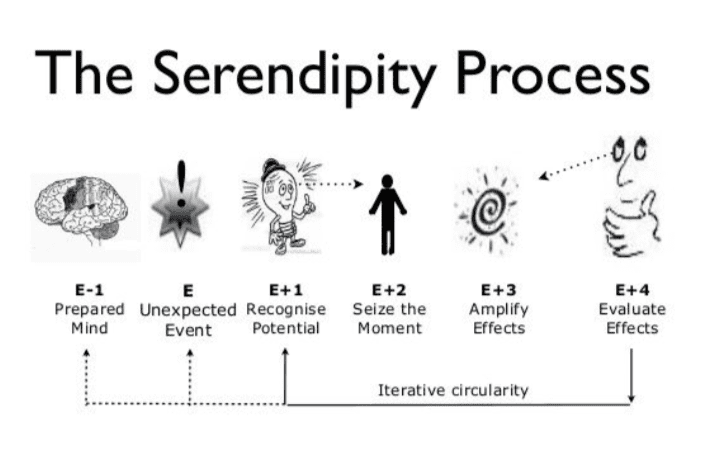
The Neuroscience of Serendipity: Why Accidents Lead to Innovation
Have you also ever tried following a recipe and failed? Then you had to try out a different recipe, and it turned out way better than your original plan. You clicked on the wrong link but stumbled upon something very interesting. Due to traffic, you took a different route and discovered an amazing cafe. Or heard of something called as Neuroscience of Serendipity?
These unexpected discoveries or moments might feel like luck, but according to the neuroscience of serendipity, your brain has been quietly turning chaos into clarity all along. This is because your brain just tries to clear the clutter and come to a meaningful conclusion during such events.
There are many such examples from the neuroscience of serendipity, like the discovery of Penicillin, to the invention of Post-it notes, serendipity often hides inside mistakes. The real wonderful powers are your brain’s ability to find patterns in randomness, transforming “oops” into “oh wow!”
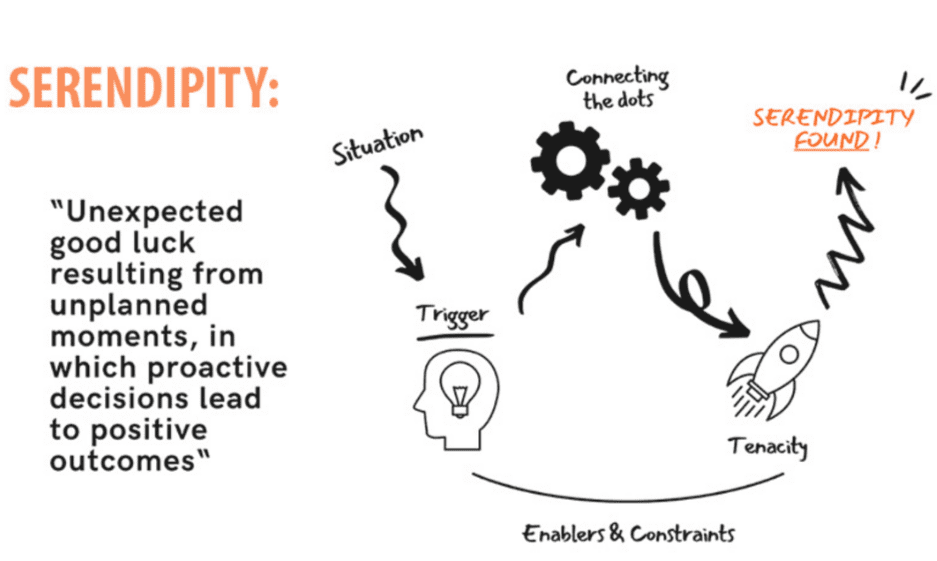
What is Serendipity?
Serendipity is when a positive event is a result of a mistake, error, or an unexpected event. It could also mean finding something good or useful without looking for it. It is a happy accident, a lucky discovery made by surprise.
Famous Example of “The Discovery of Penicillin”
- Scientist Alexander Fleming once accidentally left a petri dish open.
- He had initially planned to grow bacteria, but the dish grew mold.
- In this process, he noticed that the mold killed the bacteria around it.
- The mold released a substance that could kill harmful bacteria, and he identified it as Penicillium notatum and named it Penicillin.
- This was an unexpected accident that led to the discovery of penicillin, the world’s first antibiotic, which has saved millions of lives.
Neuroscience of Serendipity: In short
Unexpected event
↓
Brain detects a mismatch
(Prediction Error)
↓
Attention shifts to the anomaly
(Salience / Frontal Networks)
↓
Dopamine evaluates the surprise:
• “Bad?” → Ignore or avoid
• “Good?” → Explore more
↓
Information linked with memory
(Hippocampal binding)
↓
New insight, idea, or solution
→ Serendipitous discovery
When Error Meets Opportunity:
Serendipity is your brain’s ability to recognize value in the unexpected or the erred, it relies on the interaction of several systems:
- Error Signals Prediction: Your brain generates a prediction error, when something surprising happens. For example, when you say, “This wasn’t supposed to happen.” This prediction error signal activates learning circuits.
- Dopamine Release - Reward System: If this unexpected outcome turns out to be interesting or useful there is a surge of Dopamine. Now the Dopamine says, “Pay attention — this is important.”
- Dopamine Release - Reward System: If this unexpected outcome turns out to be interesting or useful there is a surge of Dopamine. Now the Dopamine says, “Pay attention — this is important.”
- Flexible Attention Networks: Your brain's attention is now redirected from the original goal towards the surprising event. This attention diversion is controlled by the Salience Network.
- Memory Integration by Hippocampus: It is this step that is the basis of aha-moments, the brain quickly links the surprising event with stored knowledge, allowing you to form new connections.
This is an example of how overall neural efficiency enables innovation, also one of the principles discussed in Billion Neuron Theory.