Is Gut Feeling Real? The Neuroscience of Intuition Explained
Have you also felt something was right or wrong before you could logically explain it? A quiet inner voice that says, “Trust this,” or “Something feels off.” It is the gut feeling which makes you think that you know something and do not even know the right explanation. At once, the instant sense, the “gut feeling” more often seems weird or unknown to us.
Whereas the neuroscience of intuition says it is not magic, in fact it is the brain’s way of processing information rapidly, below the level of conscious awareness. Your neural networks are already comparing patterns, scanning memories, and predicting outcomes, long before your conscious mind constructs an explanation. In short, it is your brain thinking fast below the surface of awareness.
However, intuition is often the compressed result of experience, learning, and emotional memory operating at high speed.
What Is Intuition or Gut Feeling?
Intuitions are decisions or judgements made without too much thinking or deliberate reasoning. A famous psychologist Daniel Kahneman has bifurcated in two types of thinking:
- Type 1: It is fast, emotional, automatic and intuitive
- Type 2: It is slow, includes some logic and is analytical.
Whenever you “go with your gut,” your brain relies on Type 1, which is a fast pattern-based system that operates unconsciously. To reach conclusions quickly, it relies on stored memories, experiences, and emotional cues. All of this, however, conveys to us that intuition is not simply “emotional thinking.”
In short, Type 1 processing includes pattern recognition, memory associations, and rapid threat detection. Because it has been trained by past experience, it operates automatically. The more exposed our brain is to a certain environment, the more refined this fast system becomes. This offers an explanation as to why experts often rely on intuition successfully. Over time, their brains have encoded thousands of micro-patterns. It is often the result of years of unconscious data accumulation, what feels like a sudden insight.
**Medical Disclaimer - This article is for educational purposes and does not replace clinical or professional advice.
How Your Brain Works with Intuition?
Neuroscientific research has revealed that intuition involves several interconnected brain regions:
- Amygdala and Insula: These emotional centers alarm even before conscious thought, they respond instantly to environmental cues, generating feelings of comfort.
- Prefrontal Cortex: The PFC guiding rapid decision-making by integrating emotional and sensory information.
- Basal Ganglia: Basal Ganglia allows the brain to recognize familiar situations without active analysis with the help of stored learned patterns and habits.
When all of these brain areas work together, they generate an “intuitive signal”, a physical or emotional sensation that guides your response.
The above regions mentioned do no work in isolation. Hence, intuition is a result of network interaction. The amygdala evaluates emotional relevance, basal ganglia detect familiar patterns, and the insula translates internal body states into conscious sensations. At the final stage the prefrontal cortex then integrates this rapid signal into a decision.
Neuroimaging studies show that even before a person reports conscious awareness of choosing, intuitive decisions often activate brain regions within milliseconds. Suggesting that the brain begins forming decisions prior to deliberate reasoning consciousness catches up later.
Why Intuition Feels Physical? The Gut–Brain Connection.
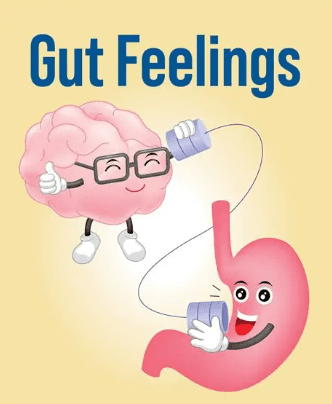
The uneasy or warm sensation in your stomach is not just poetic, it's biological. The commonly known “second brain”, the enteric nervous system, communicates constantly with the brain through the Vagus Nerve.
Because the enteric nervous system contains hundreds of millions of neurons and communicates bidirectionally with the brain. Even though it cannot “think” independently in the way the brain does, it reflects emotional states and autonomic responses. When something feels uncertain or threatening, sometimes before you can verbalize why, your body reacts.
This feedback in turn reinforces intuitive awareness. The interpretation of gut feeling is often your brain integrating memory, emotional tone, and physiological response into a single signal.
When you encounter a familiar situation, your brain also detects something familiar, threatening, or emotionally charged. Now your gut responds with physical cues such as tightness, fluttering, or calmness. This is the connection between the gut and the brain and this brain–body feedback loop helps translate unconscious processing into tangible “gut” feelings.
Can You Trust Your Intuition?
It works best in environments that are stable and predictable. Especially in case of people with expertise, intuition can be remarkably accurate. For example, doctors, experienced firefighters, and chess players more often rely on intuition. This is because their brains have stored years of experience in the form of patterns and outcomes.
But it can become unreliable in unfamiliar or emotionally charged situations. The brain may misinterpret patterns, when fear, bias, or limited experience dominate. Sometimes the amygdala can overgeneralize these kinds of threats. Experiences in the past with a negative impression can distort perception. In such cases intuition may feel intense but it can also be inaccurate. They most important factor is the quality of the experience; intuition is only as good as the patterns it has been trained on.
However, intuition isn’t infallible, it is not guaranteed. Intuition is guided by bias, emotions, and past experiences. Sometimes, under stress or fear, the amygdala may overreact, leading to poor snap judgments.
Neuroscientific evidence shows that intuition is reliable when grounded in relevant knowledge, but misleading in unfamiliar situations. Most neuroscientists emphasize that the accuracy of intuition depends on experience and context.
Research Insights to Intuition:
Numerous research studies on decision making suggest that intuitive accuracy improves when feedback is immediate and consistent. Over time, in professions where outcomes are clear and repeated, intuitive circuits refine. Whereas in environments with delayed or ambiguous feedback weaken intuitive reliability.
Thus, intuition in high-skill domains can appear almost supernatural but in everyday ambiguous decisions, it may require logical verification.
Training the Intuitive Brain:
Although intuition may feel like something innate, the truth is that it can be developed. Many studies reflect that repeated practice, feedback, and reflection strengthen the neural circuits behind pattern recognition. Let's see how to refine “gut feeling” neuro-scientifically:
- Expose yourself to diverse experiences: Exposing yourself to diverse experiences will expand the brain’s internal database. This will in turn result in faster and more accurate predictions.
- Reflect on past decisions: If you reflect on your past experiences, it helps your brain learn from intuitive successes and mistakes.
- Balance intuition with reasoning: Allow the Type 2 thinking, which is slow, logical and analytical to verify what Type 1 thinking suggests.
Sleep also plays a major role in intuitive processing. Especially during the REM stages of sleep, the brain reorganizes information and strengthens associative networks. This the reason why sometimes insights emerge suddenly in the morning or after rest, because the brain has been integrating patterns offline.
By reducing cognitive noise and emotional reactivity, mindfulness practices may also improve intuitive awareness. It allows subtle internal signals to become more noticeable without being overwhelmed by anxiety or impulsivity.
Neuroscience Of Intuition:
Neuroscientific studies, suggest that intuition is a predictive mechanism, it is a rapid, subconscious form of thinking, the brain’s shortcut built on memory, experience, and emotion. The brain constantly forecasts what will happen next based on past experiences. It is like building an internal model of the world and updating it with newer information. Before conscious reasoning fully evaluates it, intuition arises when these predictive systems generate a rapid conclusion
The next you sense something without knowing why, remember that your brain might have rapidly processed the answer. It is the because of the brain’s internal model saying, “Based on what I’ve seen before, this is likely.”
Evidence Based Facts About Intuition:
- Your gut has around 500 million neurons which is almost equal to a cat’s brain.
- Long before conscious reasoning kicks in, intuitive decisions are made in milliseconds.
- Some HRV (Heart rate variability) studies suggest that your body can anticipate emotionally charged events seconds before they even occur.
- EEG evidence studies have shown that during intuitive decision-making; experienced professionals show faster activation in the prefrontal cortex.
- Your brain continues these pattern processing during sleep, sometimes surfacing insights as “gut feelings” upon waking and Dream intuition do exists.
Summary:
Intuition does not mean that it is the opposite of logic, it is the brain’s rapid prediction system operating below awareness. Especially when built on experience, it is accurate. And sometimes it requires verification. The best of the decisions that we make come from collaboration of intuition and logic. However, intuition offers speed and direction; reasoning offers evaluation and refinement. The next time you encounter a gut feeling, pause and ask yourself whether it is grounded in experience or driven by fear. Your brain can be already working ahead of your awareness but understanding how it works allows you to use it wisely.
Neuroscience of Intuition: Q&As
Q1: Is intuition just emotions?
Answer: Not really, intuitions are influenced by emotions, but it also depends on memory, pattern recognition, and learning.
Q2: Can intuitions go wrong?
Answer: Yes, they can go wrong, when they are based on limited or biased experience. Especially in new situations, intuition can mislead.
Q3: Can you improve your intuitions?
Answer: Yes, regular practice, reflection, and mindfulness strengthen neural connections related to intuitive processing.
Q4: Why do we feel intuition in our stomach?
Answer: It is because of the gut–brain axis, a network that converts subconscious brain activity into physical sensations.
Q5: Are women more intuitive than men?
Answer: According to neuroscience of intuition there is no biological difference. The strength of intuition depends more on experience and emotional awareness than gender.
Related Neuroscience Articles:
If you are curious to read more about brain, its stories and anecdotes - Beneath the Stars and Beyond.