What Do Alpha, Beta, Theta, Delta, and Gamma Brain Waves Actually Mean?
We already know that your brain keeps generating electrical activity throughout the day. But what is more interesting is that your brain never actually stops producing electrical activity, not even when you're asleep. Only the type of electrical activity changes depending on what you're doing.
If you are in deep sleep, your brain produces slow, rolling waves. When you're solving a puzzle, the waves become faster and tighter. Like these examples, scientists have divided these patterns into five main types: delta, theta, alpha, beta, and gamma.
Each wave type tells us what the brain is doing at that moment. In this article, we will explore what each brain wave actually means, what it feels like, and what I see when these waves appear on the EEG screen in my lab.
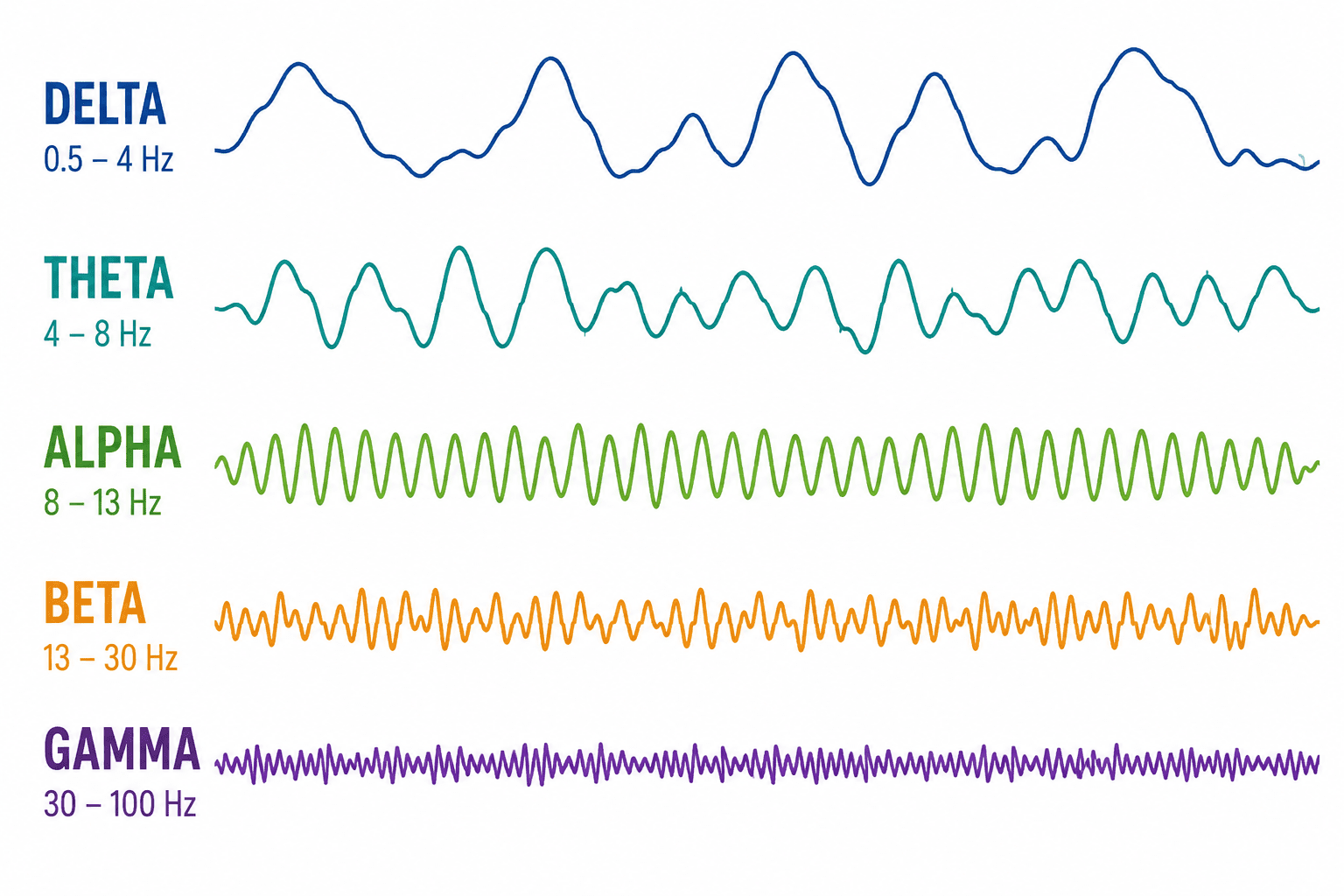
What Are EEG/Brain Waves?
- EEG, or brain waves, are produced by large groups of neurons firing together and are different patterns of electrical activity.
- They are also called EEG waves because they are measured by EEG (electroencephalography)
- Measured by the number of cycles per second in Hertz (Hz).
- Slower frequency means fewer cycles per second and therefore means brain is less actively processing
- Higher frequency implies more cycles per second and the brain is more actively processing
- ANALOGY—Imagine it like gears in a car: 1st gear (delta) is slow and powerful; 5th gear (gamma) is fast and precise
- All five EEG/brain waves are present in the brain at all times, but one type of wave is always DOMINANT depending on your state.
- No single brain wave is superior to another; you need all five, and the brain constantly shifts between them.
Delta Waves (0.5–4 Hz) — Deep Sleep Wave
What are they?
- The slowest brain waves with highest amplitude
- Their frequency ranges from 0.5 to 4 Hz
- Delta waves are dominant during deep, dreamless sleep (Stage 3/slow-wave sleep)
How do they support brain function?
- They are essential for physical recovery and healing.
- The body releases growth hormone during delta-dominant sleep
- Serve to be important for immune system function
- It is like "housekeeping"—clearing waste products by the brain.
How are they identified on an EEG tracing?
- Slow, big, and rolling waves, like ocean swells on a calm day.
- Are very easy to spot on a recording
When delta appears in the wrong place:
- Delta waves in an awake adult can indicate brain injury, a tumour, or encephalopathy
- In neonatal EEG, delta is NORMAL—babies' brains are dominated by slow activity
Delta waves are the most common pattern I see routinely in neonatal EEG recordings. In premature neonates' brains, dominant slow delta activity is seen. One of the most fascinating parts of my work is watching these slow waves gradually become faster as the baby matures. It is like watching the brain develop in real time.
Theta Waves (4–8 Hz) — The Daydreaming Wave
Definition:
Theta waves are slow waves but faster than delta, with a frequency range of 4 to 8 Hz. They are dominant during drowsiness, light sleep, deep relaxation, and meditation.
Functions:
- Associated with creativity, intuition, and memory formation
- Seen during REM sleep or dreaming
- Are linked to moments of insight and "flow states"
- Theta comes with that feeling when you get a great idea in the shower.
EEG Appearance:
- They are slightly faster than delta, smaller in height and often appears in the frontal and temporal regions
Example:
- You are driving on a familiar road, and suddenly you realize that you don't remember the last 10 minutes. In this case your brain was generating theta.
- A drowsy state just before falling asleep when random images and thoughts appear.
When does theta appear in the wrong place?
- Excessive theta during waking tasks indicates ADHD, fatigue, or cognitive slowing
- In comparison to adults, in children more theta is normal.
In consumer neuroscience studies, I often see theta activity increase when participants become disengaged or bored with a stimulus. During such studies, a sudden spike in frontal theta often tells us more about consumer engagement than any survey response could.
Alpha Waves (8–13 Hz) — The Relaxation Wave
Understanding the Wave:
- Alpha waves are the first brain wave ever discovered by Hans Berger in 1929.
- Frequency range of 8 to 13 Hz
- They are dominant during relaxed wakefulness, eyes closed and calm but alert.
Physiological Significance:
- It is a bridge between the subconscious mind and conscious thinking.
- Seen when you close your eyes and relax.
- The wave decreases when you open your eyes or start actively thinking; this is called alpha suppression or alpha blocking.
- Also associated with a calm and present mental state.
EEG Visualization:
- Rhythmic type of waves, the most "textbook" looking brain wave.
- Most prominently present in the occipital regions—back of the head.
- They disappear the moment you open your eyes or start concentrating on a given task.
Alpha blocking experiment:
- Classic EEG demonstration: close your eyes → alpha appears → open your eyes → alpha instantly disappears
- This is called Berger's Effect and is one of the first things EEG students learn
When is the alpha abnormal?
- Reduced alpha indicates anxiety, stress, or insomnia.
- Asymmetric alpha can indicate brain pathology (stronger on one side or only seen on one side).
One of the key measures in our sensory neuroscience studies is alpha suppression. The alpha power drops significantly in the somatosensory cortex when a participant touches a product. This tells us that the brain is actively processing that touch. This event is called Event-Related Desynchronization (ERD) and is one of the most reliable indicators of neural engagement.
These differences in alpha ERD between products revealed neural preferences that behavioral ratings alone could not detect.
Internal link opportunity: Link to Post 1 (What is an EEG) when mentioning Berger's discovery.
Beta Waves (13–30 Hz) — The Active Thinking Wave
How are they defined?
- Fast, low-amplitude waves with a frequency range of 13 to 30 Hz. They are dominant during active thinking, problem-solving, conversation, and focused attention.
What is their function?
- The waves are associated with alert, engaged, analytical thinking.
- Appear on the screen while you're reading, writing, working, or having a conversation
- Excessive beta is linked to anxiety and overthinking
Sub-bands:
- Low beta (13–15 Hz)—seen when you are relaxed but focused, like reading a book
- Mid beta (15–20 Hz)—while active thinking and engagement
- High beta (20–30 Hz) - during intense focus, anxiety, or stress
What pattern do they produce on EEG?
- Fast and small waves spread across the frontal and central regions of the brain.
For example:
- Right now, as you are reading and understanding this article, your brain is constantly producing beta waves
- Seen during an exam, a heated argument, or an intense concentration phase.
When are the beta waves abnormal?
- Elevated beta activity is associated with anxiety disorders, insomnia, and OCD
- Low beta activity indicates ADHD or difficulty concentrating.
In my daily work, I pay close attention to frontocentral beta activity. This is because when participants evaluate different stimuli given, an increase in beta over frontal areas often indicates deeper cognitive engagement. This means that the brain is is actively comparing, judging, and forming preferences. When this scenario is combined with alpha suppression data, beta gives us a more complete picture of how the brain responds to sensory experiences.
Gamma Waves (30–100 Hz) — Higher Consciousness Wave
What are gamma waves?
- They are fastest brain activity known
- The frequency range is between 30 and 100+ Hz (although some researchers also narrow it to 30–45 Hz)
- It is dominantly seen during, peak concentration, high-level information processing, moments of insight
What processes are they associated with?
- They are commonly seen when the brain tries to bind different sensory inputs into a unified perception
- Also active during "aha!" moments and insights
- It is also linked to advanced meditation states (experienced monks show very high gamma)
- Most important for learning, memory formation, and attention
How can they be recognized on EEG?
- Difficult to measure due to their very fast and very small amplitude nature.
- Are also easily contaminated by muscle artifacts (facial muscles produce similar frequencies)
- Needs keen observation and careful analysis to separate real gamma from noise
Why are the gamma waves controversial?
- Some researchers have questioned if scalp EEG can reliably measure gamma.
- Biggest issue is muscle contamination.
- However, if genuine gamma is detected, it is considered a marker of higher cognitive processing
In my daily lab work, I have not ever encountered gamma waves. Although I have heard that the frequency range overlaps with muscle artifact—a quick jaw clench produces electrical activity in the gamma range. These are the type of waves that consumer EEG devices rarely account for, which is why claims about 'boosting your gamma waves' from meditation apps should not be believed instantly.
Five Brain Waves Working Together:
- The brain can never only produce a single type of wave
- All the five brain waves are present simultaneously, but one of them can dominate at any given time.
- Think of it like an orchestra: all instruments play at once, but sometimes the violins are louder, sometimes the drums
State transitions through the day:
- Waking up shows a transition of delta → theta → alpha
- Starting work goes from alpha → beta
- Deep focus exhibits beta → gamma
- Taking a break means beta → alpha
- Falling asleep starts with alpha → theta → delta
- Dreaming (REM): theta with bursts of gamma
Quick Overview:
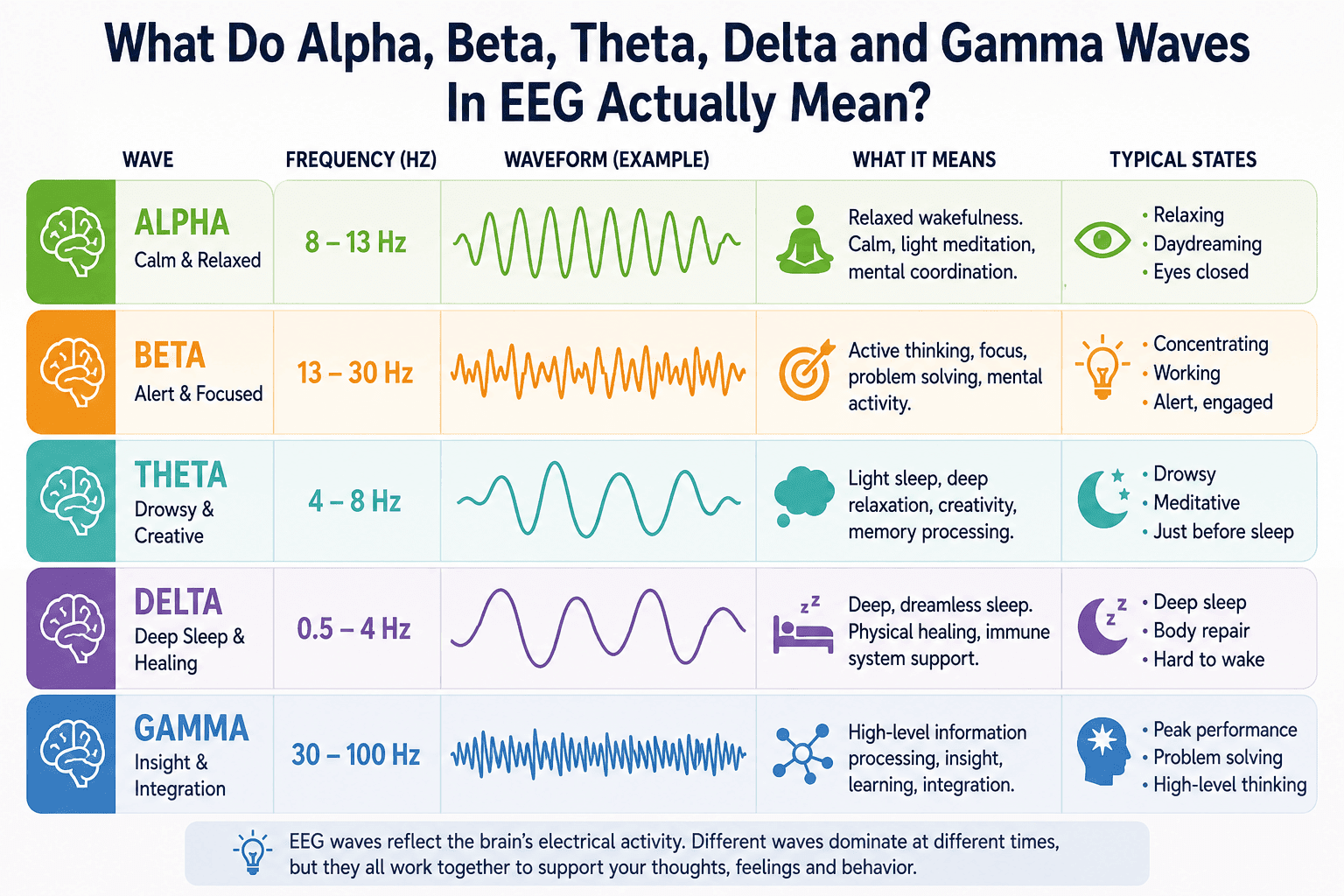
| Wave | Frequency | State | Feels Like |
|---|---|---|---|
| Delta | 0.5–4 Hz | Deep sleep | Unconscious, restorative |
| Theta | 4–8 Hz | Drowsy, creative | Daydreaming, shower thoughts |
| Alpha | 8–13 Hz | Relaxed, calm | Eyes closed, peaceful |
| Beta | 13–30 Hz | Active, focused | Working, problem-solving |
| Gamma | 30–100 Hz | Peak processing | "Aha!" moments, insight |
A Research Perspective — What Brain Waves Look Like in My Lab
With an experience of nearly six years with EEG, I've developed an almost intuitive sense for reading brainwave patterns. When the subject closes their eyes during a recording, I can see alpha waves across the occipital channels within seconds. When they start with the given task, those alpha waves vanish, and faster beta activity takes over.
What comes out as interesting is that two people doing the same task can show quite different EEG patterns. Some participants have very strong alpha rhythms; others barely show them at all. Their brains shift quickly between states; others are slower to transition.
This is the exact reason why EEG research is both fascinating and challenging. The brain waves do not always behave in the same way
Misconceptions About Brain Waves
1. Alpha waves are the best brain waves
Facts: No brain wave is “best.” Different type of brain waves help with different activities.
Beta helps you focus
Delta helps you sleep
Alpha helps you relax
In short, your brain needs all of them.
2. Meditation apps can control your brain waves
Reality: These apps and sounds designed for wellness may help you to relax, but they cannot fully control your brain activity. Any changes you notive are usually small and temporary.
3. More gamma waves means higher intelligence
In reality, they are linked to attention and information processing and do not simply mean “smarter.” Also, gamma waves are very difficult to measure accurately.
4. Slow brain waves are always bad
Slow waves like delta are normal during deep sleep and are important for recovery and healing.
Summary:
- The brain produces five main types of electrical waves: delta, theta, alpha, beta, and gamma
- Each corresponds to a different mental state, from deep sleep (delta) to peak concentration (gamma)
- All five are present at all times—but one dominates depending on what you're doing
- Brain waves are measured in Hertz (Hz) using EEG
- No single wave is "better"—the brain needs all five for healthy functioning
- Individual variation in brain wave patterns is normal and significant
FAQs - EEG Waves
1. Which brain wave respresents studying or is seen during studying?
Beta waves (13–30 Hz) are dominant and commonly seen during focused study and active thinking. Some of the research papers suggest that a balance of beta and low gamma supports optimal learning and memory consolidation.
2. Can you control your brain waves?
Only to some extent, yes, and only in some meditation, breathing exercises, and neurofeedback training can influence which brain wave becomes dominant. However, the brain naturally shifts between states, and forcefully trying to "stay" in one state is neither realistic nor healthy.
3. What brain waves occur during sleep?
Sleep progresses through various stages, starting from alpha waves appearing as you become drowsy, theta waves increasing during light sleep, delta waves dominating during deep sleep, and theta with gamma bursts appearing during REM (dream) sleep.
4. Are brain waves different in children vs. adults?
Yes. Children's EEGs show more slow-wave activity (delta and theta) even during wakefulness, which gradually decreases as the brain matures. This is why neonatal and pediatric EEG requires different interpretation standards than adult EEG.
References:
- [1] Başar, E. (2013). Brain oscillations in neuropsychiatric disease. Dialogues in Clinical Neuroscience, 15(3), 291-300. https://pubmed.ncbi.nlm.nih.gov/24174901/
- [2] Niedermeyer, E. (2005). The normal EEG of the waking adult. In Electroencephalography: Basic Principles, Clinical Applications, and Related Fields. Lippincott Williams & Wilkins.
Written and curated by - Vaishnavi Bagayi
Senior Research Associate in Consumer Neuroscience
Specializing in EEG and ERP research