What is an EEG and How the Brain Waves Are Actually Recorded
Right now, as you are reading this sentence, your brain is constantly generating tiny electrical signals. There are millions of neurons that are firing in patterns that create your thoughts, emotions, and awareness. But now the question is, how do scientists actually detect and measure this electrical activity? The simple answer is a technique called EEG, or electroencephalography. In this article we will read about what an EEG is, how it works, and what those lines on the screen actually mean. All of this information from the perspective of someone who works with EEG recordings every day.
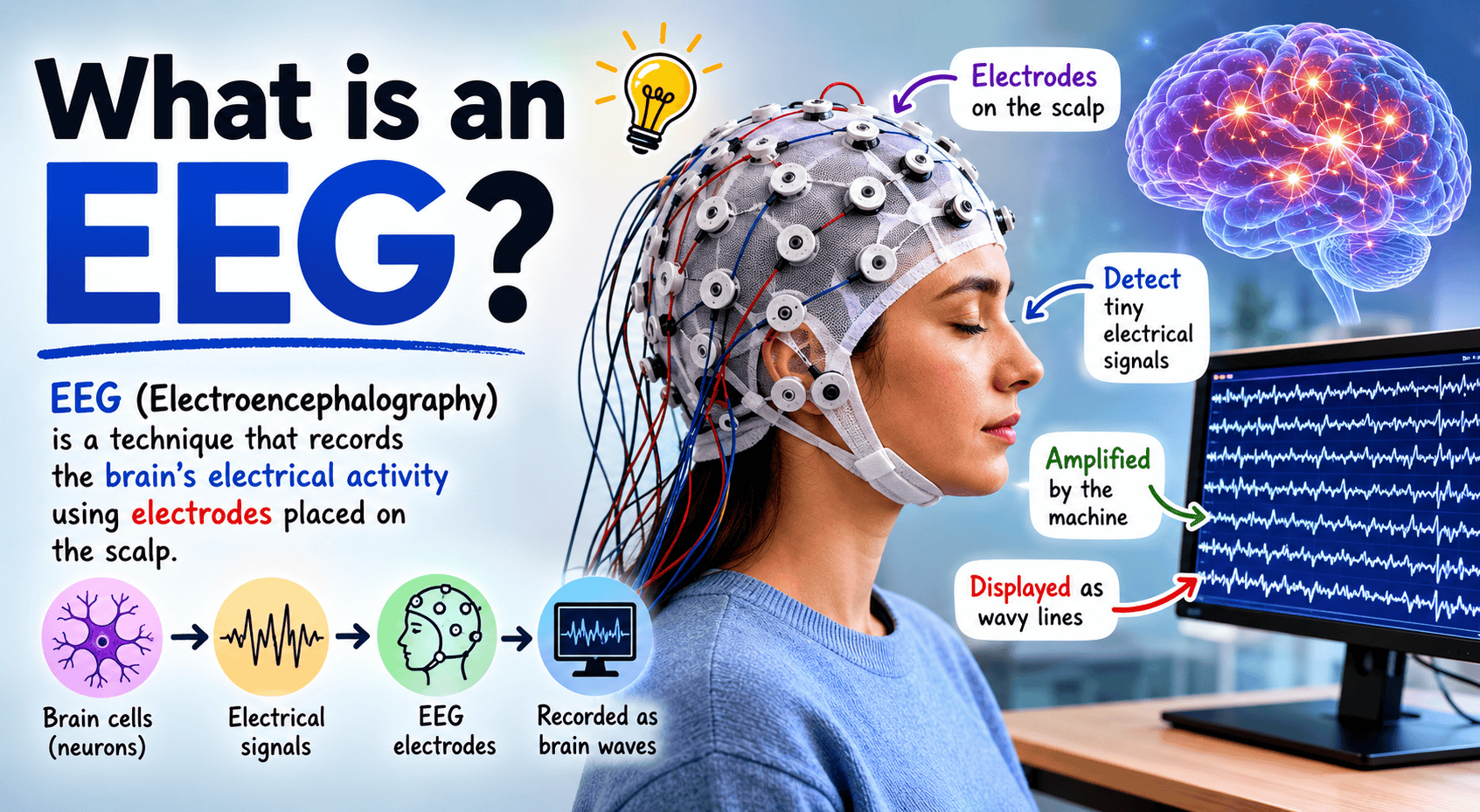
What Does the abbreviation EEG stand for?
- EEG reads as "electroencephalography"
- If we break down the word: Electro (electrical) + Encephalo (brain) + Graphy (recording)
- So, by words: "recording the brain's electricity"
- It was invented in 1924 by Hans Berger, first human EEG recording
- Brief history: It started from a single electrode to modern 64/128/256 channel systems
- Today's world it is used in hospitals, research labs, and even consumer products
How Do Neurons Communicate?
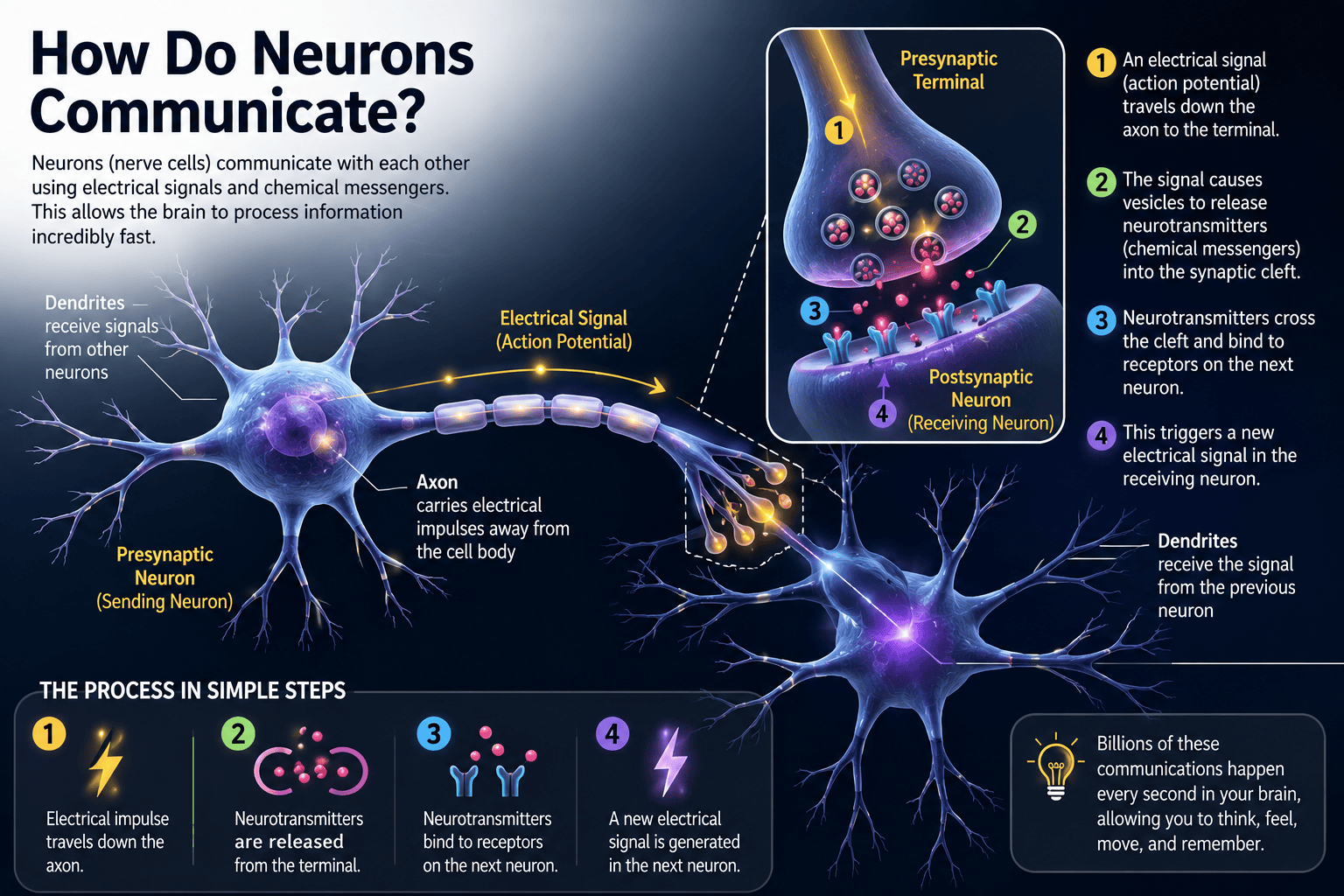
- Neurons communicate with each other through electrical impulses
- When millions of these neurons fire together (synchronize), they generate a combined electrical activity, which is strong enough to be detected at the scalp.
How Does an EEG Work?
- EEG is a device that have different numbers of electrodes (depending on the device type).
- The electrodes are small metal discs placed on the scalp with conductive gel, and these electrodes don't send anything INTO the brain; they only LISTEN.
- The signals captured through these electrodes are amplified (they're very tiny and measured in microvolts).
- A computer then records and displays these signals as wavy lines over time.
As a simple analogy:
Imagine you are standing outside a cricket stadium, and you cannot hear what a single person is saying. But at the same time, you can tell when the crowd cheers after a boundary, or when the crowd goes silent during a tense over or erupts when a wicket falls. EEG works in the same way; it cannot pick up a single neuron, but it detects the collective signal of millions of neurons responding together.
What Do the Lines on EEG Mean?
- Each line on the EEG screen represents electrical activity from one particular electrode location.
- The height (amplitude) of the waves on the line tells us how strong the activity is.
- The speed (frequency) of the waves on the lines tells us what the brain is doing.
- There are different patterns that appear during different mental states
- Activities like - alpha, beta, theta, delta, which help us to know the state in which the brain is in.
Analogy:
- Reading an EEG is like reading a language; it takes years of practice to understand what each pattern means.
- Fast waves mean alert, focused brain
- Slow waves mean relaxed, drowsy, or sleeping brain
What is an EEG Device Used For?
Clinical Uses—In hospitals
- Used for primarily diagnosing epilepsy and seizure disorders
- Monitoring the brain activity during surgery
- Sleep disorder diagnosis
- For assessing brain function in comatose patients
- Neonatal brain monitoring for premature babies and babies with suspected seizures.
Research Uses - In labs
- To study how the brain processes language, faces, emotions.
- Understanding how attention, memory, decision-making networks function in the brain
- To test the effects of products—consumer neuroscience
- For marketing purposes
- Brain-computer interface development - Neurorehabilitation cases.
Emerging Uses
- For meditation and neurofeedback apps
- Gaming and VR headsets that use EEG
- Mental health monitoring
What Does an EEG Test Do?
- It is completely painless and non-invasive
- The electrodes are placed on the scalp using a cap or individually with gel (depending on the system being used and its purpose)
- The whole setup of EEG takes around 15-30 minutes depending on the number of electrodes.
- You either lie still while the recording happens or sit and complete an activity given.
- You can also sometimes be asked to close your eyes, look at images, or listen to sounds (For research purposes)
- The recording typically lasts 20 minutes to several hours.
- There is no risk of radiation, injections or discomfort
- Most of the participants who have participated in our studies say that they got habituated to the electrodes after a few minutes.
What Working with EEG is Really Like—A Research Perspective
As a neuroscience research associate, I work with EEG recordings every day and have been working with EEG for the past six years now. I started with a 32-channel gel electrode system, and currently I use the 128-channel saline system.
Personally, I see merits and demerits to both systems depending on where they are being used. What surprised me in both cases is when I saw a seizure on the 32-channel EEG and when I saw the real answers to my question after using the 128-channel EEG.
The biggest challenge is separating real brain signals from noise (artifacts). Real EEG data is full of eye blinks, muscle movements, and even your heartbeat creates interference. A huge part of my work involves cleaning this data before we can see the actual brain responses.
EEG has changed my understanding of the brain in many ways, such that it is very complicated and not easy to decode as "A means good or B means bad."
Common Misconceptions About EEG
1. EEG can read your thoughts
- Reality is that EEG measures general patterns of brain activity and not specific thoughts.
- It can only tell if you are paying attention and not WHAT you're thinking about.
2. Consumer EEG headbands are just as good as lab EEG
- Lab EEG uses 32-256 electrodes with precise placement, whereas consumer devices use 1-4 sensors, which is very little in comparison to the traditional systems.
- Consumer EEG headbands are useful for basic applications but nowhere near research quality.
3. EEG is outdated and fMRI is better
- EEG captures changes in milliseconds and fMRI takes seconds
- EEG is often superior for studying fast brain processes (language, face recognition, decision-making).
Summary
- Electroencephalography records the brain's electrical activity through electrodes placed on the scalp
- It is painless, non-invasive, and measures the brain's responses in real time within millisecond precision
- Used in clinical diagnosis of epilepsy, sleep disorders, neonatal care, and research purposes like cognition, consumer neuroscience, and BCI.
- One of the biggest limitations is its spatial resolution; EEG tells you WHEN something happens in the brain, but not precisely about WHERE.
- Despite it being nearly 100 years old, EEG remains one of the most widely used tools in neuroscience.
Frequently Asked Questions
Is an EEG test painful?
No. EEG is a test that is completely painless and non-invasive. The electrodes are placed on the surface of the scalp and only record electrical activity, and they don't send any signals into the brain.
How long does an EEG test take?
A clinical-purpose EEG typically takes 20-40 minutes of recording time, plus 15-30 minutes for electrode setup. Research EEGs' timing varies and can last anywhere from 30 minutes to several hours depending on the study.
Can EEG detect mental illness?
EEG can only reveal patterns associated with certain conditions like epilepsy, sleep disorders, and some aspects of ADHD or anxiety. However, it cannot diagnose mental illnesses like depression or schizophrenia on its own. It is used alongside other clinical assessments to make a complete diagnosis.
What is the difference between EEG and MRI?
EEG measures the brain's electrical activity with excellent time resolution (milliseconds) but limited spatial precision. MRI (and fMRI) measures brain structure and blood flow with excellent spatial resolution but slower time resolution. They answer different questions about the brain.
References
- [1] Niedermeyer, E., & da Silva, F. L. (2004). Electroencephalography: Basic Principles, Clinical Applications, and Related Fields. Lippincott Williams & Wilkins.
- [2] Britton, J. W., Frey, L. C., et al. (2016). Electroencephalography (EEG): An Introductory Text and Atlas. American Epilepsy Society.
This is the link to download the summary image that has all the basic information about EEG.
Written and curated by - Vaishnavi Bagayi
Senior Research Associate in Consumer Neuroscience
Specializing in EEG and ERP research