7 Books That Reveal How Cognitive Biases Shape Your Thinking
Cognitive biases are features of how the brain evolved to make fast, energy-efficient decisions and are not flaws in intelligence. They quietly shape everything from judging risk to interpreting social media, what we ignore, and what feels “obviously true.”
If you are interested to know why even smart people end up making systematic errors then, the following books offer the clearest, most scientifically grounded explanations. The seven books revolve around cognitive psychology, neuroscience, and behavioral economics. This article will provide you a list of 7 books that will reveal how cognitive biases shape our thinking.
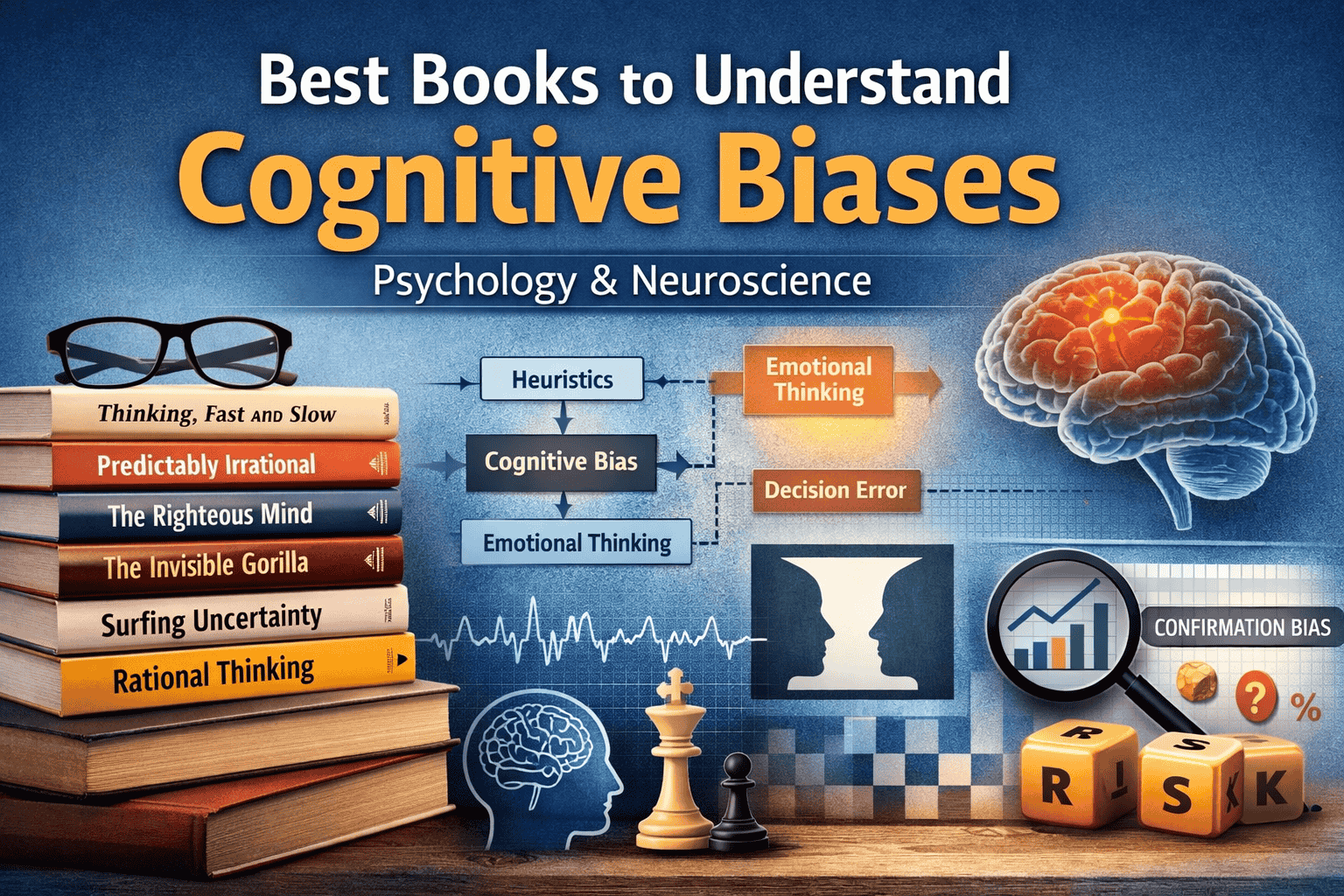
What Are Cognitive Biases?
Cognitive Biases are systemic errors in thinking that arise from:
- Emotional weighting of information
- Heuristics or mental shortcuts
- Attention limits
- Predictive processing - the brain guessing before sensing
They are also linked to:
- Perception vs reality conflicts
- Cognitive distortions
- Decision-making under uncertainty
If you are new to this field and want to start slow. As a beginner read - Cognitive Biases: How Are We Tricked to Misjudge?
-
Thinking, Fast and Slow by Daniel Kahneman
This book is the best choice for - Foundations of cognitive bias research
His work introduced the now-classic distinction between:
- System 1: Fast, automatic, intuitive
- System 2: Slow, deliberate, analytical
However, most cognitive biases like confirmation bias, availability heuristic or anchoring, originate due to System 1 dominance.
Why is this book a good read?
- The book is grounded in decades of experimental psychology
- It explains why intuition feels right even when it’s wrong
- Forms a connection between bias to attention and mental effort
Must read if you are interested in learning about:
- Risk perception
- Decision-making
- Behavioral economics
To check the book - Click Here
-
Predictably Irrational by Dan Ariely
A good read if you want to know about - Everyday decision errors
Dan Ariely focuses on how context and framing distort our rational choices especially in terms of money, relationships, and habits.
Cognitive Insight In this book:
Biases are predictable, repeatable, and context-dependent and aren’t random.
This idea aligns strongly with:
- Anchoring bias
- Framing effects
- Loss aversion
Why it’s useful
- Perfect bridge between academic bias research and daily life
- It is easy to read
- Has real-world examples
Click Here - Harper Collins India Predictably Irrational: The Hidden Forces That Shape Our Decisions
-
The Righteous Mind by Jonathan Haidt
A book that talks about - Moral and social biases.
Jonathan Haidt in this book conveys that moral reasoning is often post-hoc rationalization, not objective evaluation.
What neuroscience has to say about it?
- Reasoning often defends identity and not truth
- Our emotions precede reasoning
- The social intuitions are dominated by belief formation
Idea is strongly linked to:
- Moral reasoning biases
- Cognitive echo chambers
- Political polarization
To Read The Jonathan Hadit book on The Righteous Mind
-
What Intelligence Tests Miss by Keith E. Stanovich
What Intelligence Tests Miss tries to differentiate between Rationality and intelligence. Stanovich makes a critical distinction and states that: High IQ also cannot protect against cognitive biases.
The main concept:
- Dysrationalia: The failure to think rationally despite intelligence or high IQ.
Why does the book matter?
- The book is strongly evidence-based
- It introduces rational thinking as a skill
- Offers explanation as to why education alone doesn’t reduce bias
The book also pairs perfectly with:
- Bias awareness training
- Cognitive distortions
- Metacognition
-
How Minds Change by David McRaney
If you want to overcome belief bias or know more about it this book by David McRaney is the best choice. McRaney rather than listing the biases types focuses on how biases dissolve and when they do.
Concepts Covered:
- Social reasoning mechanisms
- Belief updating
- Identity-protective cognition
Why Is This Book Relevant?
It is because without understanding change, understanding bias is incomplete.
-
The Invisible Gorilla by Christopher Chabris & Daniel Simons
The Invisible Gorilla is the best book that talks about Attention and perception biases. The book shows how attention blindness creates false certainty.
Key takeaway from the book:
Often something that matters more is what you don’t notice more than what you do.
Concepts are strongly connected to:
- Illusion of awareness
- Inattentional blindness
- Perceptual bias
Access to “The Invisible Gorilla” here
-
Surfing Uncertainty by Andy Clark
The author keeps Predictive brain explanation of bias (advanced) as the main topic of interest. This is the area where neuroscience comes into play.
Main idea of the book:
The brain acts like a prediction machine and is constantly guessing the world and correcting errors.
Why does prediction matter for bias?
Cognitive biases emerge only when:
- Predictions dominate our sensory evidence
- Prior evidence overpower data
This book links with concepts like:
- Bayesian brain models
- Prediction Ghost
- Perception vs reality
The book is more technical but is incredibly rewarding.
Avail The Book - Here
Recommended Order to Read These Books:
If you are a beginner some books might feel too overwhelming. Hence try to read the following as a beginner:
- Harper Collins India Predictably Irrational: The Hidden Forces That Shape Our Decisions
- The Invisible Gorilla
- Thinking, Fast and Slow
If you have basic knowledge of the cognitive processes and want to know more read the following:
- The Righteous Mind
- What Intelligence Tests Miss
For experts and advanced level of reading experience go to:
- How Minds Change
- Surfing Uncertainty
Are Cognitive Biases Always Bad?
No, they are not always in fact they:
- Support social coordination
- Save cognitive energy
- Enable fast decisions
They can become harmful only when:
- Feedback is delayed or distorted
- Environments change
- Stakes increase
Check - Why Awareness of Cognitive Biases is the first Step to Overcome Them?
Bias Awareness Is a Cognitive Skill
Solely reading about biases doesn’t remove them, but it creates metacognitive distance, the ability to notice thinking while thinking. The ability is one of the strongest predictors of:
- Cognitive flexibility
- Better decisions
- Intellectual humility