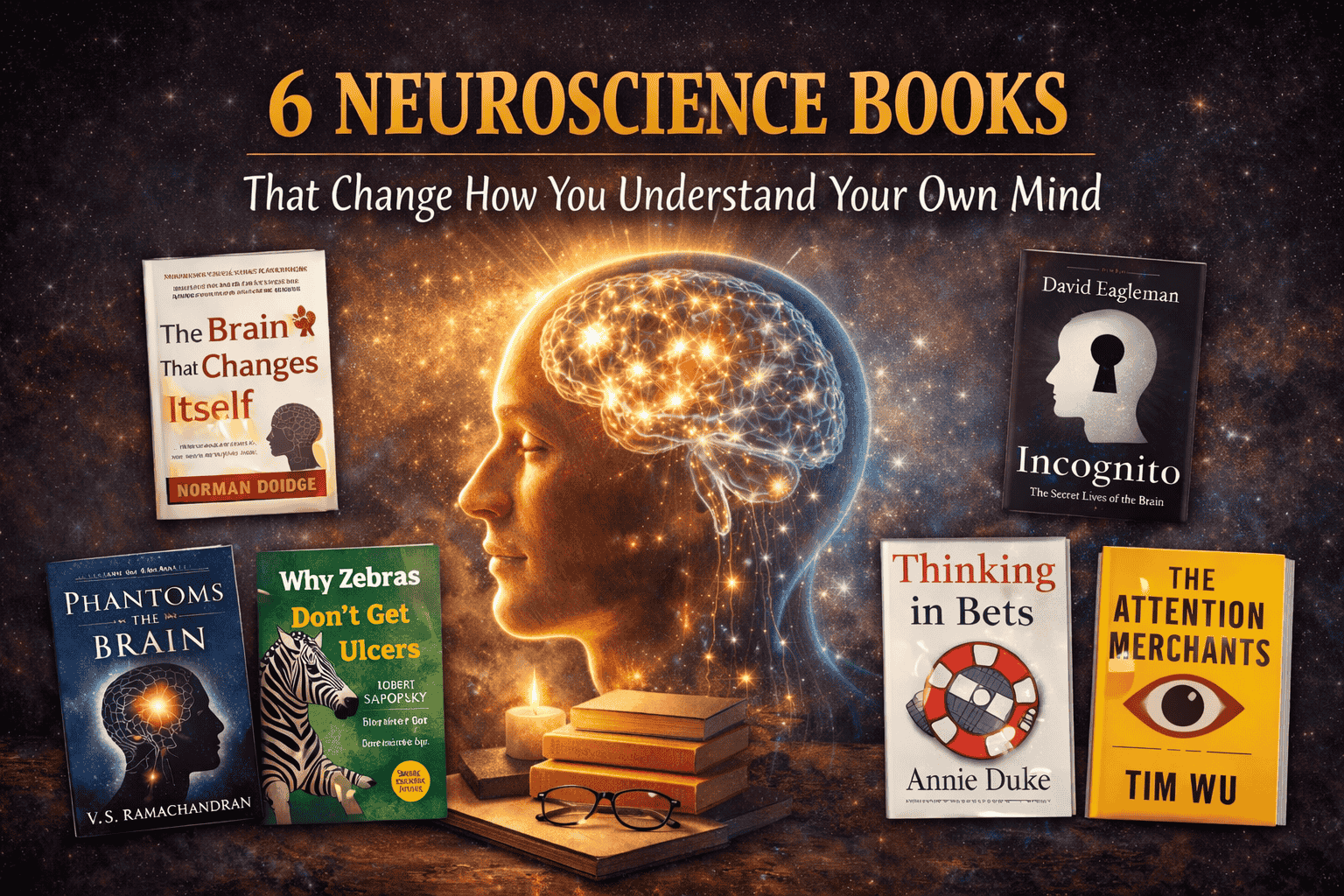
6 Neuroscience Books That Change How You Understand Your Own Mind
Most of us feel that we fully understand how our minds work. This is not true because your thoughts, decisions, emotions, and even your sense of reality are shaped by processes that operate beneath awareness. The brain constantly keeps editing experiences behind the scenes, from how you perceive time to why you feel certain emotions before understanding them. Here are six neuroscience books that just don't explain neuroscience, but they also change how you experience your own thinking. Each book has a different story to tell, backed by research, experiments, and real-world implications.
1. The Brain That Changes Itself — Norman Doidge
It is best suited for understanding neuroplasticity
The main idea is that “The brain is not hardwired, it is flexible.”
For many decades until now scientists believed the adult brain was hard-wired. Norman Doidge shows why such beliefs are wrong.
This book addresses some important question:
- How can perception be retrained?
- How does the brain rewire itself after injury?
- Why are habits so hard and yet possible to change?
He also introduces researchers like:
- Edward Taub – constraint-induced movement therapy for stroke
- Michael Merzenich - cortical remapping and sensory plasticity
- Paul Bach-y-Rita – sensory substitution like seeing with the tongue!
Each and every chapter in this book blends clinical case studies, experimental science, and personal narratives of patients who regained lost abilities like movement, vision, speech, even emotional regulation.
To Purchase the book - Click Here
2. Incognito: The Secret Lives of the Brain — David Eagleman
The book best describes unconscious processing.
Main Idea: You are not consciously in control
David Eagleman writes how most mental activity happens outside conscious awareness.
Clear & Engaging Science
This book pairs with topics like:
- Illusion of free will
- Modularity of mind
- The Bayesian brain
- Hierarchical control systems
These ideas are all presented in ways that are surprising, accessible, and often clear.
Real Stories That Give Deep Insight:
You learn what the brain does with the help of examples:
- Everyday behaviors explained by hidden computations
- Cases where memory, perception, and agency blur
- Patients whose brains reveal multiple “selves”
Thought-Provoking Questions Raised by the Author:
- How should society think about responsibility, punishment, and rehabilitation?
- Who do we really “think” we are?
- If most of the brain is unconscious, what does that mean for free will?
These questions increase our natural curiosity towards neuroscience.
3. Phantoms in the Brain — V. S. Ramachandran
The book explains all about - Neurological oddities and insight
Important Concept Covered: Extreme cases that reveal normal brain function
Through fascinating case studies, the author reveals how:
- Identity can shift due to neural damage
- Reality can distort
- Body maps can break
This book covers conditions such as:
- Mirror neurons and empathy
- Phantom limb syndrome
- Synesthesia
- Body image distortions
- Neglect syndromes
- Capgras delusion
- Anosognosia (denial of paralysis)
The author does not just treat them as isolated disorders, rather he shows how they reveal the rules the brain uses to generate self, body, emotion, and belief.
4. Thinking in Bets — Annie Duke
It is a must read for - Decision-making under uncertainty
The motive behind is that good decisions don’t guarantee good outcomes
According to former poker champion Annie Duk most of us make the mistake of judging our choices by how things turn out. He says that life is like poker; it is probabilistic not deterministic.
The key lessons are:
- Result ≠ Decision Quality
- How to think probabilistically?
- How to separate decisions from results?
- Why is outcome bias dangerous?
Cognitive Biases are explained and he tackles:
- Motivated reasoning
- Confirmation bias
- Overconfidence
- Hindsight bias
She normalizes these errors as part of being human rather than shaming the reader.
5. The Attention Merchants — Tim Wu
The best choice of book for - Understanding digital addiction.
Talks all about how your attention is being engineered.
What Does the Book Say?
The book narrates a story about how industries learned to sell human attention, starting from newspapers and radio, moving through television, and culminating in today’s digital platforms.
Wu also introduces the concept of the “attention merchant”: The primary product of business is your attention, which they further sell to advertisers.
He also reveals how each new platform begins with creativity and then gradually shifts toward:
- Capturing your attention
- Intensifying the stimulation
- Monetizing this distraction
- Finally normalizing intrusion
Insight Into Human Psychology
His books raise questions about:
- Why are silence and boredom threatening to attention markets?
- Why outrage and fear dominate the media?
- Why are “free” services rarely free?
This book is a bridge between neuroscience and modern life; explains how modern platforms hijack attention systems evolved for survival.
6. Why Zebras Don’t Get Ulcers — Robert Sapolsky
If your curious to know more about - Stress, biology, and behavior
Main Idea: Chronic stress rewires the brain
Robert Sapolsky connects endocrinology, neuroscience, and psychology to explain:
- Why is burnout biological, not moral failure?
- Why does stress damage cognition?
- How does modern life overwhelm ancient systems?
The main question raised by this book is - “When animals like zebras who face life-or-death threats do not suffer stress, why do humans suffer chronic stress-related diseases?”
Other Topics Covered by Sapolsky:
He is a rare scientist who can also explain:
- Cardiovascular effects
- Hippocampal vulnerability
- Cortisol dynamics
- Immune suppression
- Glucocorticoid receptor regulation
Despite the topics being heavily scientific, he keeps his approach humorous and light.
Conclusion:
Understanding the mind is about learning about the machinery beneath experience and not about self-help hacks. These books do not offer medical education, but they offer something better: A new relationship with your own thoughts, insight and awareness.
Also read more about brain and its creativity - Click Here
7 Books That Reveal How Cognitive Biases Shape Your Thinking